

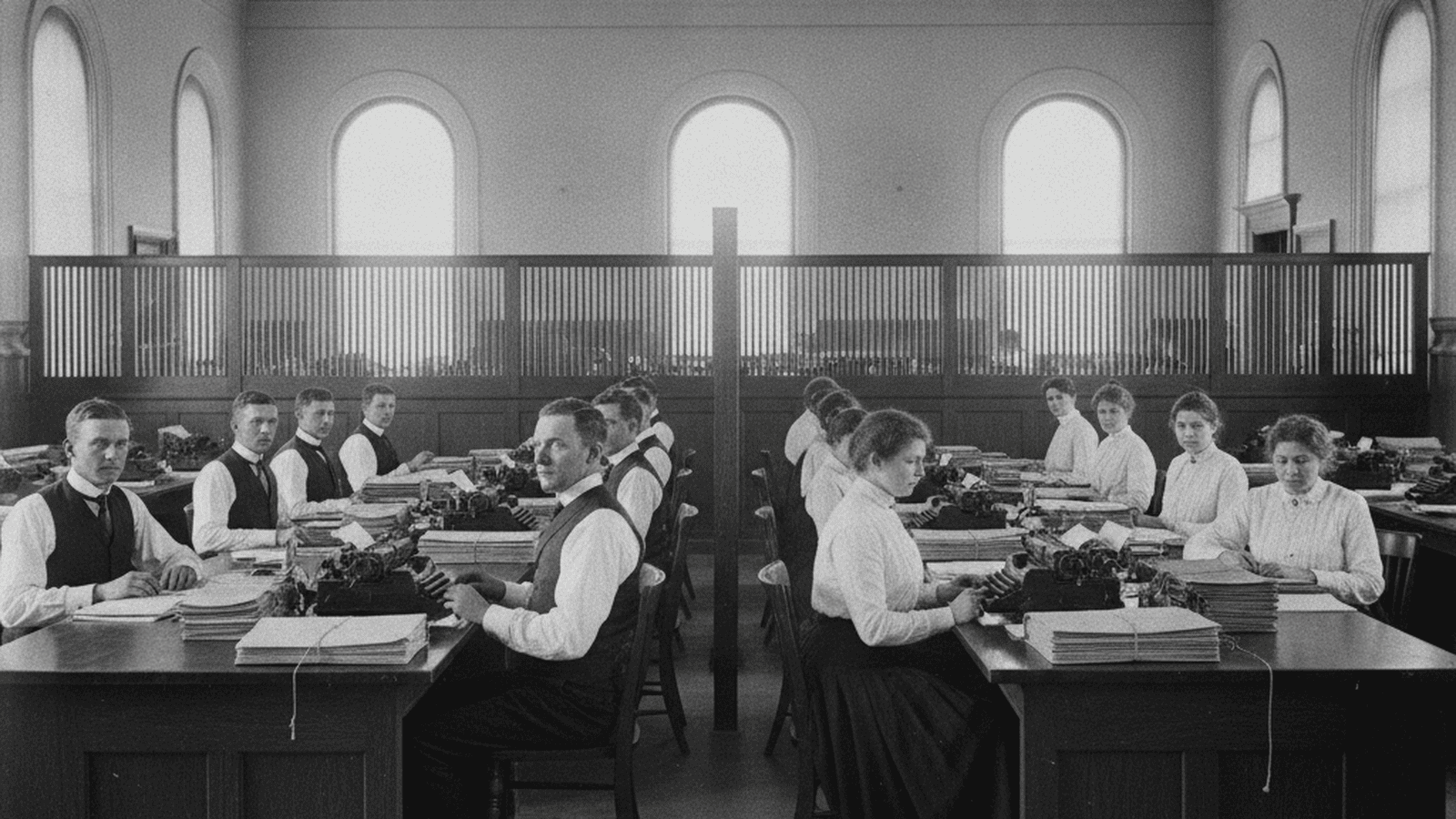
In 1913, the administration of President Woodrow Wilson implemented formal racial segregation within the United States federal civil service. This policy reversed decades of integrated work environments in Washington, D.C., and faced intense opposition from civil rights leaders.
TLDR: Following his 1913 inauguration, President Woodrow Wilson authorized his cabinet to segregate federal departments. This move dismantled the integrated civil service established during Reconstruction, forcing Black employees into separate facilities and lower-tier roles. The policy sparked a national outcry and a direct, heated confrontation between Wilson and civil rights activist William Monroe Trotter.
The inauguration of Woodrow Wilson in 1913 marked a significant shift in the political landscape of the United States. As the first Southerner elected to the presidency since the Civil War, Wilson brought with him a cabinet largely composed of Southern Democrats who sought to export regional racial customs to the federal level. While the Progressive Era is often remembered for its focus on government efficiency and social reform, for Black Americans, it signaled a period of institutionalized exclusion within the nation’s capital.
Shortly after the administration took office, Postmaster General Albert S. Burleson and Treasury Secretary William Gibbs McAdoo initiated a plan to segregate their departments. During a cabinet meeting in April 1913, Burleson argued that the presence of Black employees alongside white workers created friction and hindered productivity. He proposed that Black clerks be moved to separate rooms or partitioned areas. McAdoo concurred, suggesting that segregation would protect white female employees from having to share workspaces with Black men. Wilson, despite his campaign promises to treat Black voters with even-handed justice, gave his tacit approval to these measures.
The implementation of these policies was swift and visible. In the Treasury Department and the Post Office, physical barriers were erected to shield white workers from their Black colleagues. Separate restrooms and lunchrooms were designated, often in inferior or cramped locations. In some instances, Black employees who had held supervisory roles were demoted, and new hiring practices were introduced that required photographs of applicants, making it easier for managers to filter out non-white candidates. This systematic dismantling of the integrated civil service was a devastating blow to the Black middle class in Washington, D.C., which had viewed federal employment as a stable and prestigious career path since the Reconstruction era.
Resistance to the new policies was immediate and organized. The National Association for the Advancement of Colored People (NAACP), which was still in its infancy, launched a nationwide letter-writing campaign and published editorials condemning the administration. Civil rights leaders like W.E.B. Du Bois, who had cautiously supported Wilson during the 1912 election, expressed a sense of deep betrayal. The most dramatic confrontation occurred in November 1914, when a delegation led by William Monroe Trotter, editor of the Boston Guardian, met with Wilson in the Oval Office.
During the meeting, Trotter presented a petition with thousands of signatures and challenged the president on the morality of federal segregation. The exchange became increasingly heated as Wilson defended the policy, asserting that segregation was not humiliating but a benefit intended to prevent racial conflict. When Trotter pointed out that the policy had been implemented by Wilson’s appointees and not by the workers themselves, the president took offense at Trotter’s tone and eventually dismissed the delegation. The incident was widely reported in the press, further polarizing public opinion on the administration’s racial agenda.
The segregation of the federal civil service had long-lasting repercussions for the structure of the United States government. It entrenched a culture of discrimination that persisted through the 1920s and 1930s, limiting the economic and social mobility of Black citizens for generations. It was not until the onset of World War II and the subsequent executive orders issued by Franklin D. Roosevelt and Harry S. Truman that the federal government began the slow process of desegregation. These later reforms were driven by the persistent advocacy of civil rights organizations that had first mobilized in response to the 1913 mandates, eventually leading to the broader legislative victories of the 1960s.

Miles Harrington serves as the Senior Correspondent for Federal Systems & Executive Power at Just Right News, where he brings a disciplined, constitutionalist lens to the inner workings of the American government. With a focus on the mechanics of the federal bureaucracy and the limits of executive authority, Harrington has established himself as a vital voice for readers who value transparency, accountability, and the preservation of the separation of powers.
A native of Richmond, Virginia, Harrington’s perspective is deeply rooted in the traditions of the Old Dominion. Growing up in a city defined by its historical significance and its role as a center of American jurisprudence, he developed an early appreciation for the foundational principles of the Republic. His upbringing in Richmond—a place where the legacy of the Founding Fathers is woven into the landscape—instilled in him a belief that the federal government should remain within its constitutional bounds. This background informs his skepticism of centralized overreach and his commitment to reporting on the ways in which the administrative state impacts the lives of everyday citizens.
In his current role, Harrington specializes in the complexities of federal systems. He doesn’t just report on the headlines of the day; he digs into the structural shifts within the executive branch that often go unnoticed by the mainstream press. Whether he is analyzing the implications of a new federal regulation or investigating the expansion of agency jurisdiction, his work is characterized by a rigorous adherence to the facts and a dedication to the rule of law.
Harrington is perhaps best known for his signature feature series, “How Washington Works.” Through this ongoing project, he demystifies the often-opaque processes of the nation’s capital, pulling back the curtain on the “Deep State” and the unelected officials who wield significant influence over national policy. By breaking down complex legislative maneuvers and executive orders, he empowers Just Right News readers to understand the true levers of power in Washington. His reporting serves as a necessary check on the federal government, ensuring that the actions of those in power are held up to the light of public scrutiny.
Now based in Washington, D.C., Harrington operates at the epicenter of the political world, yet he remains intentionally distanced from the “Beltway bubble.” His proximity to the halls of power allows him to maintain a robust network of sources across the federal landscape, but his heart remains in the principled conservatism of his Virginia roots. He views his role not merely as a reporter, but as a steward of the public trust, dedicated to providing the clarity and context that conservative voters need to navigate an increasingly complex political environment.
Through his sharp analysis and unwavering commitment to the truth, Miles Harrington continues to be a cornerstone of the Just Right News team. His work ensures that the principles of limited government and executive restraint remain at the forefront of the national conversation, providing a crucial service to those who believe in a government that is truly of, by, and for the people.