

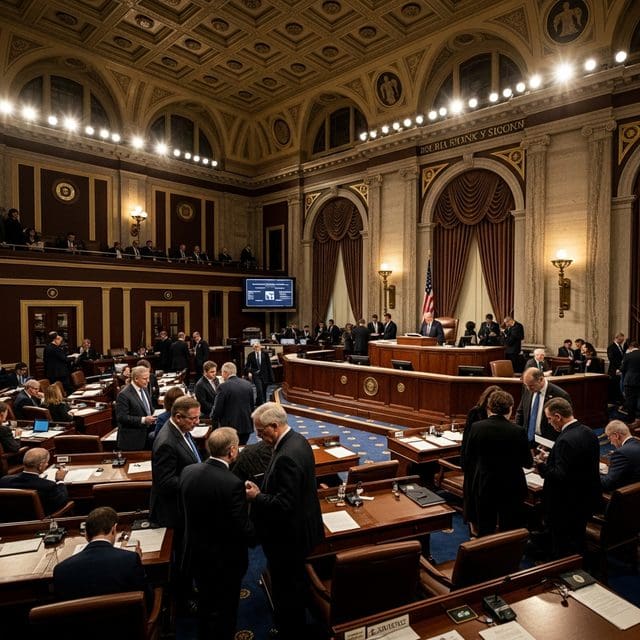
The Senate passed a critical funding measure to avert a shutdown and a major Russia sanctions package, while the Trump administration navigates personnel departures and new drone tariffs.
In a decisive series of legislative maneuvers ahead of the 2026 midterm elections, the U.S. Senate has moved to stabilize federal operations while hardening the nation’s posture against foreign adversaries. Lawmakers passed a short-term continuing resolution (CR) by a 90–6 margin on August 8, extending government funding through December 11, 2026. While the measure is designed to avoid a shutdown on October 1, the text reveals a deepening tug-of-war between the legislative and executive branches over the power of the purse.
The funding bill maintains current agency levels but includes specific Democratic-backed provisions that restrict the Trump White House from expanding political control over federal grants. Notably, the bill prevents the administration from blocking grants to “blue states” for political reasons. While the Senate agreed to certain White House “anomalies” for military health programs and disaster relief for SNAP and WIC, it pointedly rejected the President’s request for $1 billion to fund “Trump-class” battleships. The House, currently on recess until September, must now reconcile this version with its own disparate funding measure to ensure the government remains open.
On the foreign policy front, the Senate honored the legacy of the late Senator Lindsey Graham by passing the Sanctioning Russia Act of 2026. The bill, which passed 86–11, mandates aggressive sanctions on Russian leaders and state-owned enterprises. Most significantly, it authorizes tariffs of up to 100 percent on top purchasers of Russian oil and gas, specifically targeting foreign firms in nations like China and India. President Trump has reportedly agreed to back this framework, marking a shift from earlier resistance to broad penalties. The House companion bill uses identical text, signaling rare bipartisan alignment.
Simultaneously, the executive branch is managing significant internal shifts. White House Deputy National Security Adviser Andy Baker is slated to depart in the coming weeks. On the trade front, the President announced new tariffs on drone imports on August 14, with larger units subject to a 100 percent levy. This protectionist move coincides with a federal judge’s decision to lift a stay in a case involving Somali holders of temporary protected status, clearing the legal path for resumed deportations.
In the regulatory sphere, the Department of Justice announced that Veloxis Pharmaceuticals will pay over $46 million to resolve allegations of illegal kickbacks. Meanwhile, the FDA has moved to reclassify blue light cystoscopy systems to Class II medical devices and granted Fast Track Designation to Phanes Therapeutics for a new biliary tract carcinoma treatment. These actions occur alongside a 30 percent wage increase for New York Teamsters at Southern Glazer’s Wine & Spirits following a brief strike.
Finally, the military remains under scrutiny as Navy leadership met with family members of USS Abraham Lincoln sailors to address mental health concerns during the carrier’s deployment. Senate Democrats have since pressed Secretary of Defense Pete Hegseth for answers on reported suicide attempts aboard the vessel, which is currently being replaced by the USS George Washington as it returns to the United States.

Miles Harrington serves as the Senior Correspondent for Federal Systems & Executive Power at Just Right News, where he brings a disciplined, constitutionalist lens to the inner workings of the American government. With a focus on the mechanics of the federal bureaucracy and the limits of executive authority, Harrington has established himself as a vital voice for readers who value transparency, accountability, and the preservation of the separation of powers.
A native of Richmond, Virginia, Harrington’s perspective is deeply rooted in the traditions of the Old Dominion. Growing up in a city defined by its historical significance and its role as a center of American jurisprudence, he developed an early appreciation for the foundational principles of the Republic. His upbringing in Richmond—a place where the legacy of the Founding Fathers is woven into the landscape—instilled in him a belief that the federal government should remain within its constitutional bounds. This background informs his skepticism of centralized overreach and his commitment to reporting on the ways in which the administrative state impacts the lives of everyday citizens.
In his current role, Harrington specializes in the complexities of federal systems. He doesn’t just report on the headlines of the day; he digs into the structural shifts within the executive branch that often go unnoticed by the mainstream press. Whether he is analyzing the implications of a new federal regulation or investigating the expansion of agency jurisdiction, his work is characterized by a rigorous adherence to the facts and a dedication to the rule of law.
Harrington is perhaps best known for his signature feature series, “How Washington Works.” Through this ongoing project, he demystifies the often-opaque processes of the nation’s capital, pulling back the curtain on the “Deep State” and the unelected officials who wield significant influence over national policy. By breaking down complex legislative maneuvers and executive orders, he empowers Just Right News readers to understand the true levers of power in Washington. His reporting serves as a necessary check on the federal government, ensuring that the actions of those in power are held up to the light of public scrutiny.
Now based in Washington, D.C., Harrington operates at the epicenter of the political world, yet he remains intentionally distanced from the “Beltway bubble.” His proximity to the halls of power allows him to maintain a robust network of sources across the federal landscape, but his heart remains in the principled conservatism of his Virginia roots. He views his role not merely as a reporter, but as a steward of the public trust, dedicated to providing the clarity and context that conservative voters need to navigate an increasingly complex political environment.
Through his sharp analysis and unwavering commitment to the truth, Miles Harrington continues to be a cornerstone of the Just Right News team. His work ensures that the principles of limited government and executive restraint remain at the forefront of the national conversation, providing a crucial service to those who believe in a government that is truly of, by, and for the people.