

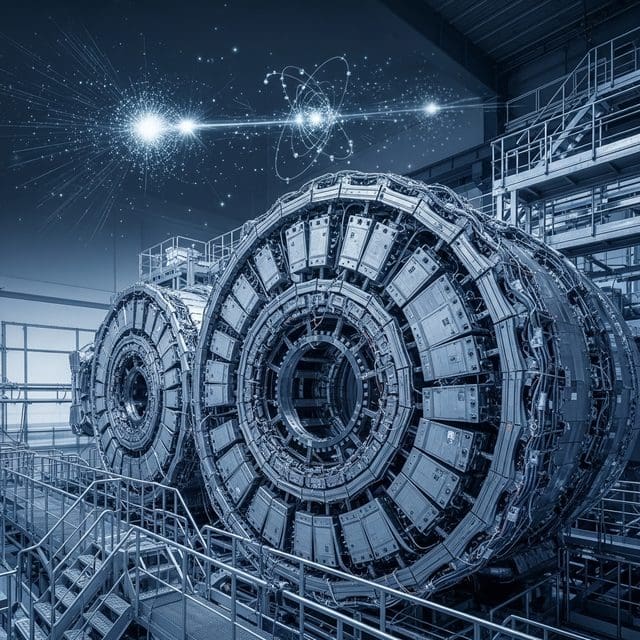
Physicists at the Beijing Electron Positron Collider have identified the X(2370) particle as a glueball-dominated state, validating a half-century-old prediction regarding the fundamental nature of matter.
A landmark discovery in high-energy physics has emerged from the Beijing Electron Positron Collider, where researchers with the BESIII Collaboration have finally pinned down a particle that has eluded definitive identification for decades. The particle, known as X(2370), has been confirmed as a pseudoscalar glueball-dominated state, marking a historic milestone in our understanding of the fundamental forces that hold the universe together. This finding, reported in mid-August 2026, represents the culmination of nearly fifty years of theoretical anticipation and experimental searching.
For decades, the theory of quantum chromodynamics (QCD) has predicted the existence of glueballs—exotic states of matter composed entirely of gluons. In the standard model of physics, typical matter such as protons and neutrons is composed of quarks held together by gluons. However, because gluons themselves carry a color charge, they are capable of interacting with one another. This unique property suggested that gluons could bind together to form a new type of matter without any quarks at all. The discovery of such a state is a direct test of the non-Abelian gauge structure of QCD, essentially proving that the messengers of force can, under the right conditions, become the building blocks of matter.
The breakthrough was presented at the International Conference on High Energy Physics (ICHEP) in Brazil, following an exhaustive analysis of a massive data set. The BESIII team utilized a sample of 10 billion J/ψ particles collected in 2024 to determine the spin-parity of the X(2370) for the first time. The analysis established that the particle possesses the 0-+ quantum numbers, which are in complete agreement with lattice QCD predictions for the lightest pseudoscalar glueball. This alignment between experimental data and complex numerical theory provides a rare moment of absolute clarity in the often-murky world of subatomic physics, verifying that gluons can bind together to form a new type of matter entirely.
While the X(2370) was first discovered in 2011, its true nature remained a subject of intense debate until this year. The recent findings establish a complete chain of experimental evidence, confirming that a pseudoscalar-glueball component must dominate the particle. This is the clearest experimental result since glueball searches began in the 1970s. It validates the sophisticated lattice QCD models used to predict how matter behaves at its most basic level, strengthening confidence in the numerical tools used to map the hadron spectrum. The work highlights the unique role of the Beijing Electron Positron Collider and high-statistic J/ψ samples in probing strong interaction physics, setting up follow-on studies of other predicted glueball states and exotic hadrons.
Beyond the realm of pure particle physics, the broader technological landscape is also seeing a surge in quantum-related advancements that mirror this progress in fundamental science. As the BESIII Collaboration confirms the fundamental nature of force mediators, other institutions are building the infrastructure to harness quantum properties for industry. For instance, Quanta Computer and Quantinuum recently partnered on August 14, 2026, to co-develop large-scale quantum computing systems and manufacturing capabilities. Simultaneously, DARPA has selected Qunnect to strengthen the resilience of quantum networks, and BTQ Technologies has reported significant commercial progress across its trusted quantum platform. These parallel tracks—fundamental discovery and industrial application—demonstrate a unified push toward a new frontier of physical understanding and sovereign technological capability.
As the global community looks toward the next generation of colliders and quantum sensors, the identification of the X(2370) sets a new benchmark for high-energy research. It demonstrates that the infrastructure of physics, when applied with precision and principled inquiry, can still unlock the deep mysteries of the constitutional laws of nature. For those who value the rigorous pursuit of objective reality, this finding is a testament to human persistence and the enduring power of the scientific method to reveal the hidden structures of our world. The discovery complements earlier tests like asymptotic freedom, providing a direct test of the non-Abelian gauge structure that governs the universe at its most fundamental level.

Mason Reed serves as a Staff Writer for Just Right News, where he spearheads the Future Frontiers & Special Projects desk. In an era defined by rapid technological shifts and evolving social landscapes, Mason provides a steady, principled voice, examining the innovations of tomorrow through the lens of traditional American values. His work is most prominently featured in his signature series, “The Next Horizon,” where he explores the intersection of emerging technology, national sovereignty, and the preservation of individual liberty.
A native of San Diego, California, Mason’s worldview was shaped by the unique culture of his hometown. Growing up in a region defined by its strong military presence and its history of maritime industry, he developed a deep-seated respect for the institutions that provide national stability and the entrepreneurial spirit that drives the American economy. This upbringing instilled in him a belief that true progress is not found in discarding the past, but in building upon a foundation of proven principles. His reporting often reflects this San Diego influence, emphasizing the importance of a robust national defense and the necessity of maintaining a competitive edge in the global marketplace.
Now based in San Francisco, Mason operates from the heart of the world’s technological engine. Living and working in the Bay Area provides him with a front-row seat to the advancements—and the ideological challenges—emanating from Silicon Valley. While many in the region embrace a “move fast and break things” mentality, Mason’s reporting serves as a vital counterweight. He offers Just Right News readers a “boots on the ground” perspective, documenting how radical local policies and the concentration of tech power impact the everyday lives of citizens. His proximity to the industry allows him to cut through the marketing jargon of big tech to uncover the real-world implications for privacy, free speech, and the nuclear family.
In his “Future Frontiers” beat, Mason tackles complex subjects ranging from the ethics of artificial intelligence to the burgeoning private space race. He approaches these topics with a healthy skepticism toward centralized bureaucracy, championing instead the decentralized innovations that empower individuals. Through “The Next Horizon,” he highlights the pioneers and thinkers who are working to ensure that the future remains a place where human dignity and constitutional rights are protected. He believes that the rapid pace of change requires more than just technical expertise; it requires a moral compass rooted in the Western tradition.
Throughout his tenure at Just Right News, Mason has remained committed to the idea that the future is something to be shaped, not merely accepted. His writing is characterized by a rigorous defense of American exceptionalism and a belief that the country’s best days lie ahead, provided it remains true to its founding ideals. Whether he is investigating the impact of automation on the American workforce or profiling the next generation of aerospace engineers, Mason Reed ensures that his readers are equipped with the insights they need to navigate a changing world with confidence and clarity.