

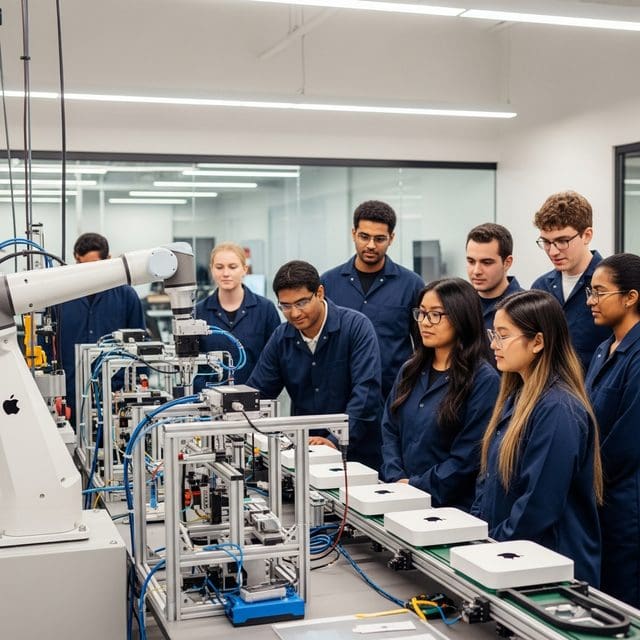
Apple and Foxconn launch a major manufacturing hub as California students face financial aid delays and international regulators move to limit classroom screen time.
The divide between market-aligned workforce preparation and the friction of government bureaucracy has sharpened this week as new initiatives in the private sector contrast with administrative hurdles in public institutions. In Houston, Apple and Foxconn have opened an 1,860-square-meter Advanced Manufacturing Center, marking Apple’s second such training hub in the United States. This facility, located within Foxconn’s existing complex, is designed to serve as a practical training ground for small-to-medium enterprise staff and college students. By focusing on quality control and production automation through machine learning, the center aims to cultivate a specialized workforce. The facility even showcases a Mac Mini assembly line slated to begin production later in 2026, highlighting how private industry is taking the lead in developing human capital through direct, hands-on experience.
While the private sector moves to streamline technical training, the public sector is struggling with administrative bottlenecks that threaten student stability. In California, approximately 23,000 returning California State University students only received their finalized 2026–27 financial aid offers last Friday. The delay, which CalMatters reports was caused by new federal fraud checks, has forced at least one campus to push its tuition payment deadline to August 19. While the university system has implemented protections to ensure students are not dropped from their courses due to these FAFSA-related delays, the last-minute nature of the aid offers underscores the fragility of a system heavily dependent on centralized federal processes. For many students, this administrative friction creates unnecessary barriers to the upward mobility that higher education is intended to provide.
California is also attempting to pivot toward more flexible, market-aligned workforce development through the California Student Aid Commission. The commission is currently racing to implement Workforce Pell and expanded Cal Grant C programs, which target short-term career training programs lasting between eight and 15 weeks. Backed by a one-time state allocation of $664,000 for the rollout, these programs represent a shift toward accountability. Starting in the 2026–27 academic year, eligibility for these grants will be tied to specific metrics, including tuition caps and graduate earnings. This move suggests a growing recognition among policymakers that education must be measured by its tangible economic utility and the employment success of its graduates.
Internationally, the debate over the quality of the learning environment is taking a regulatory turn toward traditional methods. In Noida and Greater Noida, the Gautam Buddh Nagar district administration has issued a mandate capping daily screen time at 30 minutes for primary students and 60 minutes for upper-primary students. The order requires all government, aided, and private schools to enforce these limits, alongside mandatory quarterly eye exams and the adoption of the “20-20-20” rule for breaks. By promoting “digital-free periods” and “digital detox” activities, the government is responding to concerns that the over-reliance on smart boards and digital tools may be detrimental to student health and focus. This regulatory shift mirrors broader policy discussions, such as Karnataka’s draft digital use policy, which seeks to balance digital literacy with mental wellness by capping recreational screen time.
However, the risks of institutional failure remain high when basic oversight is neglected. The National Human Rights Commission recently issued a notice to state authorities in Maharashtra following the deaths of three tribal girl students due to snakebites at a Gadchiroli ashram school hostel. The commission observed that these deaths raise serious concerns regarding the violation of students’ human rights and a lack of basic facilities. Whether through the administrative delays seen in California or the tragic safety lapses in residential schools, the current landscape demonstrates that while private innovation is accelerating, the basic duty of care and operational efficiency in public institutions continues to face significant challenges.
Daniel Owens serves as a Senior Correspondent for Just Right News, where he leads the newsroom’s coverage of Education, Workforce, and Upward Mobility. In an era where the national conversation often overlooks the practical foundations of success, Owens brings a principled perspective to the forefront of the media landscape. His work is defined by a commitment to the idea that a strong society is built on the pillars of quality education, a robust work ethic, and the removal of bureaucratic barriers to individual achievement.
Born and raised in Cleveland, Ohio, Owens’s worldview was shaped by the industrial landscape of the Midwest. Growing up in a city known for its grit and resilience, he witnessed firsthand the transformative power of steady employment and the devastating effects of economic stagnation. This background instilled in him a deep respect for the American worker and a healthy skepticism toward top-down government solutions that often fail to reach the communities they intend to help. As an African American man who has navigated the path to professional success, Owens approaches his beat with a nuanced understanding of how meritocracy and personal responsibility intersect with opportunity. He frequently draws on his roots to highlight the importance of family stability and community-led initiatives in fostering the next generation of leaders.
At Just Right News, Owens is the architect of the acclaimed feature series, “The Learning Curve.” Through this platform, he explores the evolving landscape of American schooling, from the rise of the school choice movement to the revitalization of trade schools and vocational training. He frequently challenges the status quo of higher education, advocating for a return to academic rigor and the practical alignment of degrees with market demands. For Owens, education is not merely about obtaining credentials; it is about equipping young people with the tools necessary to lead self-sufficient, meaningful lives. His reporting on “The Learning Curve” has become essential reading for parents and policymakers who believe that educational competition and parental rights are the keys to a brighter future.
Now based in Raleigh, North Carolina, Owens finds himself at the heart of one of the nation’s most dynamic regions for innovation and growth. Raleigh’s unique blend of traditional values and a fast-paced economy provides the perfect backdrop for his reporting on the modern workforce. From the tech hubs of the Research Triangle to the rural communities of the South, he tracks how shifts in the economy are impacting families and local industries. His reporting often highlights the success stories of entrepreneurs and workers who are thriving by embracing the values of hard work and innovation.
Throughout his career, Daniel Owens has remained a steadfast voice for the student seeking a better path and the worker striving for a better life. His reporting for Just Right News serves as a vital resource for readers who value common-sense solutions to the challenges of the 21st-century economy. By focusing on the intersection of policy and the human spirit, Owens continues to provide a roadmap for how individuals and communities can achieve lasting upward mobility.