

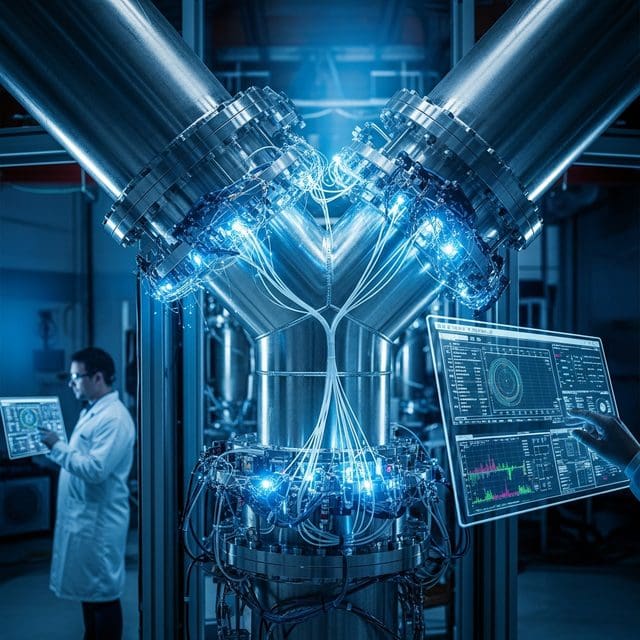
Brookhaven National Laboratory researchers have uncovered evidence that gluons define a proton’s identity, while the DOE invests $7.3 million in new Quantum Outposts.
For decades, the standard understanding of the proton—the fundamental building block of the atomic nucleus—was relatively simple: it was defined by three valence quarks. However, groundbreaking results released by Brookhaven National Laboratory on August 13, 2026, suggest this traditional model is incomplete. By analyzing high-energy particle collisions at the Relativistic Heavy Ion Collider (RHIC), researchers found that the proton’s “baryon number”—the quantum property that distinguishes matter from antimatter—may actually be carried by a Y-shaped arrangement of gluons known as a baryon junction.
This discovery, published in the journal Science, indicates that the gluon field binding quarks together plays a far more central role in defining matter than previously realized. In these experiments, researchers observed that baryon number was transported more readily than electric charge during collisions, a phenomenon that contradicts the three-quark model but aligns perfectly with the gluon-junction hypothesis. This shift in understanding how matter is organized has profound implications for our grasp of the early universe and the fundamental forces that maintain physical stability. The RHIC facility, a Department of Energy Office of Science user facility that operated at Brookhaven from 2000 through early 2026, provided the data necessary to observe these particles moving perpendicular to the beamline, a signature of the gluon junction being “stopped” more easily than quarks.
While physicists rethink the interior of the atom, the U.S. Department of Energy is simultaneously looking toward the future of American technological sovereignty. The DOE announced $7.3 million in funding for eight “Quantum Outposts” across the country. These projects are designed to bridge the gap between fundamental physics and quantum information science, ensuring that American research facilities remain at the global forefront of innovation. The awards, which include $3.2 million in FY2026 dollars with outyear funding contingent on appropriations, will run for up to three years.
Brookhaven will lead one of these outposts in partnership with the University of Pittsburgh. Their project, “Quantum Information Signatures at Colliders,” will investigate how quantum information flows through high-energy collisions at the Large Hadron Collider and the future Electron-Ion Collider. By developing new quantum sensors and applications for quantum computers, the program seeks to turn theoretical physics into practical tools for national security and industrial advancement. This initiative is particularly timely as other sectors, such as DARPA, have recently selected firms like Qunnect to strengthen the resilience of quantum networks, further signaling a national push toward secure, decentralized quantum infrastructure.
These developments arrive at a time when the practical application of quantum technology is under intense scrutiny. Recent reports from August 2026 suggest that many “quantum advantage” claims require more realistic benchmarks, as practical utility remains elusive for many commercial applications. By grounding quantum research in the hard reality of particle physics and neutrino experiments, the DOE’s new outposts aim to move beyond Silicon Valley hype and toward verifiable, principled scientific progress. The integration of quantum sensing into frontier experiments ensures that the next generation of American physicists will have the tools to defend constitutional interests through superior technological insight.
Furthermore, the intersection of materials science and quantum research continues to yield results. Brookhaven also highlighted a cross-disciplinary success involving tantalum and silicon structures, which could lead to advanced detectors or electronics. As the national average gasoline price reaches record highs and the Justice Department navigates complex legal rulings on the National Firearms Act, these advancements in fundamental science remind the public that long-term national strength is built on a foundation of basic research and the pursuit of truth within the physical world. The transition from the RHIC era to the future Electron-Ion Collider represents a commitment to maintaining a competitive edge in the global scientific landscape.

Mason Reed serves as a Staff Writer for Just Right News, where he spearheads the Future Frontiers & Special Projects desk. In an era defined by rapid technological shifts and evolving social landscapes, Mason provides a steady, principled voice, examining the innovations of tomorrow through the lens of traditional American values. His work is most prominently featured in his signature series, “The Next Horizon,” where he explores the intersection of emerging technology, national sovereignty, and the preservation of individual liberty.
A native of San Diego, California, Mason’s worldview was shaped by the unique culture of his hometown. Growing up in a region defined by its strong military presence and its history of maritime industry, he developed a deep-seated respect for the institutions that provide national stability and the entrepreneurial spirit that drives the American economy. This upbringing instilled in him a belief that true progress is not found in discarding the past, but in building upon a foundation of proven principles. His reporting often reflects this San Diego influence, emphasizing the importance of a robust national defense and the necessity of maintaining a competitive edge in the global marketplace.
Now based in San Francisco, Mason operates from the heart of the world’s technological engine. Living and working in the Bay Area provides him with a front-row seat to the advancements—and the ideological challenges—emanating from Silicon Valley. While many in the region embrace a “move fast and break things” mentality, Mason’s reporting serves as a vital counterweight. He offers Just Right News readers a “boots on the ground” perspective, documenting how radical local policies and the concentration of tech power impact the everyday lives of citizens. His proximity to the industry allows him to cut through the marketing jargon of big tech to uncover the real-world implications for privacy, free speech, and the nuclear family.
In his “Future Frontiers” beat, Mason tackles complex subjects ranging from the ethics of artificial intelligence to the burgeoning private space race. He approaches these topics with a healthy skepticism toward centralized bureaucracy, championing instead the decentralized innovations that empower individuals. Through “The Next Horizon,” he highlights the pioneers and thinkers who are working to ensure that the future remains a place where human dignity and constitutional rights are protected. He believes that the rapid pace of change requires more than just technical expertise; it requires a moral compass rooted in the Western tradition.
Throughout his tenure at Just Right News, Mason has remained committed to the idea that the future is something to be shaped, not merely accepted. His writing is characterized by a rigorous defense of American exceptionalism and a belief that the country’s best days lie ahead, provided it remains true to its founding ideals. Whether he is investigating the impact of automation on the American workforce or profiling the next generation of aerospace engineers, Mason Reed ensures that his readers are equipped with the insights they need to navigate a changing world with confidence and clarity.