

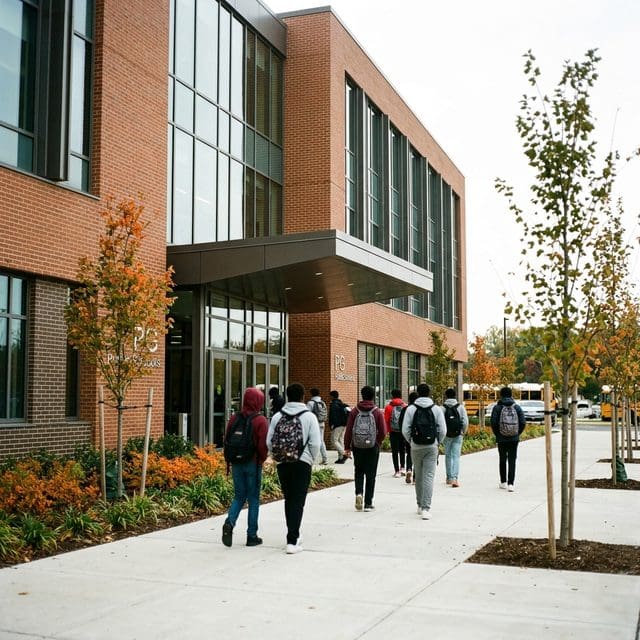
More than 1,300 students began the year in two new Prince George’s County schools, while a Karnataka group called on India’s government to appoint a qualified local academician to lead a public university.
Two recent education developments raise practical questions about how institutions serve students: whether school facilities are delivered effectively and how university leaders are selected.
In Prince George’s County, Maryland, more than 1,300 students started the school year in two new schools delivered through the Blueprint Schools program, according to a GlobeNewswire announcement. The release describes the project as a public-private partnership and the buildings as modern. It does not specify their locations, enrollment at each school or the facilities included.
New buildings can address a basic need: students and staff require functional places to learn and work. But the announcement does not say whether the project came in on budget, how maintenance costs will be handled or whether the schools have affected student outcomes. Those measures will help determine whether the arrangement delivers lasting value, beyond opening two buildings.
The release also provides no figures on construction costs or financing and does not explain how public and private partners divide responsibility. Such details matter to families and taxpayers seeking to assess cost, oversight and long-term obligations. The figure of more than 1,300 students shows the project’s reach, but it does not establish academic impact or savings.
In India, Kalyana Karnataka Pratyeka Rajya Horata Samiti has urged the Union government to appoint a qualified academician from Karnataka as vice-chancellor of the Central University of Karnataka. The university is at Kadaganchi, near Kalaburagi, The Hindu reported.
The group’s request connects regional representation with an academic qualification. The available report does not identify potential candidates, detail the appointment process or describe a government response. It offers no basis to assess individual candidates or establish how regional origin might be weighed against other qualifications.
University leadership can influence institutional priorities, academic standards and the environment in which students pursue credentials. A credible appointment process therefore needs clear criteria and evidence of leadership ability. The group’s appeal raises a question about how the Union government will balance regional expectations with the university’s needs, but the report does not say how officials will proceed.
The developments differ, but both concern public accountability. School construction is a visible investment in learning conditions; university leadership shapes academic direction. In each case, announcements and appeals are only a starting point. Families and students need institutions to explain who is responsible, what standards apply and how results will be assessed.
The available information leaves outcomes unresolved. Prince George’s County’s new schools are serving students, while the Karnataka organization’s request remains an appeal to the government. Further information on costs, responsibilities and school performance would clarify the value of the construction model. Details of the university’s selection process and any decision would show how the appointment addresses both qualifications and public expectations.
Daniel Owens serves as a Senior Correspondent for Just Right News, where he leads the newsroom’s coverage of Education, Workforce, and Upward Mobility. In an era where the national conversation often overlooks the practical foundations of success, Owens brings a principled perspective to the forefront of the media landscape. His work is defined by a commitment to the idea that a strong society is built on the pillars of quality education, a robust work ethic, and the removal of bureaucratic barriers to individual achievement.
Born and raised in Cleveland, Ohio, Owens’s worldview was shaped by the industrial landscape of the Midwest. Growing up in a city known for its grit and resilience, he witnessed firsthand the transformative power of steady employment and the devastating effects of economic stagnation. This background instilled in him a deep respect for the American worker and a healthy skepticism toward top-down government solutions that often fail to reach the communities they intend to help. As an African American man who has navigated the path to professional success, Owens approaches his beat with a nuanced understanding of how meritocracy and personal responsibility intersect with opportunity. He frequently draws on his roots to highlight the importance of family stability and community-led initiatives in fostering the next generation of leaders.
At Just Right News, Owens is the architect of the acclaimed feature series, “The Learning Curve.” Through this platform, he explores the evolving landscape of American schooling, from the rise of the school choice movement to the revitalization of trade schools and vocational training. He frequently challenges the status quo of higher education, advocating for a return to academic rigor and the practical alignment of degrees with market demands. For Owens, education is not merely about obtaining credentials; it is about equipping young people with the tools necessary to lead self-sufficient, meaningful lives. His reporting on “The Learning Curve” has become essential reading for parents and policymakers who believe that educational competition and parental rights are the keys to a brighter future.
Now based in Raleigh, North Carolina, Owens finds himself at the heart of one of the nation’s most dynamic regions for innovation and growth. Raleigh’s unique blend of traditional values and a fast-paced economy provides the perfect backdrop for his reporting on the modern workforce. From the tech hubs of the Research Triangle to the rural communities of the South, he tracks how shifts in the economy are impacting families and local industries. His reporting often highlights the success stories of entrepreneurs and workers who are thriving by embracing the values of hard work and innovation.
Throughout his career, Daniel Owens has remained a steadfast voice for the student seeking a better path and the worker striving for a better life. His reporting for Just Right News serves as a vital resource for readers who value common-sense solutions to the challenges of the 21st-century economy. By focusing on the intersection of policy and the human spirit, Owens continues to provide a roadmap for how individuals and communities can achieve lasting upward mobility.