

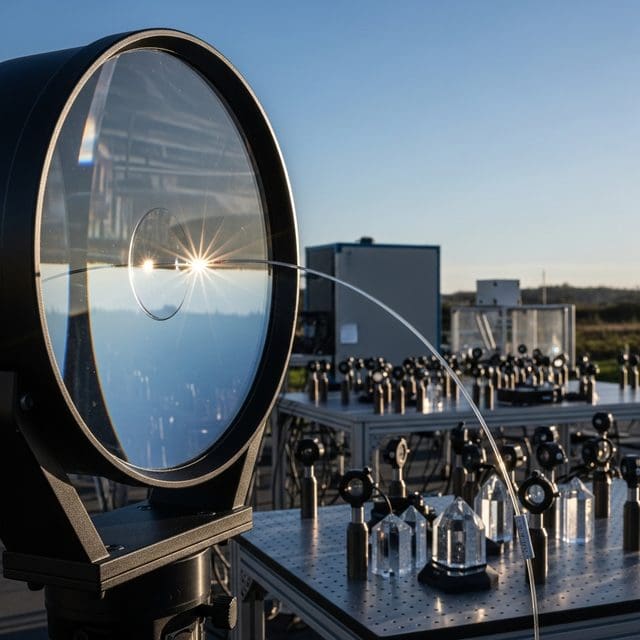
Researchers from the University of Ottawa and Max Planck Institute have demonstrated that natural sunlight can produce high-quality quantum entanglement, offering a low-energy alternative to traditional laser-based systems.
In a discovery that challenges the conventional reliance on high-powered lasers for advanced computing, researchers have successfully generated quantum entanglement using nothing more than ordinary sunlight. The breakthrough, published in the journal Optica on August 7, 2026, suggests that the building blocks of the next technological revolution could be powered by natural resources rather than massive energy grids.
For decades, the scientific community assumed that creating entangled photons—particles so deeply linked that the state of one instantly influences the other—required coherent light. Lasers, which produce synchronized waves of a single color, have been the standard tool because they provide the predictable environment traditionally thought necessary for quantum mechanics. However, a team led by Cheng Li and Robert Boyd of the University of Ottawa, with Hanieh Fattahi’s group at the Max Planck Institute for the Science of Light, has proven that the multi-colored nature of sunlight is not an insurmountable barrier.
The experiment utilized a specialized all-glass solar concentrator featuring a Fresnel lens roughly the size of a household window. This device funnels sunlight into an optical fiber no wider than a human hair, directing the beam into a millimeter-scale nonlinear crystal. Through spontaneous parametric down-conversion (SPDC), individual photons from the sun are split into pairs of entangled photons. The researchers found that while sunlight is spatially incoherent, its polarization order can be preserved to generate high-quality quantum states.
Despite the inherent chaos of solar radiation, the researchers achieved a 94% fidelity rate compared to an ideal entangled state. The resulting photons successfully violated Bell’s inequality, a rigorous test confirming genuine quantum correlations that classical physics cannot explain. This demonstrates that solar-produced entanglement is functionally equivalent to that produced by expensive, electricity-hungry laboratory lasers.
This development carries significant implications for national sovereignty and decentralized infrastructure. By utilizing ambient sunlight, future quantum satellites could operate without the heavy, power-hungry laser systems currently required for secure encryption. Such a shift could lower the barrier to entry for secure communications and reduce the energy burden of scaling up quantum computing architectures. In an era where energy independence is paramount, harvesting quantum resources directly from the environment offers a path toward technological liberty.
The project faced substantial skepticism from the scientific establishment. According to Li, world-renowned researchers initially doubted whether any photons could be detected from sunlight-driven nonlinear processes. The success of the experiment serves as a reminder that breakthrough innovation often occurs when researchers trust empirical evidence over institutional consensus. The team is now working to increase the brightness of the entangled pairs and explore other nonlinear processes like four-wave mixing.
As the world looks toward a future of quantum networks, this discovery provides a proof-of-principle for a greener, more accessible frontier. If these methods are industrialized, the path toward a sunlight-driven quantum infrastructure may be closer than previously imagined, turning the very light that hits our windows into a medium for the most secure communications known to man.

Mason Reed serves as a Staff Writer for Just Right News, where he spearheads the Future Frontiers & Special Projects desk. In an era defined by rapid technological shifts and evolving social landscapes, Mason provides a steady, principled voice, examining the innovations of tomorrow through the lens of traditional American values. His work is most prominently featured in his signature series, “The Next Horizon,” where he explores the intersection of emerging technology, national sovereignty, and the preservation of individual liberty.
A native of San Diego, California, Mason’s worldview was shaped by the unique culture of his hometown. Growing up in a region defined by its strong military presence and its history of maritime industry, he developed a deep-seated respect for the institutions that provide national stability and the entrepreneurial spirit that drives the American economy. This upbringing instilled in him a belief that true progress is not found in discarding the past, but in building upon a foundation of proven principles. His reporting often reflects this San Diego influence, emphasizing the importance of a robust national defense and the necessity of maintaining a competitive edge in the global marketplace.
Now based in San Francisco, Mason operates from the heart of the world’s technological engine. Living and working in the Bay Area provides him with a front-row seat to the advancements—and the ideological challenges—emanating from Silicon Valley. While many in the region embrace a “move fast and break things” mentality, Mason’s reporting serves as a vital counterweight. He offers Just Right News readers a “boots on the ground” perspective, documenting how radical local policies and the concentration of tech power impact the everyday lives of citizens. His proximity to the industry allows him to cut through the marketing jargon of big tech to uncover the real-world implications for privacy, free speech, and the nuclear family.
In his “Future Frontiers” beat, Mason tackles complex subjects ranging from the ethics of artificial intelligence to the burgeoning private space race. He approaches these topics with a healthy skepticism toward centralized bureaucracy, championing instead the decentralized innovations that empower individuals. Through “The Next Horizon,” he highlights the pioneers and thinkers who are working to ensure that the future remains a place where human dignity and constitutional rights are protected. He believes that the rapid pace of change requires more than just technical expertise; it requires a moral compass rooted in the Western tradition.
Throughout his tenure at Just Right News, Mason has remained committed to the idea that the future is something to be shaped, not merely accepted. His writing is characterized by a rigorous defense of American exceptionalism and a belief that the country’s best days lie ahead, provided it remains true to its founding ideals. Whether he is investigating the impact of automation on the American workforce or profiling the next generation of aerospace engineers, Mason Reed ensures that his readers are equipped with the insights they need to navigate a changing world with confidence and clarity.