

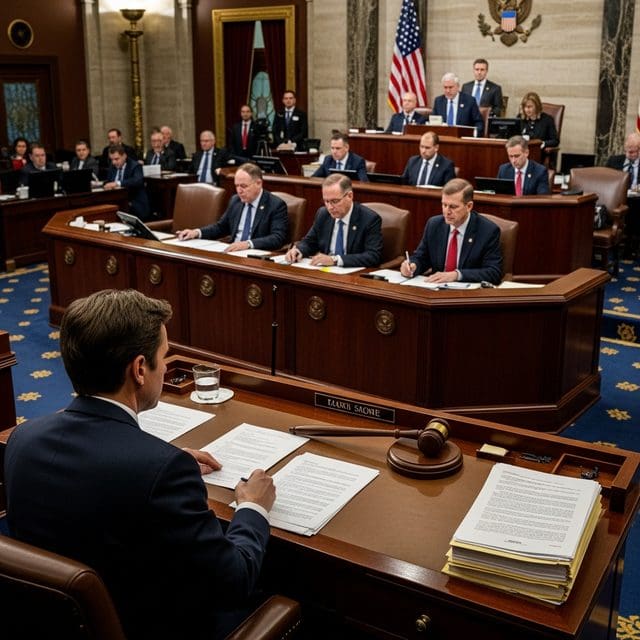
Majority Leader John Thune navigates a narrow path for Attorney General nominee Todd Blanche while advancing a major Russia sanctions package and a stopgap funding bill to avoid a government shutdown.
The Senate’s pre-recess agenda has descended into a frantic balancing act as Majority Leader John Thune (R-S.D.) attempts to navigate a razor-thin confirmation margin for Todd Blanche, the President’s nominee for Attorney General. The nomination, a cornerstone of the administration’s Justice Department overhaul, faces a precarious path following formal opposition from Senators Susan Collins (R-Maine) and Lisa Murkowski (R-Alaska). With Senator Mitch McConnell (R-Ky.) absent due to medical recovery, the Republican conference can afford only one additional defection. All eyes have turned to Senator Bill Cassidy (R-La.), whose undecided status now holds the power to stall the nomination until the fall.
Opposition to Blanche has centered on constitutional and procedural concerns. Senator Murkowski’s August 7 announcement cited anxieties regarding a proposed fund to compensate January 6 defendants, a policy she suggests remains a point of contention despite administrative assurances that such plans are inactive. This internal friction reflects a broader debate within the GOP over the limits of executive influence. Senator John Fetterman (D-Pa.) has also confirmed his opposition, ensuring the White House must maintain near-perfect party discipline. The tension is further exacerbated by a recent federal appeals court ruling that blocked the administration’s White House ballroom construction, a 2-1 decision that reaffirmed Congress’s exclusive control over White House funding.
While the Blanche nomination remains in limbo, the Senate is moving with greater speed on foreign policy. Leader Thune has teed up a final vote on the Lindsey O. Graham Sanctioning Russia Act of 2026. This legislation, which advanced with a strong 86–12 procedural vote and boasts 62 co-sponsors, represents a significant escalation in economic pressure. The bill targets global buyers of Russian oil and gas, authorizing tariffs of up to 100% on the five largest purchasers. This move signals a bipartisan consensus to tighten the administrative state’s grip on international energy markets, even as U.S. crude supplies hit a 45-year low and the Strategic Petroleum Reserve sits at its lowest level since 1983.
Simultaneously, the Senate is processing a stopgap funding bill to prevent a September 30 government shutdown. The measure, which extends current funding levels to December 11, is being presented as a “clean” bill to ensure passage before lawmakers leave town. However, the peace is fragile. Thune is also forcing a vote on a budget blueprint that includes the SAVE America Act—a suite of election security provisions backed by the White House. While Republicans privately concede the blueprint currently lacks the 50 votes required for passage, the vote serves as a public marker of the party’s legislative priorities regarding federal oversight of elections. This occurs alongside the passage of the bipartisan Youth Poisoning Protection Act, a rare moment of cooperation aimed at reducing access to lethal means for suicide.
Other major policy initiatives have failed to clear the pre-recess hurdle. A landmark cryptocurrency regulatory framework has been deferred to September after Democrats objected to the GOP’s latest draft, despite the efforts of Senators such as Ted Cruz (R-Tex.) to advance a crypto-friendly regime. Similarly, the Protect College Sports Act, championed by Senators Cruz and Maria Cantwell (D-Wash.), stalled after 11 senators blocked expedited consideration. These delays, coupled with the primary defeat of Representative Andy Ogles (R-Tenn.) to Charlie Hatcher, underscore the persistent difficulty of moving complex regulatory shifts through a chamber defined by narrow majorities. As the Senate prepares to gavel out, the administration’s ability to seat its top law enforcement officer remains the most significant unresolved question of the summer session.

Miles Harrington serves as the Senior Correspondent for Federal Systems & Executive Power at Just Right News, where he brings a disciplined, constitutionalist lens to the inner workings of the American government. With a focus on the mechanics of the federal bureaucracy and the limits of executive authority, Harrington has established himself as a vital voice for readers who value transparency, accountability, and the preservation of the separation of powers.
A native of Richmond, Virginia, Harrington’s perspective is deeply rooted in the traditions of the Old Dominion. Growing up in a city defined by its historical significance and its role as a center of American jurisprudence, he developed an early appreciation for the foundational principles of the Republic. His upbringing in Richmond—a place where the legacy of the Founding Fathers is woven into the landscape—instilled in him a belief that the federal government should remain within its constitutional bounds. This background informs his skepticism of centralized overreach and his commitment to reporting on the ways in which the administrative state impacts the lives of everyday citizens.
In his current role, Harrington specializes in the complexities of federal systems. He doesn’t just report on the headlines of the day; he digs into the structural shifts within the executive branch that often go unnoticed by the mainstream press. Whether he is analyzing the implications of a new federal regulation or investigating the expansion of agency jurisdiction, his work is characterized by a rigorous adherence to the facts and a dedication to the rule of law.
Harrington is perhaps best known for his signature feature series, “How Washington Works.” Through this ongoing project, he demystifies the often-opaque processes of the nation’s capital, pulling back the curtain on the “Deep State” and the unelected officials who wield significant influence over national policy. By breaking down complex legislative maneuvers and executive orders, he empowers Just Right News readers to understand the true levers of power in Washington. His reporting serves as a necessary check on the federal government, ensuring that the actions of those in power are held up to the light of public scrutiny.
Now based in Washington, D.C., Harrington operates at the epicenter of the political world, yet he remains intentionally distanced from the “Beltway bubble.” His proximity to the halls of power allows him to maintain a robust network of sources across the federal landscape, but his heart remains in the principled conservatism of his Virginia roots. He views his role not merely as a reporter, but as a steward of the public trust, dedicated to providing the clarity and context that conservative voters need to navigate an increasingly complex political environment.
Through his sharp analysis and unwavering commitment to the truth, Miles Harrington continues to be a cornerstone of the Just Right News team. His work ensures that the principles of limited government and executive restraint remain at the forefront of the national conversation, providing a crucial service to those who believe in a government that is truly of, by, and for the people.