

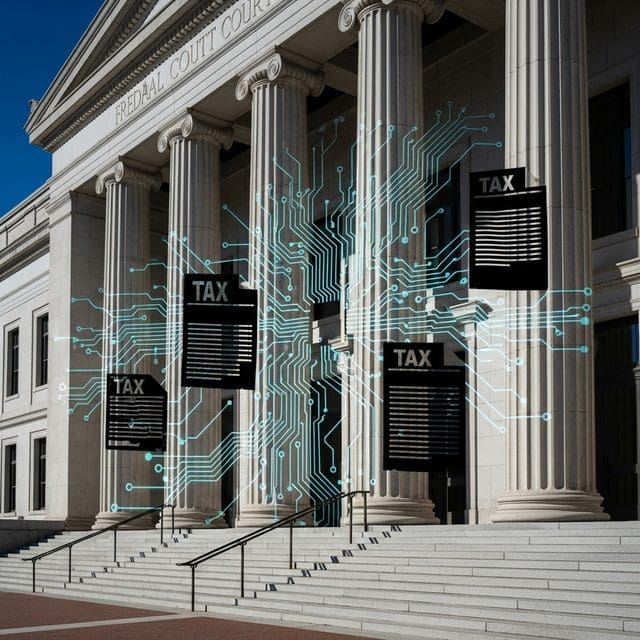
OpenAI moves to dismiss Apple’s trade secret lawsuit while the IRS faces a constitutional challenge over its aggressive enforcement of conservation easement tax disputes.
The federal judiciary is increasingly serving as the final arbiter in disputes where administrative power and corporate competition collide with the constitutional protections of property and due process. On August 5, 2026, OpenAI filed a comprehensive motion to dismiss Apple’s trade secret lawsuit, characterizing the litigation as a baseless attempt to stifle labor mobility and suppress competition in the burgeoning artificial intelligence sector. The filing argues that Apple’s claims of intellectual property theft are ‘rotten to the core,’ asserting that OpenAI has no use, need, or desire for Apple’s proprietary data.
This motion directly counters Apple’s August 4 request for a preliminary injunction, which seeks to bar OpenAI from utilizing alleged secrets during the discovery process. OpenAI’s legal team has pivoted to a defense centered on the blurring of personal and corporate data within Apple’s own ecosystem. They contend that Apple’s data policies, which allow for the synchronization of personal iMessages and iCloud data on company devices, created the very evidentiary trail Apple now cites as proof of misconduct. OpenAI has even released internal ‘receipts’ to suggest that a key employee accused of theft was merely attempting to assist a former colleague rather than misappropriating corporate assets. This case, set against a backdrop of high-stakes IP litigation with trials scheduled for October 19, 2026, tests the boundaries of trade secret law in an era where the line between personal knowledge and corporate property is increasingly thin.
While the tech sector grapples with these intellectual property boundaries, the U.S. Tax Court is managing a surge of litigation stemming from the Internal Revenue Service’s aggressive crackdown on syndicated conservation easements. As of May 2026, approximately 740 cases are pending in Tax Court, with another 400 under examination. The IRS has utilized its administrative authority to designate these as ‘listed transactions,’ a move that extends the statute of limitations to six years and allows the agency to deploy hundreds of specialized revenue agents to promoter investigations. This enforcement campaign has been described by critics as a ‘tax-code witch hunt’ that bypasses traditional judicial norms.
The agency recently opened a final, time-limited 90-day settlement window, which is set to expire shortly after the August 5 developments. This program offers reduced penalties of 10 to 20 percent, compared to the standard 40 percent, but only if taxpayers agree to the total elimination of their deductions. Such tactics have drawn sharp criticism from constitutionalists who argue the IRS is functioning as ‘judge, jury, and executioner.’ By pressuring taxpayers to settle rather than face the mounting costs of litigation, the agency effectively circumvents the neutral oversight of the court system. This pressure is particularly acute as the IRS coordinates fraud investigations through specialized offices, creating a formidable administrative apparatus that many small-scale investors find impossible to resist.
These parallel developments in the Northern District of California and the Tax Court underscore a broader trend: the judiciary is being asked to provide doctrinal clarity where statutory language remains broad and administrative agencies seek to expand their reach. Whether defining the limits of ‘protected secrets’ in the AI age or curbing the reach of the IRS’s enforcement power, the courts remain the essential check on both private and public overreach. As these cases move toward summary judgment, the legal standards established will redefine the rulebook for American industry and the regulatory state, ensuring that the law is interpreted as written rather than as a tool for administrative convenience.

Lila Hayes serves as a Staff Writer for Just Right News, where she anchors the “Courts, Law, and Constitutional Order” beat. Her work is defined by a steadfast commitment to the foundational principles of the American republic and a rigorous defense of the legal frameworks that ensure national stability. As a primary voice for the outlet, she provides readers with a clear-eyed analysis of the judiciary, focusing on the importance of originalism and the preservation of the separation of powers.
Lila’s perspective was forged in the American heartland. Raised in St. Louis, Missouri, she grew up in a Hispanic household where the values of hard work, faith, and respect for the law were paramount. Her upbringing instilled in her a deep appreciation for the American Dream and the legal protections that make it possible. This Missouri background remains a cornerstone of her reporting, providing a grounded, common-sense counter-narrative to the often-insular legal circles of the coastal elite. She understands that the decisions made in high-court chambers have real-world consequences for families and small business owners across the country.
At Just Right News, Lila has become widely recognized for her signature feature series, “The Rulebook of Power.” In this ongoing project, she delves into the mechanics of the federal government, examining how administrative overreach and judicial activism can threaten the delicate balance of the Constitution. She approaches her beat with the tenacity of a veteran journalist and the precision of a legal scholar, consistently advocating for a judiciary that interprets the law as written rather than legislating from the bench. For Lila, the Constitution is not a “living” document subject to the whims of modern social trends; it is a fixed standard that ensures the government remains the servant of the people, not their master.
Now based in Philadelphia, Pennsylvania, Lila finds herself at the very epicenter of American constitutional history. Living and working in the city where the Founders drafted the documents she defends daily provides a constant source of inspiration. The historic halls and landmarks of Philadelphia serve as a daily reminder of the high stakes involved in her reporting. Her presence in the city allows her to bridge the gap between the historical intent of the law and its contemporary application, ensuring that the legacy of the Founding Fathers remains central to the national conversation.
Throughout her career, Lila has remained dedicated to the idea that a free society requires an informed citizenry and a transparent legal system. Her reporting is more than just a collection of headlines; it is a defense of the constitutional order that has sustained the nation for over two centuries. By focusing on the “Rulebook of Power,” she ensures that her readers understand not just what is happening in the courtrooms, but why those decisions matter for the future of American liberty. Lila Hayes continues to be a vital voice for those who believe that the law should be a shield for the citizen and a constraint on the state.