

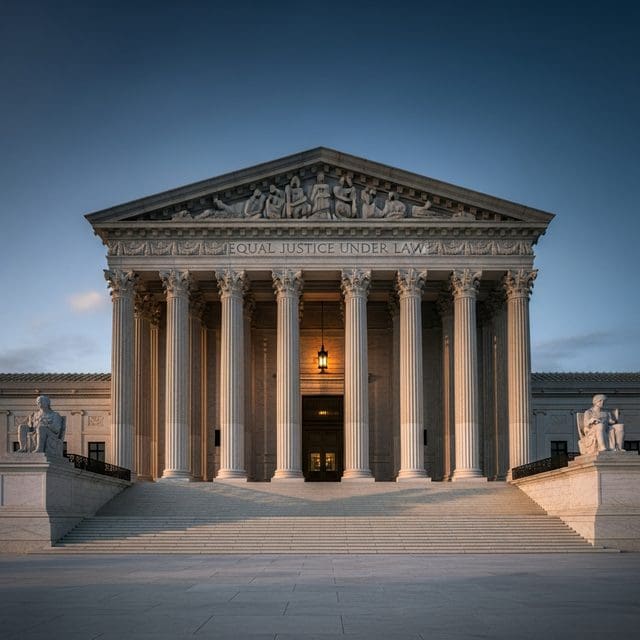
Justice Sonia Sotomayor refused to block a massive judgment against the PLO, upholding the Anti-Terrorism Act’s enforcement for American victims while appellate reviews continue.
In a significant affirmation of the judiciary’s role in adjudicating liability under domestic law, Justice Sonia Sotomayor, acting as Circuit Justice, refused on August 3 to stay a $656 million judgment against the Palestine Liberation Organization (PLO) and the Palestinian Authority. The decision leaves a substantial damages award in place for American victims of attacks in Israel, marking a pivotal moment in a long-running legal battle under the Anti-Terrorism Act. This refusal to intervene at the emergency stage signals a commitment to procedural integrity, ensuring that statutory remedies for victims are not easily sidelined by diplomatic appeals.
From a constitutional standpoint, the refusal to grant a stay reflects the high bar for emergency intervention. The petitioners sought to freeze the enforcement of the judgment while further proceedings continued, but the denial suggests that the legal requirements for such an extraordinary remedy—a showing of irreparable harm and a likelihood of success on the merits—were not sufficiently met. The case centers on the Anti-Terrorism Act, a statute designed to provide U.S. citizens with legal recourse against entities providing material support for terrorism. By allowing the judgment to stand, the court maintains the statutory pressure intended by Congress.
While the U.S. Supreme Court operates under its summer case distribution schedule, this emergency ruling provides immediate doctrinal clarity. The Court’s schedule indicates that lists will be circulated on August 5–6, 12–13, 19–20, and 26–27, providing windows for the justices to consider new petitions. This structured approach ensures that even during recess, the Court remains a gatekeeper of the constitutional order, addressing urgent matters as they arise.
Parallel to these developments, the Supreme Court of India has also been active in defining the boundaries of state power. In a matter of interstate governance, the Tamil Nadu government filed an urgent petition seeking enforcement of a water-sharing order against Karnataka. This mirrors the American experience of federalism, where courts serve as the final arbiter in conflicts between regional authorities. Furthermore, the Indian high court clarified that states may withdraw FIRs against students involved in exam protests, provided the cases do not involve grave offenses, operationalizing an earlier amnesty assurance.
In a separate public-interest matter, the Indian court directed the central government to ensure every road includes encroachment-free pedestrian space, reaffirming the right to walk on footpaths as a fundamental right. These rulings underscore a global judicial trend: courts are increasingly called upon to resolve disputes where administrative actions intersect with established constitutional safeguards. Whether in Washington or New Delhi, the judiciary is asserting its role as the primary interpreter of the rulebook of power.
Justice Sotomayor’s refusal to stay the PLO judgment serves as a reminder that the judiciary’s function is to interpret the law as written and respect the finality of lower court decisions unless a clear violation of the constitutional order is present. As the fall term approaches, the legal community will watch to see if this adherence to procedural rigor and statutory rights continues to define the Court’s approach to its expanding docket.

Lila Hayes serves as a Staff Writer for Just Right News, where she anchors the “Courts, Law, and Constitutional Order” beat. Her work is defined by a steadfast commitment to the foundational principles of the American republic and a rigorous defense of the legal frameworks that ensure national stability. As a primary voice for the outlet, she provides readers with a clear-eyed analysis of the judiciary, focusing on the importance of originalism and the preservation of the separation of powers.
Lila’s perspective was forged in the American heartland. Raised in St. Louis, Missouri, she grew up in a Hispanic household where the values of hard work, faith, and respect for the law were paramount. Her upbringing instilled in her a deep appreciation for the American Dream and the legal protections that make it possible. This Missouri background remains a cornerstone of her reporting, providing a grounded, common-sense counter-narrative to the often-insular legal circles of the coastal elite. She understands that the decisions made in high-court chambers have real-world consequences for families and small business owners across the country.
At Just Right News, Lila has become widely recognized for her signature feature series, “The Rulebook of Power.” In this ongoing project, she delves into the mechanics of the federal government, examining how administrative overreach and judicial activism can threaten the delicate balance of the Constitution. She approaches her beat with the tenacity of a veteran journalist and the precision of a legal scholar, consistently advocating for a judiciary that interprets the law as written rather than legislating from the bench. For Lila, the Constitution is not a “living” document subject to the whims of modern social trends; it is a fixed standard that ensures the government remains the servant of the people, not their master.
Now based in Philadelphia, Pennsylvania, Lila finds herself at the very epicenter of American constitutional history. Living and working in the city where the Founders drafted the documents she defends daily provides a constant source of inspiration. The historic halls and landmarks of Philadelphia serve as a daily reminder of the high stakes involved in her reporting. Her presence in the city allows her to bridge the gap between the historical intent of the law and its contemporary application, ensuring that the legacy of the Founding Fathers remains central to the national conversation.
Throughout her career, Lila has remained dedicated to the idea that a free society requires an informed citizenry and a transparent legal system. Her reporting is more than just a collection of headlines; it is a defense of the constitutional order that has sustained the nation for over two centuries. By focusing on the “Rulebook of Power,” she ensures that her readers understand not just what is happening in the courtrooms, but why those decisions matter for the future of American liberty. Lila Hayes continues to be a vital voice for those who believe that the law should be a shield for the citizen and a constraint on the state.