

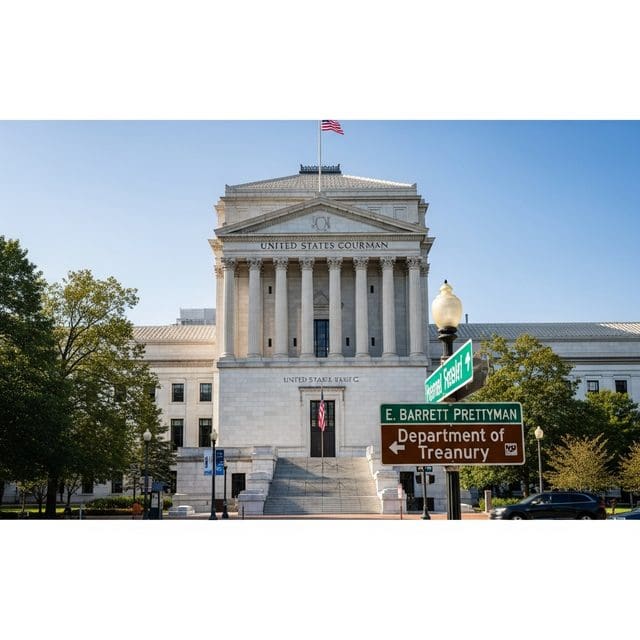
A federal appeals court ruled the EPA cannot retroactively claw back Greenhouse Gas Reduction Fund grants, restoring access to billions for climate nonprofits after a year-long freeze.
A full en banc panel of the U.S. Court of Appeals for the D.C. Circuit has delivered a significant blow to the current administration’s energy and fiscal policy. In a 6–4 decision, the court ruled that the Environmental Protection Agency (EPA) lacked the legal authority to terminate and claw back approximately $20 billion in Greenhouse Gas Reduction Fund grants. The court characterized the administration’s attempt to cancel the funds as being based solely on a policy disagreement rather than a statutory mandate, highlighting the friction between executive discretion and congressional intent.
The ruling reverses a September 2025 panel decision that had previously sided with the EPA, which had forced nonprofit organizations into a difficult legal posture in the Court of Federal Claims. By overturning that loss, the en banc court has restored an April 2025 injunction. This effectively bars the EPA and Citibank from continuing to freeze or reclaim disbursed funds that have been locked in Citibank-managed “green bank” accounts since February 2025. The court found that the administration’s reliance on the OBBBA rescissions law to retroactively reclaim funds already obligated under the Inflation Reduction Act was an unlawful application of the statute.
For major climate financing entities like the Climate United Fund, which has roughly $7 billion at stake, the decision provides immediate relief. These organizations regain access to their federal financing while the EPA determines its next move. This legal victory for nonprofits comes as the U.S. economy shows accelerating growth, particularly in the second quarter of 2026. This growth is largely driven by the demand for computer memory and technologies needed for artificial intelligence development. As American manufacturers grow at their fastest pace in more than four years, the demand for stable energy infrastructure and the capital to build it has never been higher.
However, the manufacturing boom is a double-edged sword, as firms face supply shortages and higher inflation. The sudden re-injection of $20 billion in climate-related capital into the market could influence resource allocation at a time when the grid is already under strain from AI-driven energy demand. While the court’s decision provides a technical reset for these specific funds, the broader market is also stabilizing. Citadel Securities recently declared a stock market technical reset complete, recommending a resumption of equity purchases after a volatile summer sell-off. This suggests that while the legal battle over climate funds was a point of contention, the underlying economic engine remains focused on technological expansion.
Despite the ruling, a degree of uncertainty remains for the energy sector. The court has left in place limits on any new disbursements while appeal options are explored, and the EPA now faces a deadline to decide whether to petition the U.S. Supreme Court. Furthermore, parallel litigation continues regarding the role of Citibank and the Treasury Department in the initial account freezes, which were reportedly requested by federal administrative agencies including the FBI and the EPA. These disclosures have added a layer of political scrutiny to how the administration handled the climate financing program.
For the American taxpayer and the energy sector, the case highlights the ongoing tension between executive policy shifts and the permanence of congressional spending. The decision reinforces the principle that energy policy, while subject to debate, must operate within the established framework of contract law and obligated appropriations to maintain market stability and investor confidence.

Mark Davis serves as the Senior Correspondent for Energy, Climate, and Resource Economics at Just Right News. In an era where the conversation around the environment is often dominated by alarmism and top-down mandates, Mark provides a vital, market-oriented perspective on the complex forces shaping our world. As the lead voice behind the acclaimed feature series “Power and the Planet,” he explores the intersection of environmental policy, global energy markets, and the fundamental economic principles that sustain modern civilization.
Mark’s pragmatic approach to resource management was forged in the high desert of his hometown, Albuquerque, New Mexico. Growing up in a region defined by both its breathtaking natural beauty and its rugged, resource-dependent landscape, he developed an early appreciation for the delicate balance between conservation and utilization. New Mexico’s unique position as a hub for both traditional energy production and cutting-edge scientific research provided Mark with a front-row seat to the evolution of the American energy sector. This upbringing instilled in him a deep-seated belief that true environmental stewardship is inseparable from economic prosperity and technological innovation.
Now based in Boulder, Colorado, Mark operates from the heart of the nation’s climate research community. While Boulder is often seen as a bastion of environmental idealism, Mark utilizes his post to provide a necessary counterweight, grounded in the realities of resource economics. He understands that energy policy does not exist in a vacuum; it has tangible consequences for the American taxpayer, the stability of the national power grid, and the strength of the domestic manufacturing sector. By reporting from the front lines of the climate debate, he is able to challenge prevailing narratives with hard data and a commitment to the principles of the free market.
Throughout his tenure at Just Right News, Mark has distinguished himself by focusing on the “Resource Economics” aspect of his beat. He frequently highlights the hidden costs of rapid energy transitions and advocates for an “all-of-the-above” energy strategy that prioritizes American energy independence. His work often shines a light on the geopolitical implications of resource scarcity, arguing that a secure nation must first be an energy-secure nation. Whether he is analyzing the impact of federal land-use regulations or investigating the supply chains required for new technologies, Mark remains focused on how policy decisions affect the lives and livelihoods of everyday citizens.
In “Power and the Planet,” Mark continues to bridge the gap between complex scientific concepts and the economic realities facing the country. He rejects the false choice between a healthy environment and a thriving economy, instead seeking out solutions that leverage American ingenuity and private-sector competition. For Mark, reporting on the climate is not about following the latest trends, but about ensuring that the conversation remains tethered to the foundational values of liberty, property rights, and fiscal responsibility. His contributions ensure that Just Right News readers receive a comprehensive, clear-eyed view of the challenges and opportunities defining the future of our planet.