

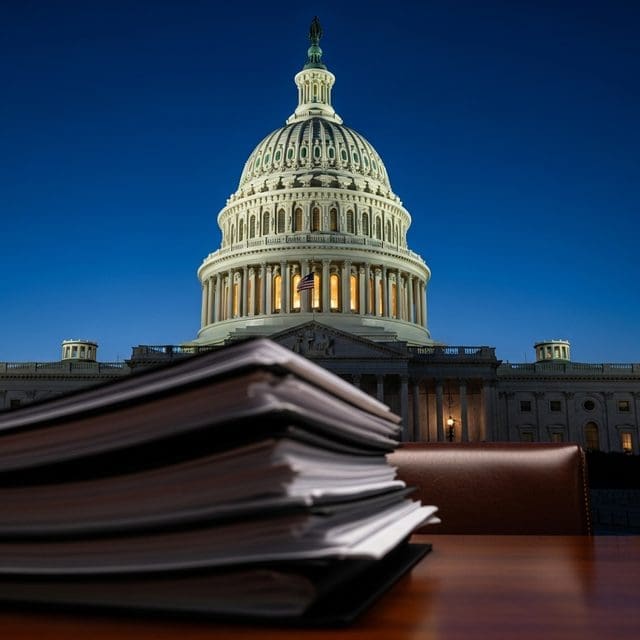
President Trump is demanding the Senate adopt a massive budget resolution for Iran war funding before the August recess, despite Majority Leader John Thune’s admission that the measure currently lacks the necessary votes.
The tension between executive ambition and legislative reality reached a fever pitch this week as President Donald Trump publicly pressured Senate Republicans to adopt a $95 billion budget resolution aimed at funding the ongoing war in Iran. The President’s demand, issued via social media on July 24, insists that the Senate move the package before the upcoming August recess. However, Senate Majority Leader John Thune has signaled a rare public break with the White House, stating he cannot currently secure the 50 votes required to pass the measure. This legislative impasse pits the administration directly against its own party leadership on a high-stakes funding bill, signaling a potential intra-Republican split over the scope and cost of U.S. involvement in the Middle East.
The $95 billion resolution, which has already cleared the House in a narrow 216–214 vote, is structured as a reconciliation vehicle. This procedural maneuver would allow the Senate to bypass the 60-vote filibuster threshold, a necessity given that Senate Republicans have long maintained there is no path to 60 votes for a straight war-funding bill. Despite this advantage, Thune remains focused on the September 30 government funding deadline, suggesting the House-passed resolution might be better utilized as leverage to avert a potential government shutdown later this year rather than as a standalone war package today. Thune and other Senate Republicans are openly considering delaying any Iran war funding vote until after the midterms to avoid political fallout.
Substantively, the resolution allocates approximately $73 billion toward direct Iran war costs, with the remainder earmarked for farm and election grants. The fiscal scale of the request has exacerbated an internal GOP divide. While the administration views the funding as an urgent national security priority, a faction of Senate Republicans remains wary of the deficit impact and the political optics of escalating war expenditures amid rising energy prices. This skepticism was mirrored in the House on July 23, when four Republicans—Reps. Tom Barrett, Warren Davidson, Thomas Massie, and Brian Fitzpatrick—joined Democrats to pass a separate war powers resolution, signaling bipartisan unease with executive military discretion and the lack of clear offsets for the multi-billion dollar price tag.
Beyond the fiscal debate, significant procedural hurdles loom. Even if Thune were to bring the resolution to the floor, Senate rules would require the addition of specific committee instructions to the budget blueprint. This would necessitate sending the amended resolution back to the House for a second vote, a timeline that makes the President’s pre-recess demand nearly impossible to meet under current standing orders. This process wrinkle suggests the White House’s pressure campaign may be more about political signaling than legislative mechanics, as the administration seeks to force a vote that would clarify where each senator stands on the conflict.
While the funding debate stalled in the Capitol, the President maintained his characteristic posture toward the administrative state and the press at a rescheduled White House Correspondents’ Association dinner. Speaking at the Waldorf Astoria—a move necessitated by a previous assassination attempt at the Washington Hilton—the President alternated between jokes about a constitutionally barred third term and sharp critiques of the media establishment. He even displayed a red cap labeled 2028, further stoking the political fire. Despite the gala’s traditional focus on the First Amendment, the underlying friction over war transparency and executive spending remains the dominant friction point between the two ends of Pennsylvania Avenue, as the White House pushes to raise overall national security funding to $1.5 trillion.
As the August recess approaches, the standoff over the $95 billion resolution serves as a stark reminder of the constitutional checks inherent in the American system. While the executive branch may set the agenda for foreign engagement, the power of the purse remains firmly within a divided Congress. For now, the Senate appears content to let the clock run out on the President’s summer deadline, prioritizing fiscal stability and electoral survival over the immediate expansion of the administrative state’s war chest.

Miles Harrington serves as the Senior Correspondent for Federal Systems & Executive Power at Just Right News, where he brings a disciplined, constitutionalist lens to the inner workings of the American government. With a focus on the mechanics of the federal bureaucracy and the limits of executive authority, Harrington has established himself as a vital voice for readers who value transparency, accountability, and the preservation of the separation of powers.
A native of Richmond, Virginia, Harrington’s perspective is deeply rooted in the traditions of the Old Dominion. Growing up in a city defined by its historical significance and its role as a center of American jurisprudence, he developed an early appreciation for the foundational principles of the Republic. His upbringing in Richmond—a place where the legacy of the Founding Fathers is woven into the landscape—instilled in him a belief that the federal government should remain within its constitutional bounds. This background informs his skepticism of centralized overreach and his commitment to reporting on the ways in which the administrative state impacts the lives of everyday citizens.
In his current role, Harrington specializes in the complexities of federal systems. He doesn’t just report on the headlines of the day; he digs into the structural shifts within the executive branch that often go unnoticed by the mainstream press. Whether he is analyzing the implications of a new federal regulation or investigating the expansion of agency jurisdiction, his work is characterized by a rigorous adherence to the facts and a dedication to the rule of law.
Harrington is perhaps best known for his signature feature series, “How Washington Works.” Through this ongoing project, he demystifies the often-opaque processes of the nation’s capital, pulling back the curtain on the “Deep State” and the unelected officials who wield significant influence over national policy. By breaking down complex legislative maneuvers and executive orders, he empowers Just Right News readers to understand the true levers of power in Washington. His reporting serves as a necessary check on the federal government, ensuring that the actions of those in power are held up to the light of public scrutiny.
Now based in Washington, D.C., Harrington operates at the epicenter of the political world, yet he remains intentionally distanced from the “Beltway bubble.” His proximity to the halls of power allows him to maintain a robust network of sources across the federal landscape, but his heart remains in the principled conservatism of his Virginia roots. He views his role not merely as a reporter, but as a steward of the public trust, dedicated to providing the clarity and context that conservative voters need to navigate an increasingly complex political environment.
Through his sharp analysis and unwavering commitment to the truth, Miles Harrington continues to be a cornerstone of the Just Right News team. His work ensures that the principles of limited government and executive restraint remain at the forefront of the national conversation, providing a crucial service to those who believe in a government that is truly of, by, and for the people.