

A dispute over Canada’s Paris targets, a bomb investigation at an Illinois ethanol plant and unverified reports of tanker strikes highlight different pressures on energy policy and markets.
Energy policy’s tradeoffs were on display in three separate developments: a dispute over Canada’s climate commitments, a bomb investigation at an Illinois ethanol plant and unverified reports of attacks on tankers in the Strait of Hormuz. Each touches a different concern—emissions goals, facility security and the movement of fuel through a critical shipping route.
In Canada, former environment ministers Catherine McKenna and Steven Guilbeault challenged Environment Minister Julie Dabrusin’s assertion that the country remains committed to its Paris Agreement targets. Global News reported that McKenna called the claim “factually untrue,” while Guilbeault said it “defies reason.” McKenna also said Canada has “zero chance” of meeting its 2030 commitment and has “no path” to net-zero emissions by 2050.
Those are the former ministers’ assessments, not a new government emissions inventory or an independently established forecast. The available reporting does not provide a detailed account of Canada’s emissions, current policies or the reductions needed to reach its targets. The dispute nevertheless raises a practical question: whether public commitments are matched by measures and measurable progress. Targets can guide investors and trading partners, but their credibility depends on governments explaining how they will be met and what the transition may cost households and businesses.
The reporting also does not quantify the cost of meeting or missing those goals, or set out an alternative plan. The disagreement alone therefore cannot establish Canada’s emissions trajectory. It does show how conflicting claims from current and former officials can leave businesses and investors less certain about the direction of future policy.
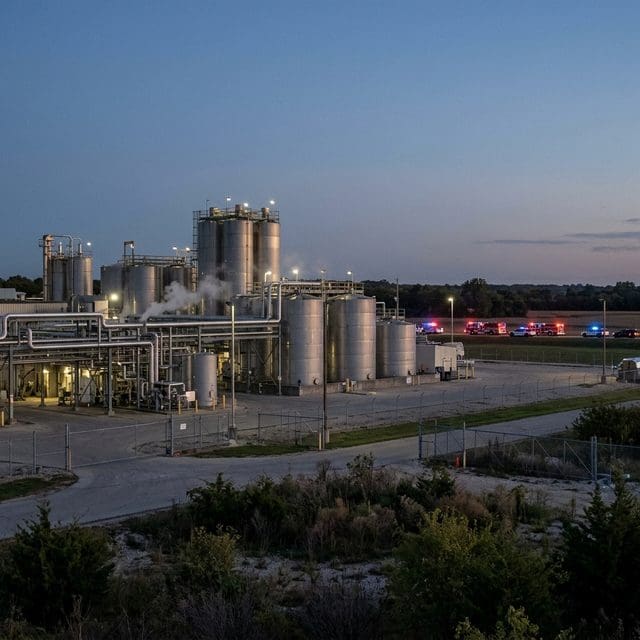
In Peoria, Illinois, a bomb was found at BioUrja Renewables’ ethanol plant and later defused, The Guardian reported. The FBI is investigating. The report does not establish a motive, identify a suspect or indicate a broader threat to ethanol facilities. The incident underscores the importance of secure production sites and reliable operations, but its impact on fuel supply is not known.
The Strait of Hormuz presents a separate risk. Iran’s military said three oil tankers struck mines and caught fire, CBS News reported Saturday. CBS said the claim could not be independently verified; Iran did not identify the vessels. The available reporting provides no independently confirmed account of the incidents or damage. That caution matters: claims of attacks can unsettle shippers and traders, but the reports should not be treated as confirmed events.
The wider oil outlook offers no guarantee of lower prices. Global supply is expected to exceed demand for the first time since the Iran war began in February 2026, according to MarketWatch and Axios. Prices may still remain high. A projected surplus does not ensure that fuel will be available wherever it is needed, and geopolitical risks and shipping access can shape prices alongside the overall balance of supply and demand.
For consumers and businesses, reliability and delivery matter as well as the amount of oil produced. The surplus is a forecast, not a promise of cheaper fuel, while the tanker reports remain unverified. Policymakers face a similarly practical test: emissions goals need transparent accounting and workable steps, while energy security depends on resilient infrastructure and dependable supply. The developments provide no single verdict on energy policy, but they show why cost, reliability and emissions cannot be assessed in isolation.

Mark Davis serves as the Senior Correspondent for Energy, Climate, and Resource Economics at Just Right News. In an era where the conversation around the environment is often dominated by alarmism and top-down mandates, Mark provides a vital, market-oriented perspective on the complex forces shaping our world. As the lead voice behind the acclaimed feature series “Power and the Planet,” he explores the intersection of environmental policy, global energy markets, and the fundamental economic principles that sustain modern civilization.
Mark’s pragmatic approach to resource management was forged in the high desert of his hometown, Albuquerque, New Mexico. Growing up in a region defined by both its breathtaking natural beauty and its rugged, resource-dependent landscape, he developed an early appreciation for the delicate balance between conservation and utilization. New Mexico’s unique position as a hub for both traditional energy production and cutting-edge scientific research provided Mark with a front-row seat to the evolution of the American energy sector. This upbringing instilled in him a deep-seated belief that true environmental stewardship is inseparable from economic prosperity and technological innovation.
Now based in Boulder, Colorado, Mark operates from the heart of the nation’s climate research community. While Boulder is often seen as a bastion of environmental idealism, Mark utilizes his post to provide a necessary counterweight, grounded in the realities of resource economics. He understands that energy policy does not exist in a vacuum; it has tangible consequences for the American taxpayer, the stability of the national power grid, and the strength of the domestic manufacturing sector. By reporting from the front lines of the climate debate, he is able to challenge prevailing narratives with hard data and a commitment to the principles of the free market.
Throughout his tenure at Just Right News, Mark has distinguished himself by focusing on the “Resource Economics” aspect of his beat. He frequently highlights the hidden costs of rapid energy transitions and advocates for an “all-of-the-above” energy strategy that prioritizes American energy independence. His work often shines a light on the geopolitical implications of resource scarcity, arguing that a secure nation must first be an energy-secure nation. Whether he is analyzing the impact of federal land-use regulations or investigating the supply chains required for new technologies, Mark remains focused on how policy decisions affect the lives and livelihoods of everyday citizens.
In “Power and the Planet,” Mark continues to bridge the gap between complex scientific concepts and the economic realities facing the country. He rejects the false choice between a healthy environment and a thriving economy, instead seeking out solutions that leverage American ingenuity and private-sector competition. For Mark, reporting on the climate is not about following the latest trends, but about ensuring that the conversation remains tethered to the foundational values of liberty, property rights, and fiscal responsibility. His contributions ensure that Just Right News readers receive a comprehensive, clear-eyed view of the challenges and opportunities defining the future of our planet.