

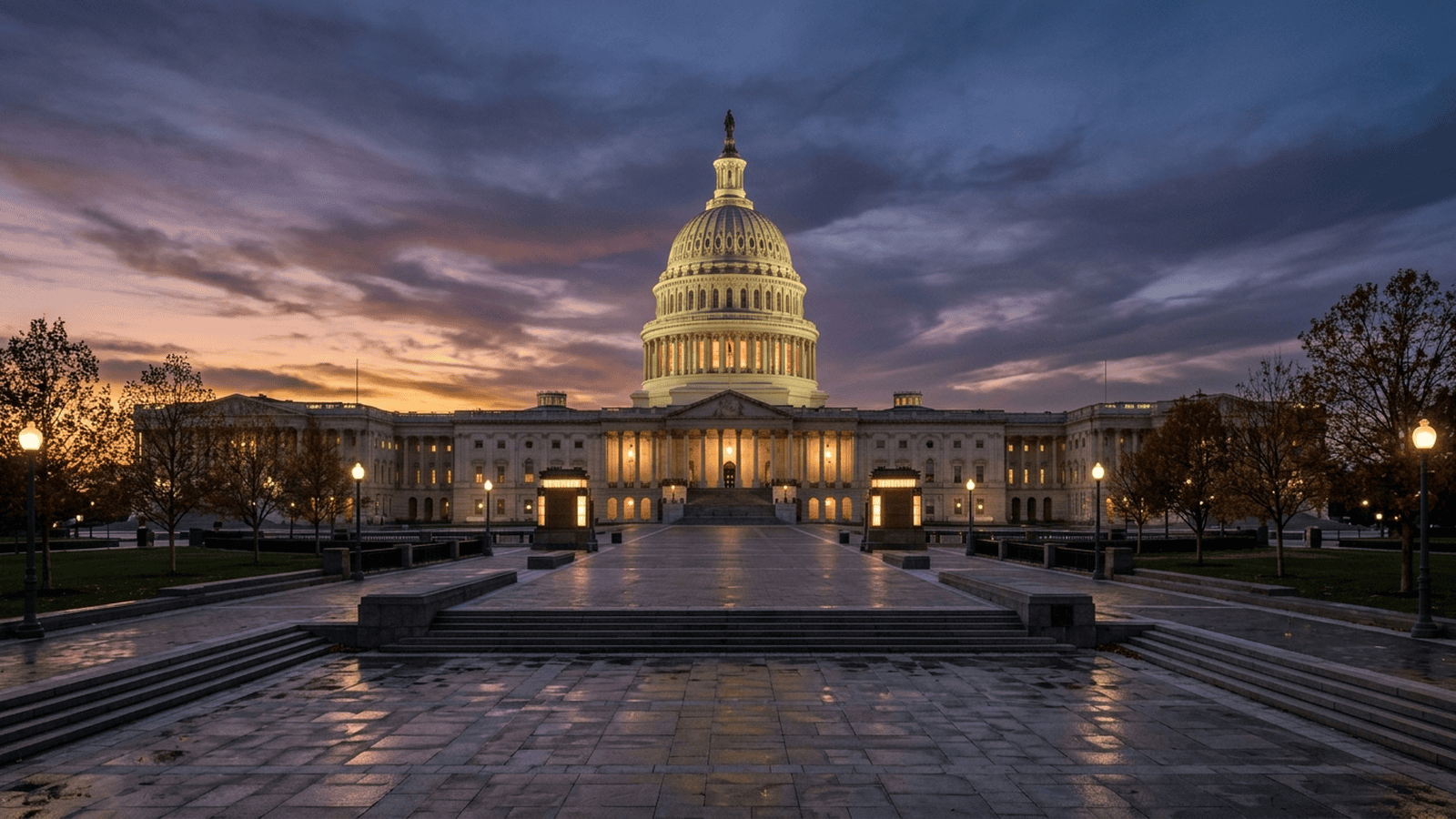
Democrats are poised to control both chambers of Congress after major victories in the 2026 midterms, reshaping Washington after two years of unified Republican government. The report cites higher prices and the Iran war as issues tied to the Republican losses, while President Trump says he will accept the results, work with Democrats, and retain his veto power. Democratic leaders have also signaled openness to talks. The election has implications for future education and workforce policy, but the report names no specific proposals, costs, paperwork, compliance rules, or deadlines in those areas. Control is established, while final chamber composition and the legislative agenda remain to be determined.
TLDR: The 2026 midterms put Democrats on course to control both chambers, creating a new balance of power for the final phase of President Trump’s term. Education and workforce proposals, their costs, and any implementation requirements are not specified in the report.
Democrats are poised to take control of both chambers of Congress after major victories in the 2026 midterm elections, according to the report. The results mark a sharp change from the two years of unified Republican government that came before them. President Donald Trump enters the final phase of his second term facing large Democratic majorities and a Congress with a different balance of power.
No single policy rationale explains the results. The report describes a broad voter rebuke of Trump and his party, while also identifying prices and the Iran war as issues raised by Republican leaders. Vice President J.D. Vance said the war was the reason Republicans lost and called for an honest party discussion. Trump said he would have handled the war no differently, but identified prices as a primary reason for the losses.
The results carry consequences for the president’s ability to advance his agenda. Trump said he would accept the election outcome and work with Democrats, while also pointing to his veto power. He said he did not want to spend the next two years vetoing everything. The report describes him as entering a lame-duck phase, but does not detail specific legislation he may seek to pass or veto.
Democratic leaders also signaled openness to talks. House Democratic Leader Hakeem Jeffries said he would sit down with the other side if it wanted to work toward the changes voters demanded. The report does not identify the exact education or workforce policies Democrats intend to pursue, or say which proposals could win enough support to become law. Any assessment of those areas must therefore distinguish the election result from future legislative action.
The shift was widespread. Democrats won major contests from Maine to the Carolinas, Michigan and Texas. In Texas, James Talarico won a Senate seat and Gina Hinojosa won the governor’s race, giving Democrats statewide victories there for the first time in nearly 40 years, according to the report. In Michigan, Abdul El-Sayed defeated Republican Mike Rogers in the Senate race. Maine Republican Senator Susan Collins conceded to Democrat Troy Jackson, and Kansas elected Democrat Adam Hamilton to the Senate, the state’s first Democratic senator in nearly a century.
Other results changed the makeup of Congress and state leadership. Chris Pappas of New Hampshire became the first openly gay man elected to the Senate in U.S. history, the report says. Juliana Stratton’s Illinois victory means three Black women will serve in the Senate for the first time. Gina Hinojosa is set to become Texas’ first Latina governor, while Deb Haaland is set to become the first Native American woman to lead a state. Melat Kiros is identified in the story kit as the first woman from Generation Z elected to Congress.
The election also delivered defeats for candidates associated with the Republican Party’s leadership. Darline Graham, whom Trump had selected for a South Carolina race, lost her bid. Florida Governor Ron DeSantis described the scale of Republican losses as unusually severe. These results show that party backing and established political ties did not guarantee victories in the contests described.
For education and workforce policy, the practical implications remain uncertain. The report contains no specific school, training, hiring, or labor proposals from the incoming congressional majority. It also provides no new fees, paperwork requirements, compliance rules, enforcement plans, or implementation deadlines. Those details are not established by the election results and remain part of the plan for future legislative decisions, rather than confirmed impacts on schools, workers, families, or employers.
Control of Congress is set, but the exact composition of the House and Senate will take time to determine, according to the story kit. That distinction matters: Democrats’ victories give them control, but the report does not specify the final seat counts or establish what legislation will pass. The president’s stated willingness to work across the aisle sits alongside his stated readiness to use the veto, leaving the next steps dependent on negotiations and congressional action.
The immediate next steps are the completion of the remaining count and the transition to the new congressional balance. No policy deadlines or formal oversight procedures are given in the report. Further details about education and workforce proposals, their costs, and any requirements for affected institutions or people have not yet been provided. Those are necessary steps for assessing how the election will translate into policy and for tracking what the new Congress actually does.
Daniel Owens serves as a Senior Correspondent for Just Right News, where he leads the newsroom’s coverage of Education, Workforce, and Upward Mobility. In an era where the national conversation often overlooks the practical foundations of success, Owens brings a principled perspective to the forefront of the media landscape. His work is defined by a commitment to the idea that a strong society is built on the pillars of quality education, a robust work ethic, and the removal of bureaucratic barriers to individual achievement.
Born and raised in Cleveland, Ohio, Owens’s worldview was shaped by the industrial landscape of the Midwest. Growing up in a city known for its grit and resilience, he witnessed firsthand the transformative power of steady employment and the devastating effects of economic stagnation. This background instilled in him a deep respect for the American worker and a healthy skepticism toward top-down government solutions that often fail to reach the communities they intend to help. As an African American man who has navigated the path to professional success, Owens approaches his beat with a nuanced understanding of how meritocracy and personal responsibility intersect with opportunity. He frequently draws on his roots to highlight the importance of family stability and community-led initiatives in fostering the next generation of leaders.
At Just Right News, Owens is the architect of the acclaimed feature series, “The Learning Curve.” Through this platform, he explores the evolving landscape of American schooling, from the rise of the school choice movement to the revitalization of trade schools and vocational training. He frequently challenges the status quo of higher education, advocating for a return to academic rigor and the practical alignment of degrees with market demands. For Owens, education is not merely about obtaining credentials; it is about equipping young people with the tools necessary to lead self-sufficient, meaningful lives. His reporting on “The Learning Curve” has become essential reading for parents and policymakers who believe that educational competition and parental rights are the keys to a brighter future.
Now based in Raleigh, North Carolina, Owens finds himself at the heart of one of the nation’s most dynamic regions for innovation and growth. Raleigh’s unique blend of traditional values and a fast-paced economy provides the perfect backdrop for his reporting on the modern workforce. From the tech hubs of the Research Triangle to the rural communities of the South, he tracks how shifts in the economy are impacting families and local industries. His reporting often highlights the success stories of entrepreneurs and workers who are thriving by embracing the values of hard work and innovation.
Throughout his career, Daniel Owens has remained a steadfast voice for the student seeking a better path and the worker striving for a better life. His reporting for Just Right News serves as a vital resource for readers who value common-sense solutions to the challenges of the 21st-century economy. By focusing on the intersection of policy and the human spirit, Owens continues to provide a roadmap for how individuals and communities can achieve lasting upward mobility.