

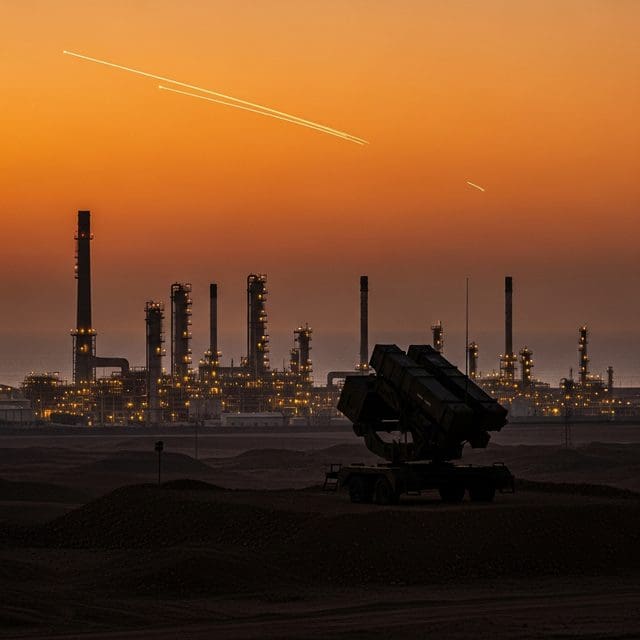
Saudi air defenses intercepted ballistic missiles targeting Yanbu refineries as Houthi militants expand their campaign against energy infrastructure, driving global crude prices past the $100 threshold.
The global energy landscape is currently navigating a period of intense volatility as military escalations in the Middle East create a dual-front crisis for oil supplies. On July 25, Saudi Arabian air defenses, utilizing a Greek-operated Patriot battery deployed since 2021, intercepted two ballistic missiles and a drone launched from Yemen. The targets were oil refineries in Yanbu, a critical Red Sea hub that serves as a vital alternative to the Persian Gulf for Saudi crude exports. While no damage was reported, the psychological impact on the market was immediate, reinforcing fears that energy infrastructure is now the primary theater of regional conflict.
This latest strike follows a series of aggressive maneuvers by Iran-backed Houthi militants, who claimed to have blockaded Red Sea cities using dozens of drones and missiles. These actions coincide with a broader U.S. naval blockade of Iran initiated by the Trump administration earlier this month. The result has been a dramatic surge in crude prices. After climbing to $83 per barrel on July 13, prices broke the $95 mark by July 22 as military tensions escalated. By July 23, following reports of Houthi attacks on Saudi tankers and the subsequent threat to the Bab al-Mandeb strait, global oil prices officially topped $100 per barrel.
For the American taxpayer, these geopolitical shifts have direct consequences at the pump. The U.S. national average for gasoline climbed above $4 per gallon on July 20. Although a brief lull occurred when reports of a potential cease-fire surfaced, driving prices down to $87, the continued use of low-cost drone technology to strike high-value refineries has kept the risk premium at historic highs. Analysts note that the democratization of precision strike technology has made it significantly cheaper for non-state actors to disrupt global supply chains, a reality that is now baked into the $100-plus price floor.
In Europe, the reaction to this instability is shifting from climate-centric policy to hard energy security. Italian Prime Minister Giorgia Meloni is reportedly preparing an expansive energy and defense spending plan. According to reports from Corriere della Sera, the Meloni government views this as a necessary measure to insulate the Italian economy from external shocks ahead of the 2027 general elections. This pivot reflects a broader European trend where the reliability of the electric grid and the security of fuel imports are being prioritized alongside, or even ahead of, traditional emissions targets.
France is facing its own set of challenges as apocalyptic wildfires have reignited debates over the resilience of the national energy grid and the impacts of climate volatility. While the French government has not yet announced a formal emergency stockpile release, the pressure to accelerate non-fossil energy independence is mounting. However, the immediate economic reality is dominated by the cost of the barrel. The intersection of these energy spikes with new U.S. trade policies—including a round of tariffs up to 12.5% on 60 trading partners effective July 24—threatens to create a stagflationary environment for global manufacturing.
As the Strait of Hormuz remains a flashpoint and the Red Sea becomes a second front, the pragmatism of energy independence is being tested. While localized projects, such as the $1.1 million in scholarships awarded by NTEC to Navajo students or new solar installations in Indian hospitals, show a move toward diversified energy futures, the global economy remains tethered to the security of Middle Eastern refineries. The current crisis underscores a harsh reality: without a secure and reliable supply of affordable energy, the broader economic and environmental goals of the West remain vulnerable to the whims of regional conflict.

Mark Davis serves as the Senior Correspondent for Energy, Climate, and Resource Economics at Just Right News. In an era where the conversation around the environment is often dominated by alarmism and top-down mandates, Mark provides a vital, market-oriented perspective on the complex forces shaping our world. As the lead voice behind the acclaimed feature series “Power and the Planet,” he explores the intersection of environmental policy, global energy markets, and the fundamental economic principles that sustain modern civilization.
Mark’s pragmatic approach to resource management was forged in the high desert of his hometown, Albuquerque, New Mexico. Growing up in a region defined by both its breathtaking natural beauty and its rugged, resource-dependent landscape, he developed an early appreciation for the delicate balance between conservation and utilization. New Mexico’s unique position as a hub for both traditional energy production and cutting-edge scientific research provided Mark with a front-row seat to the evolution of the American energy sector. This upbringing instilled in him a deep-seated belief that true environmental stewardship is inseparable from economic prosperity and technological innovation.
Now based in Boulder, Colorado, Mark operates from the heart of the nation’s climate research community. While Boulder is often seen as a bastion of environmental idealism, Mark utilizes his post to provide a necessary counterweight, grounded in the realities of resource economics. He understands that energy policy does not exist in a vacuum; it has tangible consequences for the American taxpayer, the stability of the national power grid, and the strength of the domestic manufacturing sector. By reporting from the front lines of the climate debate, he is able to challenge prevailing narratives with hard data and a commitment to the principles of the free market.
Throughout his tenure at Just Right News, Mark has distinguished himself by focusing on the “Resource Economics” aspect of his beat. He frequently highlights the hidden costs of rapid energy transitions and advocates for an “all-of-the-above” energy strategy that prioritizes American energy independence. His work often shines a light on the geopolitical implications of resource scarcity, arguing that a secure nation must first be an energy-secure nation. Whether he is analyzing the impact of federal land-use regulations or investigating the supply chains required for new technologies, Mark remains focused on how policy decisions affect the lives and livelihoods of everyday citizens.
In “Power and the Planet,” Mark continues to bridge the gap between complex scientific concepts and the economic realities facing the country. He rejects the false choice between a healthy environment and a thriving economy, instead seeking out solutions that leverage American ingenuity and private-sector competition. For Mark, reporting on the climate is not about following the latest trends, but about ensuring that the conversation remains tethered to the foundational values of liberty, property rights, and fiscal responsibility. His contributions ensure that Just Right News readers receive a comprehensive, clear-eyed view of the challenges and opportunities defining the future of our planet.