

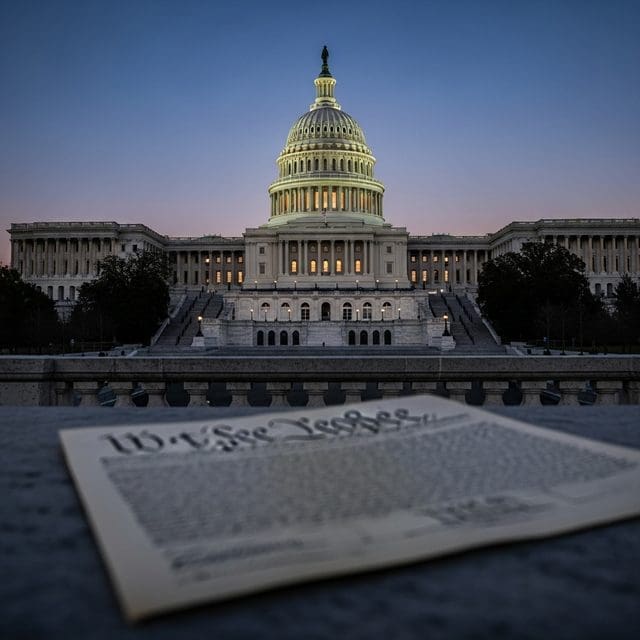
The House passed a resolution demanding congressional authorization for the Iran conflict while a controversial Saudi nuclear pact, potentially tied to the Abraham Accords, enters a high-stakes 90-day review period.
The constitutional struggle over the separation of powers intensified on Capitol Hill this week as the House of Representatives passed a nonbinding resolution directing the executive branch to halt military hostilities against Iran. The 214–208 vote, which saw four Republicans join the Democratic majority, asserts that the current conflict remains unauthorized by Congress. While the measure is largely symbolic and failed to gain traction in the Senate, it highlights a growing bipartisan skepticism regarding the administration’s management of a regional conflict that has claimed at least 18 American lives as of July 22.
This legislative friction occurs as the House simultaneously navigates a narrow $95 billion budget reconciliation package. The bill, which passed 216–214, allocates $73 billion for the Iran war and $12 billion in farm aid, but also includes a contentious $10 billion fund to incentivize states to adopt stricter voting rules under the SAVE America Act. Senate Majority Leader John Thune has already indicated that the upper chamber lacks the votes to advance this House-passed resolution, signaling a looming stalemate over federal spending and the limits of executive priorities. The House also took the symbolic step of renaming the Defense Department to the Department of War in the fiscal 2027 National Defense Authorization Act, reflecting a shift toward a more traditional, if more aggressive, posture.
Parallel to the debate over kinetic warfare, a new front has opened regarding nuclear proliferation. The administration has submitted a U.S.-Saudi civil nuclear cooperation agreement to Congress for a mandatory 90-day review. The pact, signed on July 22, has sparked immediate concern among nonproliferation experts and several Democratic lawmakers. Central to the controversy is whether the deal permits Saudi Arabia to enrich its own uranium—a capability that significantly shortens the timeline for developing nuclear weaponry. This marks a major shift from past U.S. policy that sought to keep enrichment capabilities out of Saudi hands to prevent a regional arms race.
President Trump added a layer of diplomatic complexity on July 23, stating that the nuclear agreement is “totally subject” to Saudi Arabia joining the Abraham Accords and normalizing relations with Israel. While Israeli Prime Minister Benjamin Netanyahu has welcomed this linkage, the administration’s messaging remains inconsistent. One account suggests the deal prohibits domestic enrichment, while earlier reports indicated it might allow such activities under limited International Atomic Energy Agency safeguards. This ambiguity has sharpened the focus of nonproliferation experts who warn that the agreement lacks the necessary guardrails to prevent enrichment to weapons-grade levels.
Under the law, the nuclear agreement will automatically take effect after 90 session days unless Congress passes a joint resolution of disapproval. With the Senate Foreign Relations Committee expected to take up the matter in the autumn, the administration faces a dual challenge: maintaining a multi-front military engagement in the Middle East while convincing a skeptical Congress that its nuclear diplomacy will not trigger a regional arms race. The announcement has also drawn criticism from 9/11 families who oppose closer ties with Riyadh while litigation regarding the 2001 attacks remains ongoing.
For constitutionalists, the coming months represent a critical test of whether the legislative branch will reclaim its role in overseeing both the purse strings and the power to commit the nation to foreign entanglements. As the federal appeals court blocks the administration from revoking temporary protected status for Haitians and the Transpacific Future Center establishes a permanent presence in Washington, the broader administrative state remains in a state of flux. The tension between the White House and the Capitol over the Iran conflict and the Saudi nuclear pact underscores a fundamental debate about the reach of executive power in the 21st century.

Miles Harrington serves as the Senior Correspondent for Federal Systems & Executive Power at Just Right News, where he brings a disciplined, constitutionalist lens to the inner workings of the American government. With a focus on the mechanics of the federal bureaucracy and the limits of executive authority, Harrington has established himself as a vital voice for readers who value transparency, accountability, and the preservation of the separation of powers.
A native of Richmond, Virginia, Harrington’s perspective is deeply rooted in the traditions of the Old Dominion. Growing up in a city defined by its historical significance and its role as a center of American jurisprudence, he developed an early appreciation for the foundational principles of the Republic. His upbringing in Richmond—a place where the legacy of the Founding Fathers is woven into the landscape—instilled in him a belief that the federal government should remain within its constitutional bounds. This background informs his skepticism of centralized overreach and his commitment to reporting on the ways in which the administrative state impacts the lives of everyday citizens.
In his current role, Harrington specializes in the complexities of federal systems. He doesn’t just report on the headlines of the day; he digs into the structural shifts within the executive branch that often go unnoticed by the mainstream press. Whether he is analyzing the implications of a new federal regulation or investigating the expansion of agency jurisdiction, his work is characterized by a rigorous adherence to the facts and a dedication to the rule of law.
Harrington is perhaps best known for his signature feature series, “How Washington Works.” Through this ongoing project, he demystifies the often-opaque processes of the nation’s capital, pulling back the curtain on the “Deep State” and the unelected officials who wield significant influence over national policy. By breaking down complex legislative maneuvers and executive orders, he empowers Just Right News readers to understand the true levers of power in Washington. His reporting serves as a necessary check on the federal government, ensuring that the actions of those in power are held up to the light of public scrutiny.
Now based in Washington, D.C., Harrington operates at the epicenter of the political world, yet he remains intentionally distanced from the “Beltway bubble.” His proximity to the halls of power allows him to maintain a robust network of sources across the federal landscape, but his heart remains in the principled conservatism of his Virginia roots. He views his role not merely as a reporter, but as a steward of the public trust, dedicated to providing the clarity and context that conservative voters need to navigate an increasingly complex political environment.
Through his sharp analysis and unwavering commitment to the truth, Miles Harrington continues to be a cornerstone of the Just Right News team. His work ensures that the principles of limited government and executive restraint remain at the forefront of the national conversation, providing a crucial service to those who believe in a government that is truly of, by, and for the people.