

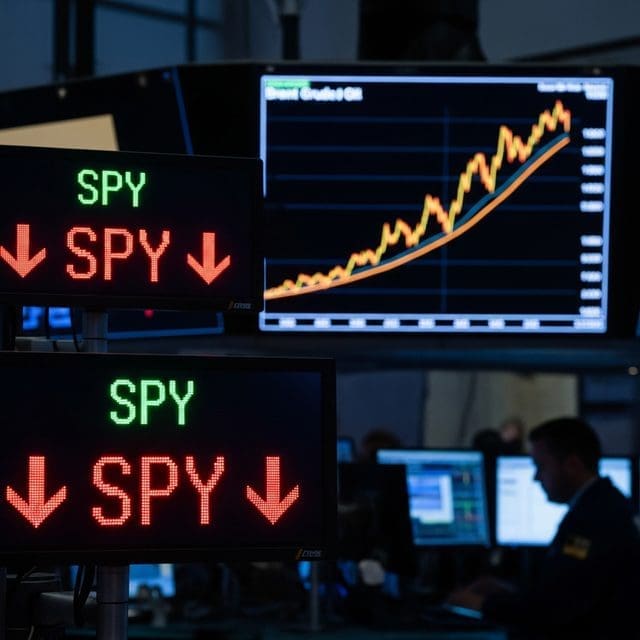
Global markets face a dual threat as surging crude prices ignite inflation fears while massive capital spending in the tech sector fails to satisfy nervous investors.
The American taxpayer is once again caught between geopolitical instability and central bank intervention. As of July 23, 2026, the S&P 500 ETF (SPY) is trading down 0.09%, a modest figure masking a volatile undercurrent. The primary driver of this unease is Brent crude, which has surged 4% to nearly $98 per barrel. With the $100 threshold in sight, the specter of higher-for-longer inflation is forcing a painful repricing of risk across all asset classes.
Energy costs are skyrocketing due to the collapse of the OPEC+ agreement and a tightening naval blockade in the Strait of Hormuz. Following military strikes involving U.S. forces and Iran, the Trump administration is weighing a massive joint military campaign with Israel or a ceasefire to reopen the waterway. Crude prices, which sat below $87 recently on ceasefire rumors, rebounded aggressively as military escalation continued. For working households, this translates to more than pain at the pump; it is driving Treasury yields to 17-week highs. The 2-year Treasury note is hovering around 4.30%, while the 10-year yield sits near 4.65%, siphoning capital away from productive equity investments.
In the technology sector, the narrative of endless growth is meeting the reality of exorbitant costs. Alphabet recently announced a $15 billion increase in capital expenditures for 2026 to support artificial intelligence. Rather than applauding the investment, the market shaved over 5% off Alphabet’s valuation, signaling skepticism regarding the immediate return on AI spending. This sentiment was further dampened by STMicroelectronics, which saw its shares plunge 15% following disappointing guidance, dragging the broader semiconductor sector down and pulling the Nasdaq lower. Even as Nvidia CEO Jensen Huang defends the use of Chinese open-source AI models, the market remains fixated on the high cost of maintaining technological dominance.
Currency markets reflect this flight to safety. The U.S. dollar remains firm, while the Japanese yen has languished at a 40-year low. This imbalance, coupled with the administration’s decision to invoke a provision of the 1930 Smoot-Hawley Tariff Act against Canada over export disputes, suggests a shift toward a more protectionist trade environment. These tensions, combined with securities class action lawsuits hitting firms like Verra Mobility Corporation and GeneDx Holdings, add layers of litigation risk to a fragile corporate landscape.
While the broader equity market wobbles, pockets of resilience highlight an uneven economy. Real estate remains a notable outlier; Miami-Dade posted its strongest June sales in three years, and Texas median home prices held steady at $340,000 despite rising rates. Furthermore, institutional shifts like the National Equity Fund’s acquisition of the St. Louis Equity Fund Portfolio suggest that while the ‘Invisible Economy’ of Wall Street is in turmoil, hard assets still command interest. However, for the average investor, these gains are overshadowed by the macro headwinds of rising borrowing costs.
For the domestic observer, the message is clear: the era of cheap energy and easy money is being replaced by a regime of high yields and geopolitical premiums. As the European Central Bank prepares for its next move—with markets pricing in an 80% chance of a September hike—the pressure on global liquidity will intensify. Germany’s 10-year Bund yield has already hit its highest level since 2011 at 3.2%. Until there is a de-escalation in the Middle East or a pivot toward fiscal discipline, the broader markets are likely to remain pinned under these systemic pressures, leaving the SPY struggling for direction.

Jordan Lee serves as the Senior Correspondent for Wall Street, Finance, and Monetary Systems at Just Right News. Based in the heart of the world’s financial capital, New York City, Lee brings a sharp, principled eye to the complex mechanisms that drive the global economy. His reporting is defined by a commitment to fiscal responsibility, the defense of the free market, and a deep-seated belief that a transparent monetary system is the bedrock of a free society.
Raised in Portland, Oregon, Lee’s perspective was forged in a city that has undergone significant cultural and economic shifts. His upbringing in the Pacific Northwest instilled in him a profound appreciation for the industriousness of small business owners and the importance of local economic stability. Watching the evolution of his hometown’s landscape sparked an early interest in how federal fiscal policy and large-scale financial trends eventually trickle down to the average citizen. This background provides him with a unique vantage point; he understands the growing disconnect between the policy-making elite and the reality of Main Street, a theme that frequently resonates throughout his work.
Now operating from his base in New York City, Lee bridges the gap between the high-stakes trading floors of Manhattan and the households of everyday Americans. He views the financial sector not merely as a collection of numbers and tickers, but as a vital engine of American prosperity that requires constant vigilance and accountability. His reporting often highlights the dangers of centralized financial control and the necessity of maintaining a system that rewards merit, risk-taking, and innovation.
As the creator and lead of the featured series, “The Invisible Economy,” Lee pulls back the curtain on the often-opaque world of monetary systems. He specializes in translating the dense jargon of central banking and international finance into actionable insights for the Just Right News audience. His work explores the “invisible” forces—such as inflationary pressures, regulatory creep, and the expansion of the administrative state—that erode the purchasing power of American families. By focusing on these systemic issues, Lee empowers readers to understand the hidden forces shaping their financial independence.
Lee’s journalistic philosophy is rooted in a steadfast commitment to traditional American values. As an Asian American professional who has navigated the competitive corridors of the financial world, he is a vocal advocate for meritocracy and the preservation of the American Dream. He believes that a stable currency and a predictable regulatory environment are essential for national sovereignty and individual liberty. His reporting frequently warns against the risks of government overreach in the private sector, arguing that the most effective solutions to economic challenges arise from competition and individual enterprise rather than bureaucratic mandates.
At Just Right News, Jordan Lee remains dedicated to providing a clear-eyed defense of the taxpayer. Whether he is analyzing market volatility or investigating the long-term implications of national debt, his mission is to provide the truth about where the money is going and what it means for the future of the country. Through his rigorous analysis and principled stance, Lee has become a trusted voice for those who value a strong, sovereign, and fiscally sound America.