

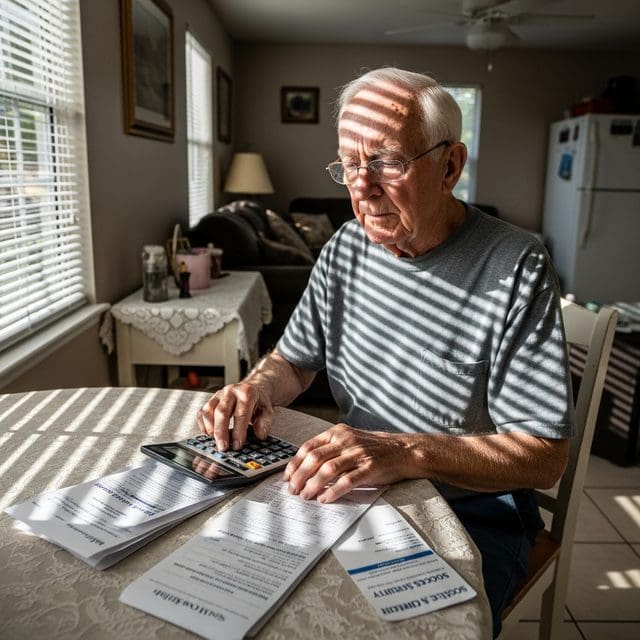
Surging costs in Florida have pushed the required retirement savings past $1.1 million, exposing a widening mobility gap for seniors reliant on a strained Social Security system.
The promise of a dignified retirement in the Sunshine State is increasingly becoming a luxury reserved for the wealthy, as new data reveals a staggering shift in the cost of independence. A comfortable retirement in Florida now requires a nest egg exceeding $1.1 million for the typical couple, a figure driven upward by relentless increases in housing, insurance, and healthcare. For those who have spent a lifetime in the workforce, the target for a stable lifestyle has shifted to an annual spending need of approximately $81,825, a threshold many find nearly impossible to reach through traditional savings alone.
This financial reality exposes a stark divide in the American social safety net. While Social Security was designed to be a foundation for the elderly, it was never intended to be a sole source of support. In the current economic climate, the program’s benefit structure is inadvertently widening the wealth gap. Higher-income couples with two full Social Security records can often navigate retirement with smaller private savings, while lower-earning households or single retirees—who rely on a single primary benefit—find themselves falling further behind the cost-of-living curve. This disparity illustrates how lifetime earnings and the specific architecture of federal benefits drive retirement mobility and long-term security.
The pressure on low-income seniors and the working class is being compounded by global energy volatility and corporate retrenchment. Following the collapse of the OPEC+ production agreement and the subsequent U.S. naval blockade on Iran on July 13, 2026, crude oil prices surged 9% to roughly $83 per barrel. These global shifts manifest locally at the pump and in utility bills, disproportionately affecting those on fixed incomes. As energy giants like BP continue to divest from retail mobility—most recently selling their Austrian retail network of 250 sites to Volenergy AG to streamline corporate portfolios—the downstream reality for consumers remains one of persistent price pressure. BP’s multi-year exit from European retail, including previous sales in the Netherlands and Switzerland, mirrors a broader corporate shift away from the direct consumer interface, often leaving local markets vulnerable to price fluctuations.
For many Floridians, the interaction between federal supports like SNAP, SSI, and Social Security is becoming the primary determinant of economic mobility. When the cost of basic necessities outpaces benefit adjustments, the safety net functions less like a springboard and more like a tether. There is a missing thread in the national conversation regarding how recent inflation and rising insurance premiums are reshaping the real value of these benefits. In Florida, where state-specific pressures are particularly acute, the current coverage gap between what the government provides and what life actually costs is widening at an alarming rate.
True economic resilience requires a sober look at these numbers. If the baseline for comfort has moved to seven figures, the path to independence for the working class must be reinforced through robust local economies and fiscal discipline. The restorative power of hard work is diminished when the goalposts for a secure old age are moved by forces beyond a worker’s control. Without a focus on reducing the cost of living and encouraging private savings early in a career, the dream of a self-sufficient retirement may drift out of reach for those who have worked their entire lives to achieve it.
As the nation watches the fallout from military strikes in the Middle East and the resulting energy shocks, the domestic focus must remain on the dignity of the individual. The social safety net should serve as a temporary bridge to mobility, but for many Florida seniors, it has become a permanent, albeit fragile, lifeline. Addressing the wealth gap requires more than just top-down intervention; it requires a commitment to maintaining the purchasing power of the American worker and ensuring that the fruits of a lifetime of labor are not swallowed by bureaucracy and inflation.

James Foster serves as the Senior Correspondent for Inequality and the Social Safety Net at Just Right News, where he brings a principled and nuanced perspective to the most pressing economic challenges facing the nation. With a career dedicated to exploring the intersection of policy and personal responsibility, Foster has become a leading voice in documenting how government programs and economic shifts impact the American family. His reporting is characterized by a commitment to the “human element,” moving beyond cold statistics to highlight the stories of resilience, work, and community that define the modern American experience.
Foster’s perspective is deeply rooted in his upbringing in Birmingham, Alabama. Growing up in a city with a rich industrial heritage and a history of economic transformation, he witnessed firsthand the importance of the dignity of work and the strength of local institutions. In Birmingham, he saw how the most effective safety nets were often those woven by neighbors, faith-based organizations, and local civic groups. This background instilled in him a lifelong skepticism of “one-size-fits-all” solutions from distant bureaucracies, favoring instead the localized, community-driven support systems that he frequently champions in his writing.
Now based in Atlanta, Georgia, Foster operates from one of the most dynamic and rapidly evolving metropolitan hubs in the South. His location provides a front-row seat to the stark contrasts of the modern economy. From the gleaming towers of Atlanta’s financial districts to the struggling neighborhoods on the city’s periphery, Foster finds the stories that illustrate the complexities of upward mobility. His reporting from the Sun Belt serves as a microcosm for the national debate on poverty, highlighting how inflation, housing costs, and labor market shifts affect the working class in real-time.
As the lead for the acclaimed feature series “America’s Balancing Act,” Foster explores the delicate tension between providing a necessary hand up and fostering long-term independence. The series has become a cornerstone of Just Right News, offering a deep dive into the unintended consequences of social welfare policies. Foster’s work often focuses on the “cliff effect” and other systemic hurdles that can inadvertently discourage employment, arguing that true compassion is measured by how many people are empowered to leave the safety net, rather than how many are added to it.
Throughout his tenure, Foster has remained dedicated to the mission of Just Right News, providing a clear-eyed, conservative analysis of social issues. He believes that a free society thrives when individuals are empowered and the private sector is allowed to innovate. Whether he is interviewing small business owners about the challenges of a changing workforce or documenting the success of private charitable initiatives, Foster’s goal is to provide readers with the truth about the state of the American Dream. His work serves as a vital reminder that while the challenges of inequality are great, the solutions are often found in the strength of the American spirit and the preservation of traditional values.