

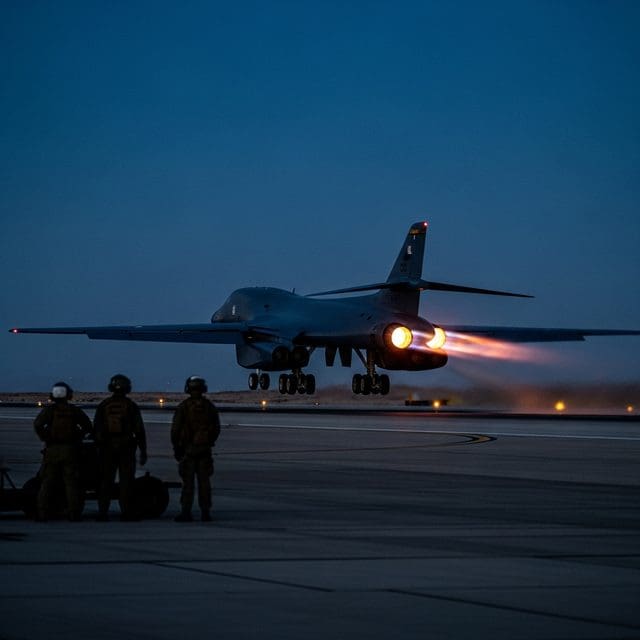
The Pentagon has launched heavy airstrikes against Iranian military infrastructure following the first direct Iranian fire to kill U.S. service members in the current conflict.
The Pentagon has shifted Middle East operations from maritime protection to direct kinetic retaliation following the deaths of three U.S. service members in Jordan and Iraq. U.S. Central Command confirmed that Iranian missile and drone barrages over the weekend evaded base defenses, marking the first time American troops have been killed by direct Iranian fire in the current theater. The Department of Defense identified two of the fallen as First Lt. Tyler Feehan and Pvt. Isabella Gonzales. A third service member remains missing, and dozens more were wounded.
In response, the Trump administration authorized a sustained air campaign targeting the Islamic Revolutionary Guard Corps (IRGC). Since July 18, U.S. strikes have focused on IRGC missile storage, coastal surveillance, and air defense batteries. These operations aim to degrade Tehran’s ability to threaten the Strait of Hormuz and punish units responsible for the casualties at Jordan’s Azraq Air Base. Officials signaled that further attacks are planned, moving beyond “freedom of navigation” messaging to a doctrine of direct retaliation for American casualties.
The IRGC claimed responsibility, asserting its forces destroyed U.S. aircraft in Jordan while striking installations in Kuwait and Bahrain. Tehran characterized these maneuvers as a “punitive response” to U.S. strikes on Iranian territory. The emergence of Jordan as a central theater signals a significant expansion of the conflict. While the administration focuses on neutralizing Iranian threats, it maintains a complex posture toward other powers. Despite the escalation, trade friction with China persists; exports of rare-earth magnets to the U.S. remain 20 percent below pre-trade war levels despite the Trump-Xi agreement.
Domestically, the administration continues filling key vacancies during this instability. Following the death of Senator Lindsey Graham on July 12, his sister, Darline Graham Nordone, was appointed to his seat. President Trump has asked Nordone to run in the special Republican primary, where she faces Rep. Ralph Norman. Simultaneously, attorney general nominee Todd Blanche faced rigorous confirmation hearings, meeting with Epstein accusers to satisfy Senate demands. Memorial services for Senator Graham are scheduled to begin July 28 in Washington and South Carolina.
The strategic reality for the Pentagon is now defined by the need to restore deterrence without triggering a total regional collapse. As the military pounds Iranian infrastructure, the administration is also streamlining domestic operations, including canceling automatic protections for imperiled species and halting offshore wind development on national security grounds. These moves reflect a realist shift toward prioritizing core defense and energy sovereignty while navigating the most significant direct military challenge from Iran in decades.

Olivia Kendall serves as the Senior Correspondent for Geopolitics, Defense, and Foreign Policy at Just Right News, where she provides a principled, conservative perspective on the complex forces shaping the global stage. With a career dedicated to deconstructing the intricacies of international relations, Kendall has become a trusted voice for readers who value national sovereignty, a robust military, and a foreign policy that prioritizes American interests above all else.
A native of Washington, D.C., Kendall’s professional journey is deeply rooted in her upbringing within the nation’s capital. Growing up in the epicenter of American political life, she developed an early and profound understanding of how policy is crafted and, more importantly, how it often fails to account for the values of the American heartland. This unique vantage point allowed her to witness firsthand the rise of globalist bureaucracies, fueling her commitment to reporting that champions the constitutional foundations of the United States. Her background as a British White American further informs her worldview, providing her with a keen appreciation for the Western tradition and the enduring importance of the “Special Relationship” in maintaining global stability.
Now based in Arlington, Virginia, Kendall operates from the doorstep of the Pentagon and the heart of the nation’s defense establishment. Her proximity to the decision-makers in the military and intelligence communities allows her to provide boots-on-the-ground reporting that is both timely and deeply informed. For Kendall, Arlington is more than just a base of operations; it is a daily reminder of the sacrifices made by the men and women in uniform. This connection to the defense community drives her rigorous coverage of military readiness and her advocacy for a “peace through strength” approach to diplomacy.
At Just Right News, Kendall is perhaps best known for her acclaimed feature series, “The World’s Shadow on America.” In this ongoing project, she explores the direct correlation between international developments and the daily lives of American citizens. Whether she is analyzing the encroachment of foreign adversaries in domestic supply chains or the impact of international treaties on local economies, Kendall’s work serves as a vital bridge between distant geopolitical shifts and their consequences at home. She rejects the notion that foreign policy is an abstract concern for elites, instead proving that what happens in the corridors of power in Brussels or Beijing has a tangible “shadow” that falls across every American doorstep.
Throughout her tenure, Kendall has remained a steadfast critic of international overreach and a vocal proponent of a clear-eyed, realistic foreign policy. She brings a sharp analytical mind to her beat, often challenging the prevailing narratives of the mainstream media to uncover the underlying truths that affect national security. Her reporting is characterized by a refusal to compromise on the truth and a dedication to the idea that a strong, secure America is the world’s best hope for liberty. As a Senior Correspondent, Olivia Kendall continues to lead the charge in providing the essential context and conservative insight necessary to navigate an increasingly volatile world.