

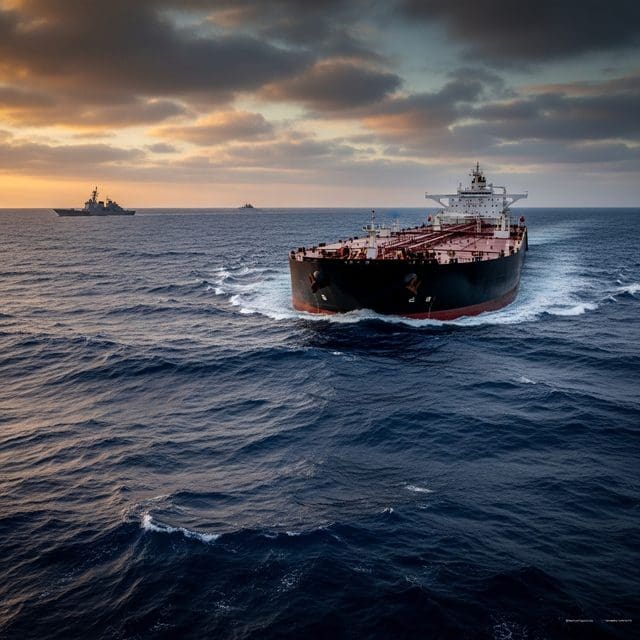
A U.S. naval blockade on Iran and tightening EU maritime emissions rules are creating a high-cost pincer movement for global energy shippers and consumers.
The global energy landscape is caught between geopolitical conflict and rigid climate policy. Following the July 13 announcement of a U.S. naval blockade on Iran, crude oil prices surged to approximately $83 per barrel. This escalation follows the collapse of an OPEC+ agreement that was contingent on a U.S.-Iran peace deal, a prospect that vanished after Iran resumed attacks in the Strait of Hormuz on July 7. President Trump declared the ceasefire over on July 8, with military strikes continuing through the week.
While the blockade aims to curb Iranian aggression, it has introduced immediate volatility. The human cost is also rising; two U.S. service members were killed in an Iranian ballistic missile attack on a Jordan airbase on July 19, bringing the total military death toll in this conflict to 16. For the American taxpayer, these disruptions translate to higher costs at the pump and increased supply risks as the military situation remains fluid and the risk of wider strikes on Iranian infrastructure persists.
Simultaneously, the European Union is tightening its Emissions Trading System (ETS). As of July 2026, shipping firms must surrender allowances for 70% of their 2025 emissions, rising to 100% by 2027. These rules now include methane and nitrous oxide, applying to 50% of emissions from voyages starting or ending outside the EU. This creates a specific cost overlay for energy traffic already being rerouted to avoid Middle East conflict zones. With the Strait of Hormuz and Red Sea routes under threat, the financial burden of ETS compliance on longer voyages around the Cape of Good Hope is straining maritime logistics.
European policymakers are attempting to balance these costs with a July 17 proposal for a targeted ETS revision, including a new Industrial Decarbonisation Bank. However, critics have labeled these reforms a “Trojan horse,” arguing they may slow emission cuts without providing immediate relief from price spikes. This debate unfolds as a severe continental heatwave pushes the electric grid toward a crisis, with temperatures hitting 40C in the UK while supply remains precarious.
Amid these systemic pressures, some resilience is emerging. Studies on Southern Right Whales suggest the species is more adaptable to warming oceans than previously thought, shifting diets as krill populations fluctuate. In technology, the FAA accepted nearly 40 new standards for power-lift aircraft on July 17, and Eve Air Mobility secured a letter of intent for 16 eVTOL aircraft, signaling a long-term pivot toward electrified transport despite current fossil fuel volatility.
The intersection of a naval blockade and tightening carbon regulations represents a pincer movement on energy economics. As the U.S. maintains its military posture and the EU holds its regulatory schedule, the market is pricing in both the risk of kinetic war and the certainty of climate surcharges. The era of cheap, frictionless energy movement has become a casualty of both geopolitical necessity and environmental mandate, leaving the global taxpayer to fund a more expensive energy future.

Mark Davis serves as the Senior Correspondent for Energy, Climate, and Resource Economics at Just Right News. In an era where the conversation around the environment is often dominated by alarmism and top-down mandates, Mark provides a vital, market-oriented perspective on the complex forces shaping our world. As the lead voice behind the acclaimed feature series “Power and the Planet,” he explores the intersection of environmental policy, global energy markets, and the fundamental economic principles that sustain modern civilization.
Mark’s pragmatic approach to resource management was forged in the high desert of his hometown, Albuquerque, New Mexico. Growing up in a region defined by both its breathtaking natural beauty and its rugged, resource-dependent landscape, he developed an early appreciation for the delicate balance between conservation and utilization. New Mexico’s unique position as a hub for both traditional energy production and cutting-edge scientific research provided Mark with a front-row seat to the evolution of the American energy sector. This upbringing instilled in him a deep-seated belief that true environmental stewardship is inseparable from economic prosperity and technological innovation.
Now based in Boulder, Colorado, Mark operates from the heart of the nation’s climate research community. While Boulder is often seen as a bastion of environmental idealism, Mark utilizes his post to provide a necessary counterweight, grounded in the realities of resource economics. He understands that energy policy does not exist in a vacuum; it has tangible consequences for the American taxpayer, the stability of the national power grid, and the strength of the domestic manufacturing sector. By reporting from the front lines of the climate debate, he is able to challenge prevailing narratives with hard data and a commitment to the principles of the free market.
Throughout his tenure at Just Right News, Mark has distinguished himself by focusing on the “Resource Economics” aspect of his beat. He frequently highlights the hidden costs of rapid energy transitions and advocates for an “all-of-the-above” energy strategy that prioritizes American energy independence. His work often shines a light on the geopolitical implications of resource scarcity, arguing that a secure nation must first be an energy-secure nation. Whether he is analyzing the impact of federal land-use regulations or investigating the supply chains required for new technologies, Mark remains focused on how policy decisions affect the lives and livelihoods of everyday citizens.
In “Power and the Planet,” Mark continues to bridge the gap between complex scientific concepts and the economic realities facing the country. He rejects the false choice between a healthy environment and a thriving economy, instead seeking out solutions that leverage American ingenuity and private-sector competition. For Mark, reporting on the climate is not about following the latest trends, but about ensuring that the conversation remains tethered to the foundational values of liberty, property rights, and fiscal responsibility. His contributions ensure that Just Right News readers receive a comprehensive, clear-eyed view of the challenges and opportunities defining the future of our planet.