

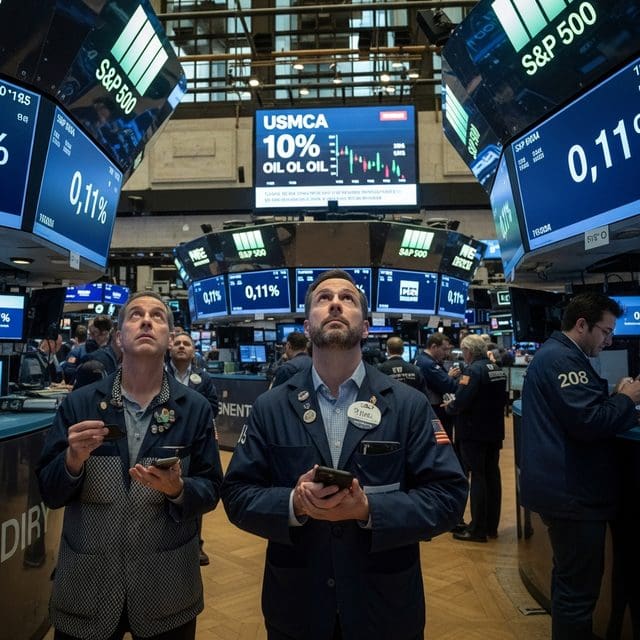
The SPY dipped 0.11% as the administration’s decision to exit the current USMCA framework balanced against a historic drop in oil prices and a record-breaking SpaceX IPO.
Financial markets exhibited a cautious stance on July 1, 2026, as the S&P 500 ETF Trust (SPY) hovered at -0.11% on the session. The marginal decline reflects a tug-of-war between geopolitical breakthroughs and a sudden shift in North American trade policy. For American households, the day’s volatility serves as a reminder that while energy costs are easing, the foundations of regional commerce are entering a period of profound renegotiation.
U.S. Trade Representative Jamieson Greer injected fresh uncertainty by announcing that the Trump administration will not renew the U.S.-Mexico-Canada Agreement (USMCA) in its current form. This decision to move away from the established trade framework prompted an immediate re-evaluation of supply chain costs. While the administration frames this as a necessary step for national sovereignty and the protection of domestic labor, Wall Street is pricing in the potential for increased tariffs and a disruption in the flow of goods. This trade pivot comes as the political landscape shifts, evidenced by Governor Josh Shapiro distancing himself from democratic socialist primary winners like Darializa Avila Chevalier, signaling a debate over the nation’s economic direction.
Counteracting these trade headwinds is a historic shift in the global energy sector. Following a memorandum of understanding between the U.S. and Iran, oil prices plummeted over 10% after confirmation that the Strait of Hormuz has reopened for transit without tolls. This memorandum includes a 60-day ceasefire extension involving Lebanon and provides relief to global shipping lanes. For Main Street, this collapse in crude prices offers a reprieve at the pump, potentially cooling the inflationary pressures that have dogged the domestic economy. The ceasefire, which began in mid-April, appears to be holding, allowing for a stabilization of the transport costs that govern the Invisible Economy.
In the capital markets, the technological sector received a massive liquidity injection via SpaceX. The company raised an unprecedented $75 billion in its IPO on June 11, achieving a valuation of approximately $1.77 trillion. The scale of the IPO has already drawn the attention of the legislative branch, with the first known congressional stock purchases surfacing shortly after the debut. This surge in private sector space investment highlights a shift toward high-growth frontier industries, even as traditional manufacturing sectors face trade-related questions. The IPO success suggests that despite trade jitters, there remains a deep appetite for American innovation and meritocratic achievement.
Institutional stability remained a focal point as the Supreme Court issued a ruling affirming the independence of the Federal Reserve. The Court determined that President Trump cannot immediately remove Federal Reserve Governor Lisa Cook, a decision that provides predictability for monetary policy. Investors favor a central bank insulated from direct political turnover, and this ruling helps maintain the credibility of the dollar in international FX markets. Simultaneously, the Court refused to overturn a jury verdict against the President regarding the E. Jean Carroll case, signaling that the judiciary continues to operate independently of executive preferences.
While the SPY’s minor retreat suggests a ‘wait-and-see’ approach, the underlying movement in commodities and trade policy indicates a restructuring of the American economic landscape. Working households are witnessing a transition where cheaper energy and high-tech capital raises are balanced against the risks of a more protectionist trade stance. As the nation prepares for its 250th anniversary, the tension between free-market expansion and centralized trade control remains the primary driver of market sentiment.

Jordan Lee serves as the Senior Correspondent for Wall Street, Finance, and Monetary Systems at Just Right News. Based in the heart of the world’s financial capital, New York City, Lee brings a sharp, principled eye to the complex mechanisms that drive the global economy. His reporting is defined by a commitment to fiscal responsibility, the defense of the free market, and a deep-seated belief that a transparent monetary system is the bedrock of a free society.
Raised in Portland, Oregon, Lee’s perspective was forged in a city that has undergone significant cultural and economic shifts. His upbringing in the Pacific Northwest instilled in him a profound appreciation for the industriousness of small business owners and the importance of local economic stability. Watching the evolution of his hometown’s landscape sparked an early interest in how federal fiscal policy and large-scale financial trends eventually trickle down to the average citizen. This background provides him with a unique vantage point; he understands the growing disconnect between the policy-making elite and the reality of Main Street, a theme that frequently resonates throughout his work.
Now operating from his base in New York City, Lee bridges the gap between the high-stakes trading floors of Manhattan and the households of everyday Americans. He views the financial sector not merely as a collection of numbers and tickers, but as a vital engine of American prosperity that requires constant vigilance and accountability. His reporting often highlights the dangers of centralized financial control and the necessity of maintaining a system that rewards merit, risk-taking, and innovation.
As the creator and lead of the featured series, “The Invisible Economy,” Lee pulls back the curtain on the often-opaque world of monetary systems. He specializes in translating the dense jargon of central banking and international finance into actionable insights for the Just Right News audience. His work explores the “invisible” forces—such as inflationary pressures, regulatory creep, and the expansion of the administrative state—that erode the purchasing power of American families. By focusing on these systemic issues, Lee empowers readers to understand the hidden forces shaping their financial independence.
Lee’s journalistic philosophy is rooted in a steadfast commitment to traditional American values. As an Asian American professional who has navigated the competitive corridors of the financial world, he is a vocal advocate for meritocracy and the preservation of the American Dream. He believes that a stable currency and a predictable regulatory environment are essential for national sovereignty and individual liberty. His reporting frequently warns against the risks of government overreach in the private sector, arguing that the most effective solutions to economic challenges arise from competition and individual enterprise rather than bureaucratic mandates.
At Just Right News, Jordan Lee remains dedicated to providing a clear-eyed defense of the taxpayer. Whether he is analyzing market volatility or investigating the long-term implications of national debt, his mission is to provide the truth about where the money is going and what it means for the future of the country. Through his rigorous analysis and principled stance, Lee has become a trusted voice for those who value a strong, sovereign, and fiscally sound America.