

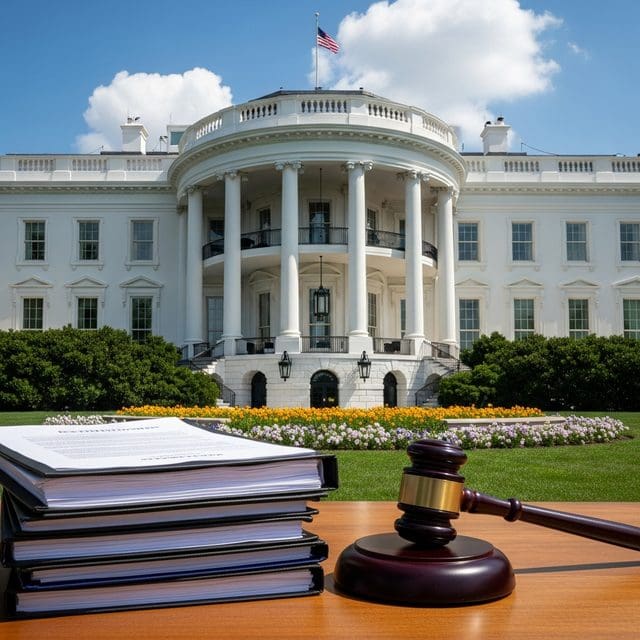
The White House is marking America’s 250th anniversary by institutionalizing permanent tax cuts and sweeping environmental permitting reforms while utilizing executive authority to reshape federal social policy.
As the nation observes its 250th anniversary, the Trump administration has moved to solidify a series of economic and regulatory shifts designed to constrain the administrative state and permanentize tax reductions. Official Treasury and White House data released this week claim that the Working Families Tax Cuts have provided $82 billion in direct relief over the past year. According to the administration, the policy prevented a projected $5 trillion tax hike that would have occurred upon the expiration of 2017-era provisions. The Treasury reports that nearly 97% of filers received a tax cut, with more than 29 million workers utilizing the “No Tax on Overtime” provision and over 7.5 million claiming “No Tax on Tips.”
Beyond the headline figures, the administration has moved to make the 20% small-business deduction permanent, a move they estimate will generate $750 billion in economic growth and support over one million new jobs. The Treasury Department reports $325 billion in total refunds for 2026, with an average refund of $3,300 per filer. While the White House frames these as wins for the middle class, congressional tax writers remain divided. House and Senate committees are currently circulating competing “myth vs. fact” analyses to determine if the benefits disproportionately favor middle-income households or higher earners, with Republicans claiming that 96% of recipients earn under $200,000 annually.
On the regulatory front, the Environmental Protection Agency and the Department of the Interior have finalized rules to streamline the National Environmental Policy Act (NEPA). These changes, which the White House describes as a “Win for All Americans,” impose strict two-year deadlines for environmental impact statements and tighter page limits. The EPA’s new implementation memorandum reforms how the agency issues comment letters under the Clean Air Act, effectively accelerating the review process for pipelines, highways, and energy projects. This implementation follows earlier Supreme Court rulings that narrowed the scope of federal environmental reviews, providing the administration with the legal footing to curb what it views as excessive bureaucratic delay.
Simultaneously, the executive branch is aggressively reshaping federal social policy through agency-level directives. Recent actions from the Department of Health and Human Services and the VA have begun phasing out federal support for gender-affirming care. These rules include removing such care from “essential benefits” under the Affordable Care Act and scheduling a full exclusion for federal employee health plans next year. The White House characterized these moves as a victory against “insanity,” following a Supreme Court decision that the administration views as an endorsement of its authority to define federal benefit standards. Litigation trackers indicate that these executive orders are already facing challenges in the lower courts.
In a separate use of executive power, President Trump issued an emergency proclamation to temporarily suspend import duties on phosphate fertilizer from Morocco. This action, grounded in emergency trade authority, is intended to address rising farm input costs and domestic supply concerns. The measure was paired with a detailed fact sheet signaling a full policy package rather than a mere rhetorical gesture. This move highlights the administration’s willingness to use delegated statutory powers to intervene in trade when domestic agricultural interests are at stake.
While the administration continues to push its domestic agenda, international and regional tensions persist. Iran’s Parliament Speaker recently warned of a response should the U.S. or Israel breach existing interim peace agreements. Domestically, regional issues such as a looming strike by Mass General Brigham Home Care clinicians and a record-setting year for drowning deaths in Florida provide a stark backdrop to the federal policy maneuvers. As President Trump prepares to deliver a rebuke of communism from Mount Rushmore, the administrative actions taken this week suggest a concerted effort to lock in a legacy of limited government and executive-led deregulation before the next legislative session.

Miles Harrington serves as the Senior Correspondent for Federal Systems & Executive Power at Just Right News, where he brings a disciplined, constitutionalist lens to the inner workings of the American government. With a focus on the mechanics of the federal bureaucracy and the limits of executive authority, Harrington has established himself as a vital voice for readers who value transparency, accountability, and the preservation of the separation of powers.
A native of Richmond, Virginia, Harrington’s perspective is deeply rooted in the traditions of the Old Dominion. Growing up in a city defined by its historical significance and its role as a center of American jurisprudence, he developed an early appreciation for the foundational principles of the Republic. His upbringing in Richmond—a place where the legacy of the Founding Fathers is woven into the landscape—instilled in him a belief that the federal government should remain within its constitutional bounds. This background informs his skepticism of centralized overreach and his commitment to reporting on the ways in which the administrative state impacts the lives of everyday citizens.
In his current role, Harrington specializes in the complexities of federal systems. He doesn’t just report on the headlines of the day; he digs into the structural shifts within the executive branch that often go unnoticed by the mainstream press. Whether he is analyzing the implications of a new federal regulation or investigating the expansion of agency jurisdiction, his work is characterized by a rigorous adherence to the facts and a dedication to the rule of law.
Harrington is perhaps best known for his signature feature series, “How Washington Works.” Through this ongoing project, he demystifies the often-opaque processes of the nation’s capital, pulling back the curtain on the “Deep State” and the unelected officials who wield significant influence over national policy. By breaking down complex legislative maneuvers and executive orders, he empowers Just Right News readers to understand the true levers of power in Washington. His reporting serves as a necessary check on the federal government, ensuring that the actions of those in power are held up to the light of public scrutiny.
Now based in Washington, D.C., Harrington operates at the epicenter of the political world, yet he remains intentionally distanced from the “Beltway bubble.” His proximity to the halls of power allows him to maintain a robust network of sources across the federal landscape, but his heart remains in the principled conservatism of his Virginia roots. He views his role not merely as a reporter, but as a steward of the public trust, dedicated to providing the clarity and context that conservative voters need to navigate an increasingly complex political environment.
Through his sharp analysis and unwavering commitment to the truth, Miles Harrington continues to be a cornerstone of the Just Right News team. His work ensures that the principles of limited government and executive restraint remain at the forefront of the national conversation, providing a crucial service to those who believe in a government that is truly of, by, and for the people.