

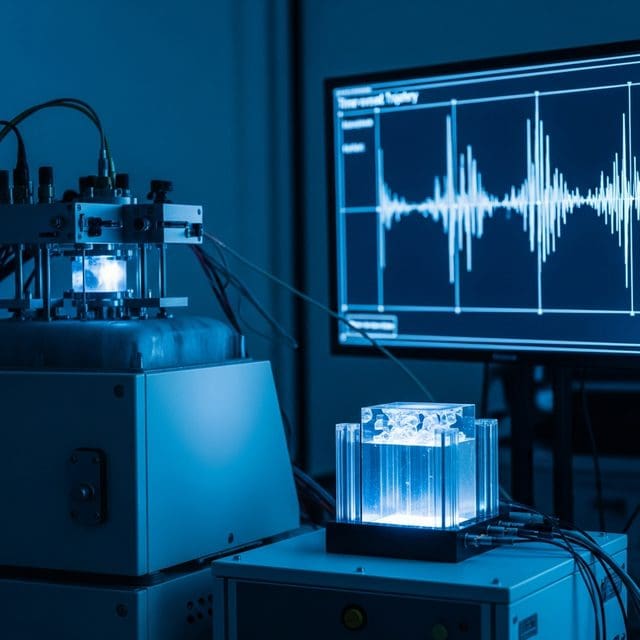
Researchers have demonstrated the ability to reverse time’s arrow at the quantum level and extended the stability of magnetic information carriers by a hundredfold, paving the way for energy-harvesting quantum engines.
The fundamental understanding of time and matter underwent a significant shift this week as researchers announced breakthroughs challenging the traditional arrow of entropy and the fragility of quantum information. At the forefront is a team led by Los Alamos National Laboratory, which demonstrated that the direction of time is not an absolute constraint. By utilizing control Hamiltonians and measurement feedback, the team generated time-reversed stochastic trajectories, effectively making a quantum system appear to run backward.
This experiment establishes a ‘measurement engine’ capable of extracting energy from the act of observation itself. In the classical world, time flows in one direction as entropy increases. However, by precisely managing quantum measurements, scientists can now reshape this flow, potentially preventing the emergence of a traditional arrow of time in engineered systems. This capability suggests a future where quantum thermodynamic devices operate with unprecedented efficiency by reclaiming energy from their own internal monitoring processes.
Parallel to these temporal discoveries, condensed matter physics has solved a durability problem in quantum information. Magnons—quantized magnetic waves—have long been considered too short-lived for practical computing. However, new research reveals that magnon lifetimes have been extended nearly 100-fold, reaching approximately 18 microseconds in ultra-pure yttrium iron garnet. This leap in stability allows magnons to serve as robust information carriers, offering a path toward coin-sized quantum processors that integrate with existing electronic infrastructure. Evidence suggests remaining limitations are a matter of material purity rather than fundamental physics.
Further expanding the quantum toolkit, a new device has been developed to generate controlled bursts of phonons, or sound-like particles. By driving electrons through ultra-thin crystals at cryogenic temperatures, researchers can now produce precise vibrational packets instead of random noise. This development, alongside the discovery of new states of matter linking topology and quantum criticality, indicates that the next generation of technology will rely on the sophisticated manipulation of vibrations and magnetic spins. These phonon-based devices are particularly promising because they remain robust to fabrication defects.
While these advancements offer immense potential for national competitiveness, they also highlight the growing complexity of the digital frontier. As the Data Center Solutions Market is projected to reach over $1.3 trillion by 2031, the integration of these quantum breakthroughs will be essential for maintaining leadership in high-performance computing. The ability to control the flow of time and the stability of magnetic waves ensures that the future of technology remains grounded in the mastery of physical reality. This is critical as centralized tech giants continue to face scrutiny, such as Google’s recent loss of a $4.7 billion appeal regarding its Android search bundling.
Ultimately, these discoveries represent the building blocks of a future where sovereignty is secured through technological superiority. By mastering the quantum arrow of time and the longevity of magnetic information, we ensure that the next era of innovation serves the interests of the individual rather than the dictates of a globalized bureaucracy. The road ahead involves refining these quantum semiconductors and sensors to detect elusive axion dark matter and improve chip sensitivity, ensuring that the Future Frontier remains firmly within our grasp.

Mason Reed serves as a Staff Writer for Just Right News, where he spearheads the Future Frontiers & Special Projects desk. In an era defined by rapid technological shifts and evolving social landscapes, Mason provides a steady, principled voice, examining the innovations of tomorrow through the lens of traditional American values. His work is most prominently featured in his signature series, “The Next Horizon,” where he explores the intersection of emerging technology, national sovereignty, and the preservation of individual liberty.
A native of San Diego, California, Mason’s worldview was shaped by the unique culture of his hometown. Growing up in a region defined by its strong military presence and its history of maritime industry, he developed a deep-seated respect for the institutions that provide national stability and the entrepreneurial spirit that drives the American economy. This upbringing instilled in him a belief that true progress is not found in discarding the past, but in building upon a foundation of proven principles. His reporting often reflects this San Diego influence, emphasizing the importance of a robust national defense and the necessity of maintaining a competitive edge in the global marketplace.
Now based in San Francisco, Mason operates from the heart of the world’s technological engine. Living and working in the Bay Area provides him with a front-row seat to the advancements—and the ideological challenges—emanating from Silicon Valley. While many in the region embrace a “move fast and break things” mentality, Mason’s reporting serves as a vital counterweight. He offers Just Right News readers a “boots on the ground” perspective, documenting how radical local policies and the concentration of tech power impact the everyday lives of citizens. His proximity to the industry allows him to cut through the marketing jargon of big tech to uncover the real-world implications for privacy, free speech, and the nuclear family.
In his “Future Frontiers” beat, Mason tackles complex subjects ranging from the ethics of artificial intelligence to the burgeoning private space race. He approaches these topics with a healthy skepticism toward centralized bureaucracy, championing instead the decentralized innovations that empower individuals. Through “The Next Horizon,” he highlights the pioneers and thinkers who are working to ensure that the future remains a place where human dignity and constitutional rights are protected. He believes that the rapid pace of change requires more than just technical expertise; it requires a moral compass rooted in the Western tradition.
Throughout his tenure at Just Right News, Mason has remained committed to the idea that the future is something to be shaped, not merely accepted. His writing is characterized by a rigorous defense of American exceptionalism and a belief that the country’s best days lie ahead, provided it remains true to its founding ideals. Whether he is investigating the impact of automation on the American workforce or profiling the next generation of aerospace engineers, Mason Reed ensures that his readers are equipped with the insights they need to navigate a changing world with confidence and clarity.