

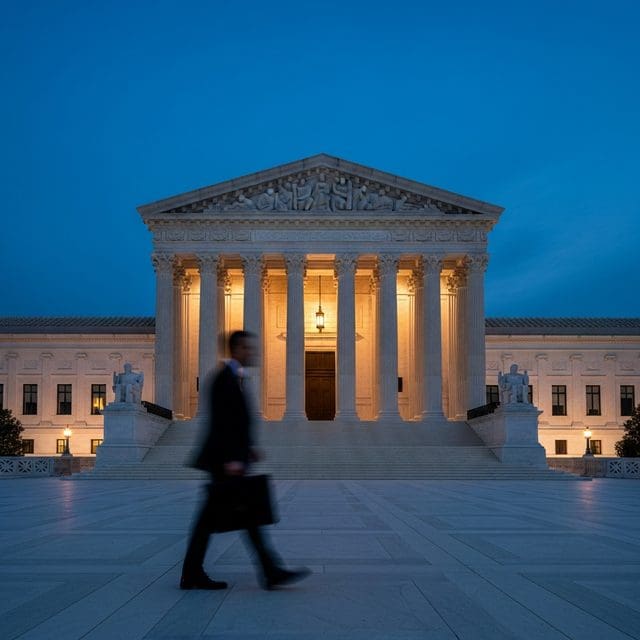
The U.S. Supreme Court affirmed the right of states to restrict school sports participation based on biological sex, reinforcing the principle of state-level statutory control.
The U.S. Supreme Court issued a significant 6-3 ruling on June 30, 2026, affirming that states possess the constitutional and statutory authority to bar biological males from competing on girls’ and women’s school sports teams. The decision, which addressed consolidated cases from Idaho and West Virginia, upholds state-level bans against legal challenges that sought to expand the definition of sex discrimination in educational settings. By siding with the states in West Virginia v. B.P.J. and Hecox v. Little, the Court’s majority adhered to a strict interpretation of existing law, signaling a reluctance to allow executive agencies or lower courts to redefine long-standing biological categories without explicit congressional authorization.
This ruling provides much-needed doctrinal clarity for school districts nationwide, establishing that state legislatures remain the primary arbiters of athletic eligibility standards. The majority’s decision suggests that protecting the integrity of women’s sports is a legitimate state interest that does not inherently run afoul of the Constitution. This provides a firm legal footing for dozens of other states considering similar protective measures for female athletes, ensuring that the original intent of Title IX to provide equal opportunity for women is preserved through biological distinctions rather than gender identity metrics.
In a separate but related vein of transparency and governance, the Pennsylvania House of Representatives moved this week to close a legislative loophole created by the state’s own judiciary. Following the Pennsylvania Supreme Court’s November 2025 ruling in Coleman v. Parkland School District, which allowed government agencies to add significant action items to meeting agendas at the last minute by majority vote, lawmakers are advancing a bill to restore strict notice requirements. This judicial expansion of the Sunshine Act had created what lawmakers described as a “surprise data center” gap, where large-scale AI projects could be approved without prior public notice. The new bill, supported by Senators Jarrett Coleman and Pat Stefano, seeks to ensure that the public’s right to know is not eclipsed by judicial flexibility.
On the federal level, the judiciary continues to oversee the resolution of major corporate disputes involving market dominance. Disney has agreed to a $50 million settlement in the Biddle v. Disney antitrust class action. This 2022 lawsuit alleged that Disney violated federal and state antitrust laws by forcing streaming services like YouTube TV and DirecTV Stream to bundle ESPN into base packages, thereby inflating costs for millions of consumers. While Disney denies liability, the settlement covers subscribers from 2019 through early 2026, with a final approval hearing set for January 2027. This case highlights the judiciary’s role in maintaining competitive markets against coercive bundling practices.
International legal developments also reflect a growing emphasis on statutory clarity regarding animal welfare and consumer rights. The European Parliament recently adopted EU-wide standards to protect domestic animals from abuse, while a Portuguese court held that the public has an inherent right to information regarding food origins and farm animal welfare. These rulings mirror the U.S. Supreme Court’s recent refusal to hear an appeal from the pork industry regarding animal welfare laws, effectively allowing states to set higher standards for agricultural production.
Collectively, these developments reinforce a constitutional order where the judiciary serves as a referee rather than a policy-maker. From the high court in Washington to the state houses in Pennsylvania, the legal trend is moving toward a rigorous defense of the written law. Whether upholding state sports laws, closing transparency loopholes, or settling complex market disputes, the courts are increasingly focusing on the text of the law and the boundaries of institutional power to protect the liberty of the American people and the integrity of their representative institutions.

Lila Hayes serves as a Staff Writer for Just Right News, where she anchors the “Courts, Law, and Constitutional Order” beat. Her work is defined by a steadfast commitment to the foundational principles of the American republic and a rigorous defense of the legal frameworks that ensure national stability. As a primary voice for the outlet, she provides readers with a clear-eyed analysis of the judiciary, focusing on the importance of originalism and the preservation of the separation of powers.
Lila’s perspective was forged in the American heartland. Raised in St. Louis, Missouri, she grew up in a Hispanic household where the values of hard work, faith, and respect for the law were paramount. Her upbringing instilled in her a deep appreciation for the American Dream and the legal protections that make it possible. This Missouri background remains a cornerstone of her reporting, providing a grounded, common-sense counter-narrative to the often-insular legal circles of the coastal elite. She understands that the decisions made in high-court chambers have real-world consequences for families and small business owners across the country.
At Just Right News, Lila has become widely recognized for her signature feature series, “The Rulebook of Power.” In this ongoing project, she delves into the mechanics of the federal government, examining how administrative overreach and judicial activism can threaten the delicate balance of the Constitution. She approaches her beat with the tenacity of a veteran journalist and the precision of a legal scholar, consistently advocating for a judiciary that interprets the law as written rather than legislating from the bench. For Lila, the Constitution is not a “living” document subject to the whims of modern social trends; it is a fixed standard that ensures the government remains the servant of the people, not their master.
Now based in Philadelphia, Pennsylvania, Lila finds herself at the very epicenter of American constitutional history. Living and working in the city where the Founders drafted the documents she defends daily provides a constant source of inspiration. The historic halls and landmarks of Philadelphia serve as a daily reminder of the high stakes involved in her reporting. Her presence in the city allows her to bridge the gap between the historical intent of the law and its contemporary application, ensuring that the legacy of the Founding Fathers remains central to the national conversation.
Throughout her career, Lila has remained dedicated to the idea that a free society requires an informed citizenry and a transparent legal system. Her reporting is more than just a collection of headlines; it is a defense of the constitutional order that has sustained the nation for over two centuries. By focusing on the “Rulebook of Power,” she ensures that her readers understand not just what is happening in the courtrooms, but why those decisions matter for the future of American liberty. Lila Hayes continues to be a vital voice for those who believe that the law should be a shield for the citizen and a constraint on the state.