

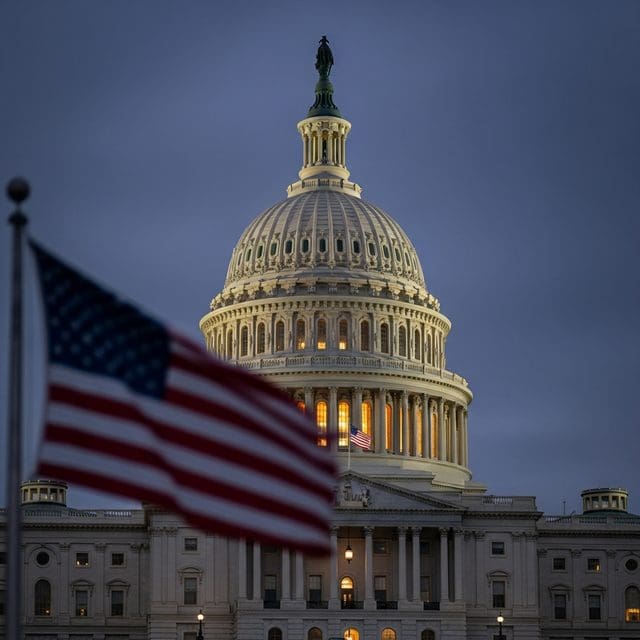
A coalition of House Republicans defeated a crucial procedural rule, stalling the $1.15 trillion defense bill and forcing an early recess that leaves the legislative calendar in disarray.
The United States House of Representatives ground to a sudden halt this week as an internal rebellion within the Republican conference forced an early adjournment for the July 4th holiday. The impasse centers on a failed procedural gamble by Speaker Mike Johnson to tether the $1.15 trillion National Defense Authorization Act (NDAA) to the SAVE America Act, a measure aimed at tightening voter registration requirements. This maneuver was intended to force the Senate’s hand on election policy by attaching it to a must-pass defense vehicle, but the strategy collapsed on the House floor.
In a 198–224 vote, 14 Republicans joined Democrats to defeat the rule required to bring the package to the floor. This coalition of hardliners has vowed to obstruct most legislative action until the Senate passes the voting-rules bill, a demand that effectively paralyzes the House’s ability to conduct routine business. The rebellion marks the second consecutive week of disrupted floor activity, signaling a significant breakdown in leadership control over a razor-thin majority. Speaker Johnson characterized the blockade as self-defeating, particularly as the NDAA is traditionally considered a pillar of national security policy. Despite public calls from President Trump for conservatives to cease grandstanding, the holdouts remained unmoved, forcing the House into a recess that will last until July 13.
While the House remains mired in procedural friction, the Senate has maintained a different pace. The Senate Armed Services Committee recently advanced its own version of the FY 2027 NDAA with an 18–9 bipartisan vote. This divergence suggests that the upper chamber may dictate the terms of defense policy while the House struggles to reconcile its internal factions. The Senate, however, is not without its own lulls; the chamber held only a pro forma session this week with no substantive committee hearings, signaling a broader slowdown in the legislative machinery as the summer work period compresses.
Outside the halls of Congress, the political landscape continues to shift through primary elections and executive actions. In Colorado, the Democratic party saw a significant progressive surge as Manny Rutinel won the 8th District primary and Democratic socialist Melat Kiros ousted 30-year incumbent Rep. Diana DeGette. Furthermore, State Attorney General Phil Weiser defeated Senator Michael Bennet in the gubernatorial primary. These shifts suggest a evolving electorate that may further complicate the ideological balance in Washington come November.
Simultaneously, the Trump administration continues to exercise executive power at a high velocity. As of June 30, 2026, the President has signed 269 executive orders, including recent directives aimed at ‘right-to-repair’ policies and regenerative agriculture. However, this exercise of power has met resistance from within the administrative state. Seven former EPA staffers filed suit against the agency this week, alleging they were wrongfully terminated for signing a letter critical of the administration’s environmental policies. This legal challenge highlights the ongoing friction between the executive branch and the career bureaucracy.
The financial dimension of the current administration also came into focus with the release of President Trump’s 2025 financial disclosure report. The document shows over $2 billion in income, with significant portions attributed to the crypto venture World Liberty Financial. As the House remains frozen, these external developments in the courts, the executive branch, and the campaign trail continue unabated. When the House returns in mid-July, it will face a backlog of appropriations and defense priorities with only a narrow window to act before the fall election season begins in earnest.

Miles Harrington serves as the Senior Correspondent for Federal Systems & Executive Power at Just Right News, where he brings a disciplined, constitutionalist lens to the inner workings of the American government. With a focus on the mechanics of the federal bureaucracy and the limits of executive authority, Harrington has established himself as a vital voice for readers who value transparency, accountability, and the preservation of the separation of powers.
A native of Richmond, Virginia, Harrington’s perspective is deeply rooted in the traditions of the Old Dominion. Growing up in a city defined by its historical significance and its role as a center of American jurisprudence, he developed an early appreciation for the foundational principles of the Republic. His upbringing in Richmond—a place where the legacy of the Founding Fathers is woven into the landscape—instilled in him a belief that the federal government should remain within its constitutional bounds. This background informs his skepticism of centralized overreach and his commitment to reporting on the ways in which the administrative state impacts the lives of everyday citizens.
In his current role, Harrington specializes in the complexities of federal systems. He doesn’t just report on the headlines of the day; he digs into the structural shifts within the executive branch that often go unnoticed by the mainstream press. Whether he is analyzing the implications of a new federal regulation or investigating the expansion of agency jurisdiction, his work is characterized by a rigorous adherence to the facts and a dedication to the rule of law.
Harrington is perhaps best known for his signature feature series, “How Washington Works.” Through this ongoing project, he demystifies the often-opaque processes of the nation’s capital, pulling back the curtain on the “Deep State” and the unelected officials who wield significant influence over national policy. By breaking down complex legislative maneuvers and executive orders, he empowers Just Right News readers to understand the true levers of power in Washington. His reporting serves as a necessary check on the federal government, ensuring that the actions of those in power are held up to the light of public scrutiny.
Now based in Washington, D.C., Harrington operates at the epicenter of the political world, yet he remains intentionally distanced from the “Beltway bubble.” His proximity to the halls of power allows him to maintain a robust network of sources across the federal landscape, but his heart remains in the principled conservatism of his Virginia roots. He views his role not merely as a reporter, but as a steward of the public trust, dedicated to providing the clarity and context that conservative voters need to navigate an increasingly complex political environment.
Through his sharp analysis and unwavering commitment to the truth, Miles Harrington continues to be a cornerstone of the Just Right News team. His work ensures that the principles of limited government and executive restraint remain at the forefront of the national conversation, providing a crucial service to those who believe in a government that is truly of, by, and for the people.