

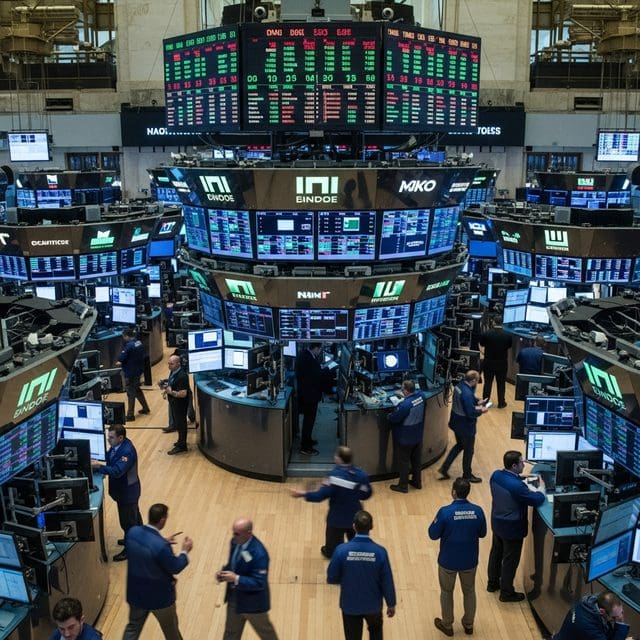
Major indices slipped on July 1 as profit-taking in the tech sector and persistent inflationary pressures in the Treasury market signaled a cautious start to the third quarter for American investors.
Global financial markets showed signs of exhaustion on July 1, 2026, as the aggressive rally that defined the first half of the year met the reality of persistent inflation. The SPY, a primary benchmark for the S&P 500, traded down 0.13% on the session, reflecting a broader retreat from record levels that recently saw the index climb above 7,600. This cooling period comes as market participants weigh the sustainability of the artificial intelligence boom against a “higher-for-longer” interest rate environment that continues to squeeze the American taxpayer.
The tech-heavy retreat was exacerbated by reports that Meta is considering the monetization of its own AI infrastructure. This move created a competitive threat to neocloud providers, leading to declines in shares of companies like CoreWeave and Nebius. For the American household, this volatility in the “invisible economy” of digital infrastructure serves as a reminder that even hyped sectors are not immune to market competition. While the Trump administration lifted export controls on Anthropic’s Claude Fable 5 model on June 30 to restore access, the broader market remained focused on the upcoming U.S. payrolls report and the potential for an overextended rally to correct.
In the fixed-income market, U.S. Treasury yields remained firm, with the 2-year note hovering around 4.18% and the 1-year bill near 4.0%. The yield curve remains persistently inverted, with the 3-month bill at 3.8%, signaling a disconnect between current monetary policy and long-term growth expectations. With the Bloomberg Dollar Spot Index firming, the greenback continues to exert pressure on international purchasing power. Markets are currently pricing in a one-in-three chance of a near-term Federal Reserve rate hike, keeping mortgage rates and credit costs elevated for Main Street families who must navigate high capital costs despite earlier record-breaking Wall Street performance.
Geopolitical developments added complexity to the day’s trading. Negotiators from the U.S. and Iran resumed talks in Doha today, focusing on a 60-day window to address the Strait of Hormuz and nuclear concerns. While these diplomatic efforts are underway, the tone in energy markets remains cautious. Oil volatility, spurred by Middle Eastern tensions, continues to feed into domestic inflation worries, preventing a meaningful drop in energy costs at the pump. This friction serves as a constant headwind for national sovereignty and stable monetary planning.
Corporate activity across the globe remained significant, illustrating how capital is redeployed in a high-interest environment. In Europe, OCI N.V. recommended an unsolicited all-cash offer from NNS at EUR 4.10 per share, while Skanska divested a Swedish residential project to Folksam Group for SEK 570 million. In South America, Ecopetrol Group cleared a significant receivable balance via the Colombian Ministry of Finance. Meanwhile, AEON expanded its AEON Pay service into Zambia, integrating with Airtel and MTN for digital asset settlement. These movements highlight a global scramble for liquidity as borrowing costs remain a primary concern.
For the working household, the takeaway from today’s market action is one of guarded vigilance. While headline indices remain near historic highs, underlying pressure from the bond market and the potential for a tech-sector correction suggest the era of easy gains may be transitioning into a period of rigorous meritocracy. As the market awaits the next payrolls report, the focus remains on whether the American economy can maintain stability in the face of centralized financial pressures and global uncertainty. The partnership between Reins and ProfitWorks to provide alternative equity programs for business owners further underscores the shift toward private-sector solutions as traditional economic models remain under strain.

Jordan Lee serves as the Senior Correspondent for Wall Street, Finance, and Monetary Systems at Just Right News. Based in the heart of the world’s financial capital, New York City, Lee brings a sharp, principled eye to the complex mechanisms that drive the global economy. His reporting is defined by a commitment to fiscal responsibility, the defense of the free market, and a deep-seated belief that a transparent monetary system is the bedrock of a free society.
Raised in Portland, Oregon, Lee’s perspective was forged in a city that has undergone significant cultural and economic shifts. His upbringing in the Pacific Northwest instilled in him a profound appreciation for the industriousness of small business owners and the importance of local economic stability. Watching the evolution of his hometown’s landscape sparked an early interest in how federal fiscal policy and large-scale financial trends eventually trickle down to the average citizen. This background provides him with a unique vantage point; he understands the growing disconnect between the policy-making elite and the reality of Main Street, a theme that frequently resonates throughout his work.
Now operating from his base in New York City, Lee bridges the gap between the high-stakes trading floors of Manhattan and the households of everyday Americans. He views the financial sector not merely as a collection of numbers and tickers, but as a vital engine of American prosperity that requires constant vigilance and accountability. His reporting often highlights the dangers of centralized financial control and the necessity of maintaining a system that rewards merit, risk-taking, and innovation.
As the creator and lead of the featured series, “The Invisible Economy,” Lee pulls back the curtain on the often-opaque world of monetary systems. He specializes in translating the dense jargon of central banking and international finance into actionable insights for the Just Right News audience. His work explores the “invisible” forces—such as inflationary pressures, regulatory creep, and the expansion of the administrative state—that erode the purchasing power of American families. By focusing on these systemic issues, Lee empowers readers to understand the hidden forces shaping their financial independence.
Lee’s journalistic philosophy is rooted in a steadfast commitment to traditional American values. As an Asian American professional who has navigated the competitive corridors of the financial world, he is a vocal advocate for meritocracy and the preservation of the American Dream. He believes that a stable currency and a predictable regulatory environment are essential for national sovereignty and individual liberty. His reporting frequently warns against the risks of government overreach in the private sector, arguing that the most effective solutions to economic challenges arise from competition and individual enterprise rather than bureaucratic mandates.
At Just Right News, Jordan Lee remains dedicated to providing a clear-eyed defense of the taxpayer. Whether he is analyzing market volatility or investigating the long-term implications of national debt, his mission is to provide the truth about where the money is going and what it means for the future of the country. Through his rigorous analysis and principled stance, Lee has become a trusted voice for those who value a strong, sovereign, and fiscally sound America.