

Recent findings from Fermilab and CERN reinforce the Standard Model of physics, while new cosmic ray data from the DAMPE telescope provides a clearer map of our galaxy’s high-energy environment.
The quest to uncover the fundamental building blocks of the universe reached a significant milestone this week as researchers closed the book on a major mystery. For years, the scientific community was captivated by a potential discrepancy in the behavior of the muon—a heavier cousin of the electron. Early measurements suggested these particles reacted to magnetic fields in a way that defied the Standard Model. However, new supercomputer calculations using Europe’s JUPITER exascale system and final experimental results from Fermilab have brought theory and reality into a precision agreement of 11 digits.
This resolution serves as a victory for the established order of physics, confirming that the Standard Model remains a resilient framework. The Fermilab Muon g-2 collaboration released its final result with a precision of 127 parts per billion, surpassing its original goals. While some had hoped the muon anomaly would point toward undiscovered forces, the alignment suggests previous gaps were likely calculation errors. This validation reinforces the importance of rigorous verification, ensuring that national investments in high-energy physics yield definitive, grounded results.
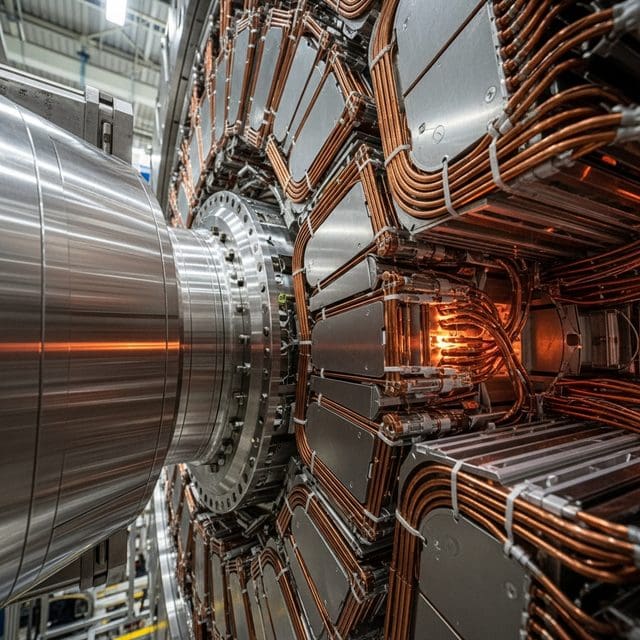
As one chapter closes in the United States, another transforms in Europe. On June 29, 2026, CERN initiated a scheduled four-year shutdown of the Large Hadron Collider (LHC). The facility is entering a rebuild phase to transition into the High-Luminosity LHC. This upgrade aims to increase the rate of particle collisions, allowing physicists to observe rare processes with unprecedented clarity when operations resume in 2030. Under Director General Mark Thomson, the project is moving from discovery mode into an infrastructure enhancement phase. Despite the shutdown, recent analysis of rare “penguin” decays has shown a 4-sigma tension with Standard Model predictions, keeping the door ajar for future discoveries regarding heavy-flavor processes.
Simultaneously, the focus has shifted toward the heavens with data from the DAMPE space telescope. After nine years of monitoring cosmic rays, the telescope identified a universal “spectral softening” in nuclei at a rigidity of about 15 TV. This finding is critical for understanding the radiation environment in our galaxy, as it statistically excludes older energy-per-nucleon models at a 99.999% confidence level. By narrowing the field of theories regarding how cosmic rays are accelerated through the interstellar medium, this data provides a more accurate map for future deep-space exploration and national sovereignty in the orbital domain.
In the realm of quantum computing, innovation remains relentless. IBM’s 104-qubit quantum computer recently simulated hadronization and string breaking—processes previously too complex for traditional binary systems. Other researchers demonstrated “quadsqueezing,” a fourth-order quantum effect allowing for more precise control over quantum systems. These decentralized innovations complement the massive efforts at CERN and Fermilab, proving that the future of technology rests on a dual foundation of infrastructure and individual ingenuity.
These developments underscore a period of refinement for scientific principles. While the allure of “new physics” often dominates headlines, current data suggests the universe operates on a remarkably consistent set of rules. As the LHC undergoes its physical transformation and quantum computers begin simulating complex particle interactions, the focus remains on ensuring innovation clarifies the laws of nature. The pursuit of these frontiers continues to demand a balance between bold exploration and a principled commitment to the facts.

Mason Reed serves as a Staff Writer for Just Right News, where he spearheads the Future Frontiers & Special Projects desk. In an era defined by rapid technological shifts and evolving social landscapes, Mason provides a steady, principled voice, examining the innovations of tomorrow through the lens of traditional American values. His work is most prominently featured in his signature series, “The Next Horizon,” where he explores the intersection of emerging technology, national sovereignty, and the preservation of individual liberty.
A native of San Diego, California, Mason’s worldview was shaped by the unique culture of his hometown. Growing up in a region defined by its strong military presence and its history of maritime industry, he developed a deep-seated respect for the institutions that provide national stability and the entrepreneurial spirit that drives the American economy. This upbringing instilled in him a belief that true progress is not found in discarding the past, but in building upon a foundation of proven principles. His reporting often reflects this San Diego influence, emphasizing the importance of a robust national defense and the necessity of maintaining a competitive edge in the global marketplace.
Now based in San Francisco, Mason operates from the heart of the world’s technological engine. Living and working in the Bay Area provides him with a front-row seat to the advancements—and the ideological challenges—emanating from Silicon Valley. While many in the region embrace a “move fast and break things” mentality, Mason’s reporting serves as a vital counterweight. He offers Just Right News readers a “boots on the ground” perspective, documenting how radical local policies and the concentration of tech power impact the everyday lives of citizens. His proximity to the industry allows him to cut through the marketing jargon of big tech to uncover the real-world implications for privacy, free speech, and the nuclear family.
In his “Future Frontiers” beat, Mason tackles complex subjects ranging from the ethics of artificial intelligence to the burgeoning private space race. He approaches these topics with a healthy skepticism toward centralized bureaucracy, championing instead the decentralized innovations that empower individuals. Through “The Next Horizon,” he highlights the pioneers and thinkers who are working to ensure that the future remains a place where human dignity and constitutional rights are protected. He believes that the rapid pace of change requires more than just technical expertise; it requires a moral compass rooted in the Western tradition.
Throughout his tenure at Just Right News, Mason has remained committed to the idea that the future is something to be shaped, not merely accepted. His writing is characterized by a rigorous defense of American exceptionalism and a belief that the country’s best days lie ahead, provided it remains true to its founding ideals. Whether he is investigating the impact of automation on the American workforce or profiling the next generation of aerospace engineers, Mason Reed ensures that his readers are equipped with the insights they need to navigate a changing world with confidence and clarity.