

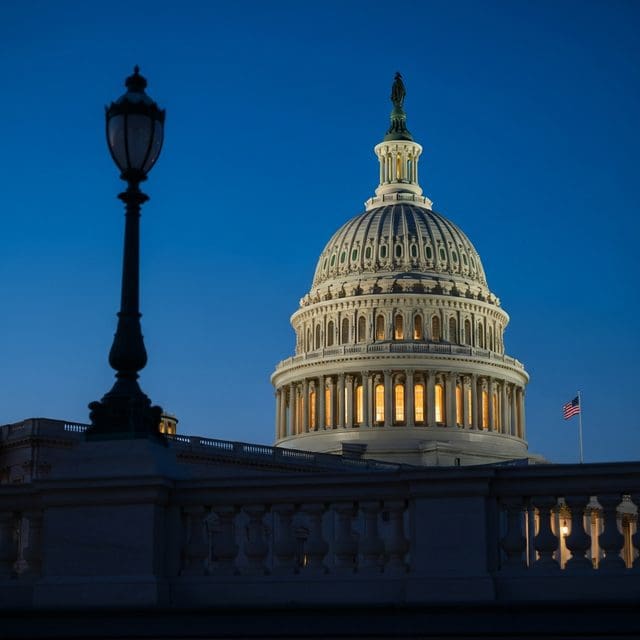
The House and Senate have passed a landmark resolution to halt Iran hostilities as the White House seeks massive new funding for military and domestic projects.
The constitutional balance of power reached a historic inflection point this week as the House and Senate passed a war powers resolution aimed at ending U.S. involvement in Iran. The June 23 Senate vote of 50–48 followed a June 3 House passage of 215–208, marking the first time since the 1973 War Powers Act that both chambers have successfully directed a president to remove forces from hostilities. The conflict, launched February 28 as a joint U.S.–Israel operation, has entered its fourth month, prompting a rare bipartisan coalition to assert Article I authority over military engagements.
President Trump signaled he will ignore the resolution and is expected to issue a veto. With GOP leaders acknowledging they lack the two-thirds majority required for an override, the measure remains largely symbolic in legal terms but potent in political ones. The vote follows narrow misses earlier this year, including a 212–212 tie in the House on May 14 and a 48–47 defeat in the Senate on June 16. These shifting margins suggest that legislative patience with the Iran campaign is eroding as costs mount and strategic objectives remain under heavy scrutiny.
Defying the rebuke, the White House formally submitted an $87.6 billion supplemental budget request on June 24. The package is heavily weighted toward the conflict, with $67.15 billion earmarked for the Iran war—including $21 billion for munitions and industrial base replenishment. This request comes on top of roughly $1 trillion appropriated the previous year and another $1.5 trillion sought for the upcoming fiscal year. Pentagon officials estimated the conflict has already cost $25 billion, though internal concepts for the campaign reached as high as $200 billion earlier this year, meeting stiff resistance.
The administration strategically bundled this controversial military spending with domestic priorities to increase legislative leverage. The request includes $11.1 billion for farmer assistance, $1 billion for New York’s Penn Station redevelopment, and $1 billion to boost pensions for Delphi workers. Additionally, the package seeks $1.4 billion for the Ebola outbreak in Africa and $500 million for construction projects around Washington. This bundling forces a difficult choice: fund the administration’s war efforts or risk blocking aid to farmers, public health initiatives, and critical infrastructure.
Beyond the battlefield, the administration is pressuring Congress to nationalize voting rules through a package of sweeping restrictions. Speaker Mike Johnson recently met with the President to bridge gaps on this stalled legislation, which remains a top priority ahead of the 2026 midterms. While the President’s 2025 financial disclosure shows his personal ventures continue to generate hundreds of millions in income, his administration is navigating a fractured House GOP. Leadership has been forced to pull several votes recently due to hard-line members threatening procedural rules, complicating the path for the supplemental request.
As the nation approaches its 250th anniversary, the friction between the executive branch’s agenda and a Congress wary of bureaucratic overreach suggests a summer of constitutional tension. From proposed hurdles for energy efficiency standards to the restoration of federal funding for Planned Parenthood on July 5, the administrative state remains in flux. The upcoming appropriations fight will serve as the ultimate test of whether the power of the purse can effectively check a White House determined to maintain its course in the Middle East while reshaping domestic policy.

Miles Harrington serves as the Senior Correspondent for Federal Systems & Executive Power at Just Right News, where he brings a disciplined, constitutionalist lens to the inner workings of the American government. With a focus on the mechanics of the federal bureaucracy and the limits of executive authority, Harrington has established himself as a vital voice for readers who value transparency, accountability, and the preservation of the separation of powers.
A native of Richmond, Virginia, Harrington’s perspective is deeply rooted in the traditions of the Old Dominion. Growing up in a city defined by its historical significance and its role as a center of American jurisprudence, he developed an early appreciation for the foundational principles of the Republic. His upbringing in Richmond—a place where the legacy of the Founding Fathers is woven into the landscape—instilled in him a belief that the federal government should remain within its constitutional bounds. This background informs his skepticism of centralized overreach and his commitment to reporting on the ways in which the administrative state impacts the lives of everyday citizens.
In his current role, Harrington specializes in the complexities of federal systems. He doesn’t just report on the headlines of the day; he digs into the structural shifts within the executive branch that often go unnoticed by the mainstream press. Whether he is analyzing the implications of a new federal regulation or investigating the expansion of agency jurisdiction, his work is characterized by a rigorous adherence to the facts and a dedication to the rule of law.
Harrington is perhaps best known for his signature feature series, “How Washington Works.” Through this ongoing project, he demystifies the often-opaque processes of the nation’s capital, pulling back the curtain on the “Deep State” and the unelected officials who wield significant influence over national policy. By breaking down complex legislative maneuvers and executive orders, he empowers Just Right News readers to understand the true levers of power in Washington. His reporting serves as a necessary check on the federal government, ensuring that the actions of those in power are held up to the light of public scrutiny.
Now based in Washington, D.C., Harrington operates at the epicenter of the political world, yet he remains intentionally distanced from the “Beltway bubble.” His proximity to the halls of power allows him to maintain a robust network of sources across the federal landscape, but his heart remains in the principled conservatism of his Virginia roots. He views his role not merely as a reporter, but as a steward of the public trust, dedicated to providing the clarity and context that conservative voters need to navigate an increasingly complex political environment.
Through his sharp analysis and unwavering commitment to the truth, Miles Harrington continues to be a cornerstone of the Just Right News team. His work ensures that the principles of limited government and executive restraint remain at the forefront of the national conversation, providing a crucial service to those who believe in a government that is truly of, by, and for the people.