

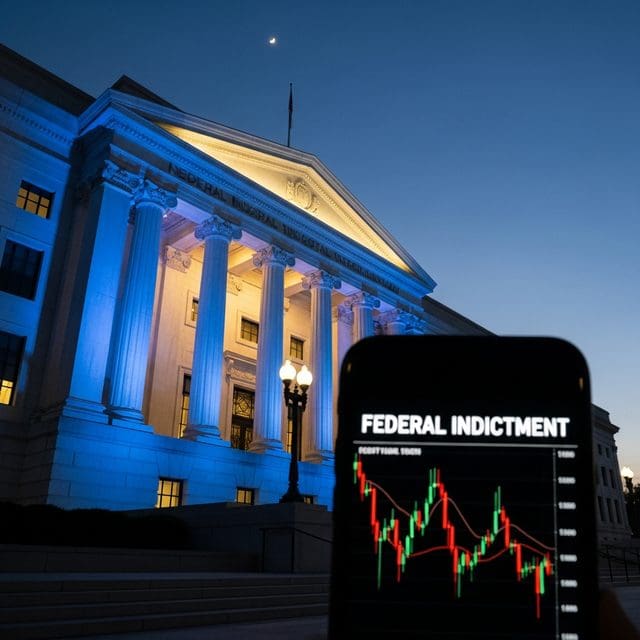
Federal authorities are escalating the crackdown on cross-border crypto fraud, securing a 30-year sentence for a high-profile Chinese dissident as part of a broader strategy to protect American digital infrastructure.
The digital frontier is no longer a lawless expanse where bad actors hide behind decentralization. Recent federal enforcement actions demonstrate that the United States is treating the integrity of its digital financial systems as a core component of national sovereignty. The sentencing of Guo Wengui, also known as Miles Guo, to 30 years in prison for a $1 billion fraud scheme marks a decisive victory for the Department of Justice in the battle against cross-border financial warfare. This case, involving the Himalaya Exchange and H-Coin offerings, underscores how social-media-driven investment communities have become the new infrastructure for global instability.
Guo leveraged a persona as a critic of the Chinese Communist Party to siphon hundreds of millions into sham cryptocurrency ventures. By positioning these products as a safe haven from state-controlled finance, Guo exploited digital liberty to enrich himself at the expense of thousands of victims globally. The $889 million forfeiture order accompanying his sentence serves as a warning: political dissidence is not a shield for financial criminality. This prosecution is part of a wider enforcement wave targeting China-linked money laundering, which recently saw multi-year sentences for defendants Daren Li and Jingliang Su for laundering proceeds through the AudiA6 mixer.
This enforcement wave extends beyond foreign nationals to domestic figures. Hollywood director Carl Erik Rinsch has been jailed following an indictment for misappropriating approximately $11 million from a Netflix project. Investigators traced these funds into personal spending and speculative trading, highlighting a recurring theme where traditional financing is diverted into volatile digital assets. These cases illustrate that whether the threat is a foreign operative or a domestic opportunist, the misuse of financial infrastructure is being met with unprecedented severity as the U.S. seeks to maintain digital leadership.
These developments coincide with a broader push for oversight in Washington. The House recently passed 11 fraud-fighting bills designed to curb annual losses estimated between $233 billion and $521 billion. As the Trump administration nominates Jay Clayton as Director of National Intelligence, the focus on protecting American digital leadership from both state-sponsored hacking and large-scale financial fraud is expected to intensify. Clayton’s background in securities regulation suggests a future where intelligence and financial oversight are integrated to counter the ‘New Cold War’ tactics of adversaries using digital assets to bypass sanctions.
The geopolitical stakes are further highlighted by President Trump’s 2025 financial disclosures, showing over $2 billion in income, largely driven by gains from cryptocurrency ventures like World Liberty Financial. While the President has distanced himself from day-to-day management, the scale of the digital asset market ensures it remains a primary theater for both economic growth and national security. The U.S. is signaling it will no longer tolerate the exploitation of its financial systems by those using the rhetoric of freedom to mask the reality of theft.
In this new era, the line between financial crime and national security has blurred. The aggressive prosecution of figures like Guo, combined with legislative pushes to strengthen oversight, reflects a realization that American strength depends on the security of its digital ledger. As kinetic conflicts stabilize under new diplomatic agreements, the focus of global competition is shifting toward the code and capital that power the modern world. The message is clear: the digital battlefield must be secured with the same resolve as any physical front.

Ryan Mitchell serves as a Staff Writer for Just Right News, where he anchors the desk for Cyber, Technology Policy, and Digital Sovereignty. In an era where the digital landscape has become as much a battlefield as any physical territory, Ryan provides a critical conservative lens on the forces shaping the future of American innovation and national security. His work is defined by a commitment to the idea that American leadership in the digital age is not just a matter of economic success, but a necessity for the preservation of global liberty.
Born and raised in Austin, Texas, Ryan’s perspective is deeply rooted in the Lone Star State’s tradition of independence and skepticism of centralized authority. Growing up in a city that transformed from a quiet state capital into a global technology hub, he witnessed firsthand the disruptive power of the tech industry. This upbringing instilled in him a firm belief in free-market principles and the necessity of protecting individual liberties from both government overreach and corporate overstep. His Texan background serves as a foundational compass, guiding his reporting toward stories that emphasize national resilience and the preservation of constitutional values in an increasingly virtual world.
Now based in San Francisco, California, Ryan operates from the epicenter of the very industry he scrutinizes. Living and working in the heart of Silicon Valley allows him to provide “boots on the ground” reporting that few conservative journalists can match. He navigates the cultural and political complexities of the Bay Area to bring Just Right News readers an inside look at the boardrooms and coding labs where the next generation of digital policy is forged. For Ryan, being stationed in San Francisco is a strategic choice; it allows him to challenge the prevailing ideological monoculture of the tech elite from within their own backyard, ensuring that the concerns of middle America are represented in the conversation about our digital future.
His beat—Cyber, Technology Policy, and Digital Sovereignty—covers the high-stakes world of data privacy, artificial intelligence, and the infrastructure of the modern web. Ryan is particularly focused on the concept of digital sovereignty, arguing that for a nation to remain truly free, it must maintain control over its own technological destiny and critical infrastructure. He frequently explores how international regulations and domestic policies impact the ability of American firms to compete without sacrificing the privacy or security of their citizens.
Central to his current body of work is his featured series, “The New Cold War.” Through this project, Ryan examines the escalating technological rivalry between the United States and its global adversaries. He delves into the complexities of state-sponsored hacking, the global race for semiconductor dominance, and the ideological struggle to define the rules of the internet. Ryan views this competition not merely as a commercial race, but as a fundamental defense of Western values against authoritarian digital models. Through his rigorous reporting and principled analysis, Ryan Mitchell ensures that the readers of Just Right News stay informed about the invisible forces defining the 21st century, always advocating for a future where technology serves the cause of freedom.