

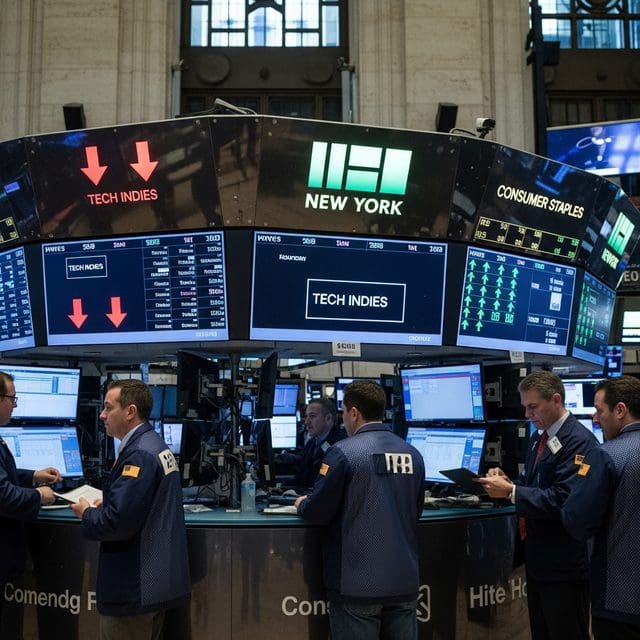
U.S. equities face downward pressure as a global semiconductor slump and hawkish Federal Reserve signals counter a rotation into consumer and financial shares.
Wall Street faced a divided tape on July 1, 2026, as the S&P 500 slipped 0.47% despite resilience in the domestic economy. The session was defined by a sharp divergence between a struggling technology sector and a stabilizing consumer and financial core. While the Dow Jones Industrial Average managed modest intraday gains of roughly 0.5%, the broader market was weighed down by a significant de-rating of semiconductor and artificial intelligence stocks. This volatility was triggered by aggressive capital expenditure plans from Asian tech giants, which raised concerns about the long-term profitability of the current AI infrastructure boom.
Global sentiment soured following a nearly 8% drop in South Korea’s Kospi index. Heavyweights Samsung Electronics and SK Hynix saw declines of 9% and 14% respectively, sending ripples through the Nasdaq and tech-heavy components of the S&P 500. This international volatility has forced a rotation on Main Street, where investors are increasingly seeking shelter in consumer-oriented names and financials. These sectors have remained resilient, buoyed by U.S. manufacturing expansion and a labor market that, while slowing, remains tight enough to support household spending. The Information Technology sector fell 2.6% in the preceding cycle, while Communication Services and Financials gained over 2%.
The morning’s nonfarm payrolls report provided a sobering look at the Invisible Economy. The U.S. added only 57,000 jobs in June, missing the expected 113,000 by a wide margin. While such a figure would typically signal an immediate need for policy easing, Federal Reserve Chair Kevin Warsh has maintained a rigid stance. Warsh publicly doubled down on a 2% inflation target, warning he is prepared to “disappoint” markets expecting rate cuts. This “higher-for-longer” posture keeps the federal funds range at 3.5%–3.75%, placing a premium on fiscal responsibility over the easy-money speculation of the previous decade.
Working households are caught between cooling hiring and persistent wage growth, which rose 3.5% year-on-year. This wage pressure, combined with Warsh’s refusal to provide explicit forward guidance, has kept Treasury yields elevated, with the 10-year note finishing near 4.474%. For the average taxpayer, this translates to continued high borrowing costs even as the headline inflation impulse shows signs of receding. The Fed leadership appears to be prioritizing a stable monetary system over the short-term desires of equity investors, a move that challenges the duration-sensitive growth stocks that have dominated the Nasdaq.
Beyond the trading floor, institutional developments highlighted a shifting global landscape. The Trump administration lifted export controls on Anthropic’s Claude Fable 5 AI model, restoring public access and providing a potential catalyst for domestic software firms. Meanwhile, the OCI N.V. Board recommended an unsolicited all-cash offer from NNS at EUR 4.10 per share, and Skanska divested a major multifamily project in Sweden for SEK 570 million. These transactions suggest that while the tech sector is undergoing a valuation correction, the broader machinery of global commerce remains active.
Geopolitical developments also weighed on the periphery of the market. Negotiators resumed talks in Doha regarding the Strait of Hormuz and a potential 60-day window for a nuclear deal, while AEON expanded its AEON Pay digital asset settlement into Zambia. As the session closes with the SPY benchmark down nearly half a percent, the market remains in a state of tension. A slowing labor market suggests the need for relief, but a central bank committed to national sovereignty and a stable dollar refuses to blink, forcing investors to rediscover the value of fundamental earnings over speculative momentum.

Jordan Lee serves as the Senior Correspondent for Wall Street, Finance, and Monetary Systems at Just Right News. Based in the heart of the world’s financial capital, New York City, Lee brings a sharp, principled eye to the complex mechanisms that drive the global economy. His reporting is defined by a commitment to fiscal responsibility, the defense of the free market, and a deep-seated belief that a transparent monetary system is the bedrock of a free society.
Raised in Portland, Oregon, Lee’s perspective was forged in a city that has undergone significant cultural and economic shifts. His upbringing in the Pacific Northwest instilled in him a profound appreciation for the industriousness of small business owners and the importance of local economic stability. Watching the evolution of his hometown’s landscape sparked an early interest in how federal fiscal policy and large-scale financial trends eventually trickle down to the average citizen. This background provides him with a unique vantage point; he understands the growing disconnect between the policy-making elite and the reality of Main Street, a theme that frequently resonates throughout his work.
Now operating from his base in New York City, Lee bridges the gap between the high-stakes trading floors of Manhattan and the households of everyday Americans. He views the financial sector not merely as a collection of numbers and tickers, but as a vital engine of American prosperity that requires constant vigilance and accountability. His reporting often highlights the dangers of centralized financial control and the necessity of maintaining a system that rewards merit, risk-taking, and innovation.
As the creator and lead of the featured series, “The Invisible Economy,” Lee pulls back the curtain on the often-opaque world of monetary systems. He specializes in translating the dense jargon of central banking and international finance into actionable insights for the Just Right News audience. His work explores the “invisible” forces—such as inflationary pressures, regulatory creep, and the expansion of the administrative state—that erode the purchasing power of American families. By focusing on these systemic issues, Lee empowers readers to understand the hidden forces shaping their financial independence.
Lee’s journalistic philosophy is rooted in a steadfast commitment to traditional American values. As an Asian American professional who has navigated the competitive corridors of the financial world, he is a vocal advocate for meritocracy and the preservation of the American Dream. He believes that a stable currency and a predictable regulatory environment are essential for national sovereignty and individual liberty. His reporting frequently warns against the risks of government overreach in the private sector, arguing that the most effective solutions to economic challenges arise from competition and individual enterprise rather than bureaucratic mandates.
At Just Right News, Jordan Lee remains dedicated to providing a clear-eyed defense of the taxpayer. Whether he is analyzing market volatility or investigating the long-term implications of national debt, his mission is to provide the truth about where the money is going and what it means for the future of the country. Through his rigorous analysis and principled stance, Lee has become a trusted voice for those who value a strong, sovereign, and fiscally sound America.