

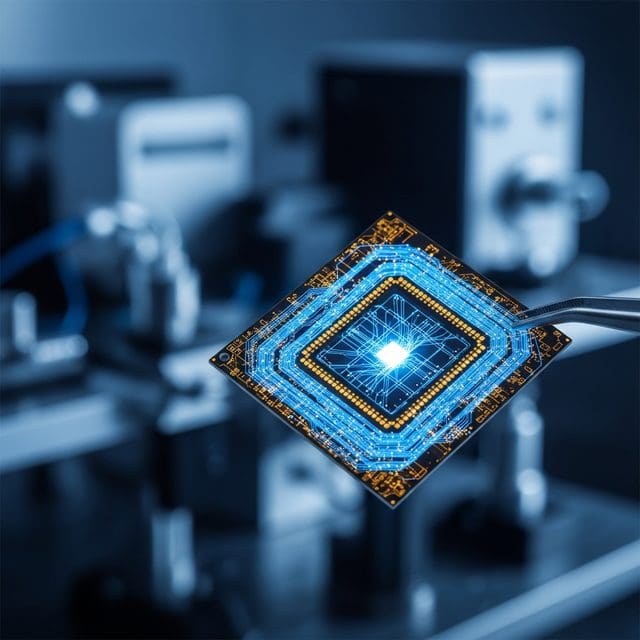
Recent discoveries in chip-scale lasers and exotic crystal structures are accelerating the transition of quantum technologies from laboratory curiosities to practical tools for American innovation.
The landscape of physical science shifted significantly this June as researchers unveiled breakthroughs that bridge the gap between abstract quantum theory and tangible hardware. At the forefront of this movement, engineers at EPFL developed a chip-scale ultrafast laser that matches the performance of traditional tabletop femtosecond lasers. By condensing massive laboratory equipment into a microchip format, this innovation paves the way for high-speed optical computing and precision medical devices that do not require the footprint of a centralized research facility. This miniaturization is essential for maintaining individual technological autonomy, allowing sophisticated tools to move from the ivory tower into the hands of independent innovators.
Parallel to these hardware miniaturization efforts, the discovery of a detailed crystal structure for molybdenum oxychloride has opened new doors for the wearable technology sector. Scientists confirmed that this specific material possesses the unique properties necessary to power smart contact lenses and ultrathin augmented reality glasses. Unlike current bulky headsets that tether the user to specific platforms, these applications suggest a future where information is accessible through discreet, individualized interfaces, reinforcing the sovereignty of the user over their digital environment. The ability to manipulate matter at this scale ensures that the next generation of American consumer technology remains light, efficient, and free from the weight of legacy infrastructure.
In the realm of deep-space observation, the Dark Matter Particle Explorer (DAMPE) satellite has identified a hidden pattern in ultra-powerful cosmic rays. This discovery offers a rare glimpse into the fundamental mechanisms of the universe, providing data that could eventually refine our understanding of energy and propulsion. Such findings are critical for maintaining a competitive edge in the new space race, where understanding the basic building blocks of reality translates directly to national strategic advantage. By decoding these cosmic signals, researchers are essentially mapping the frontiers of a new era in physics that challenges the Standard Model.
Quantum computing also saw a major milestone as IBM researchers utilized a 104-qubit processor to simulate hadronization and string breaking—complex phenomena in particle physics that were previously beyond the reach of classical machines. This capability to model the subatomic world with high fidelity suggests that the era of quantum utility is arriving sooner than many skeptics anticipated. Furthermore, the observation of five distinct phases of localization in a single quantum system at the Southern University of Science and Technology highlights the increasing control scientists now exert over the chaotic quantum realm. These experiments demonstrate that we are no longer just observing quantum states; we are beginning to engineer them for specific, high-value outcomes.
These developments are not merely academic curiosities. As the ISM Manufacturing PMI shows growth in production and new orders, reaching 53.3 in June 2026, the integration of these advanced physics principles into American manufacturing will be essential for sustained economic liberty. From the launch of the Robinhood Chain on mainnet to the expansion of integrated data solutions in the Midwest by firms like Mobile Communications America, the demand for secure, high-speed, and decentralized infrastructure is growing. The ability to harness light-based information on a single chip, as demonstrated in early June, provides the technological backbone needed to support a free and innovative society.
Ultimately, the convergence of these breakthroughs—from the sunlight-powered materials that convert visible light to UV, to the creation of fractional Fermi seas in ultracold atoms—points toward a future where the laws of physics are leveraged to protect individual privacy and national sovereignty. By mastering the quantum and the microscopic, the next frontier of American industry can bypass centralized bureaucracy, favoring instead a decentralized network of high-performance, localized innovation that respects the constitutional rights of every citizen.

Mason Reed serves as a Staff Writer for Just Right News, where he spearheads the Future Frontiers & Special Projects desk. In an era defined by rapid technological shifts and evolving social landscapes, Mason provides a steady, principled voice, examining the innovations of tomorrow through the lens of traditional American values. His work is most prominently featured in his signature series, “The Next Horizon,” where he explores the intersection of emerging technology, national sovereignty, and the preservation of individual liberty.
A native of San Diego, California, Mason’s worldview was shaped by the unique culture of his hometown. Growing up in a region defined by its strong military presence and its history of maritime industry, he developed a deep-seated respect for the institutions that provide national stability and the entrepreneurial spirit that drives the American economy. This upbringing instilled in him a belief that true progress is not found in discarding the past, but in building upon a foundation of proven principles. His reporting often reflects this San Diego influence, emphasizing the importance of a robust national defense and the necessity of maintaining a competitive edge in the global marketplace.
Now based in San Francisco, Mason operates from the heart of the world’s technological engine. Living and working in the Bay Area provides him with a front-row seat to the advancements—and the ideological challenges—emanating from Silicon Valley. While many in the region embrace a “move fast and break things” mentality, Mason’s reporting serves as a vital counterweight. He offers Just Right News readers a “boots on the ground” perspective, documenting how radical local policies and the concentration of tech power impact the everyday lives of citizens. His proximity to the industry allows him to cut through the marketing jargon of big tech to uncover the real-world implications for privacy, free speech, and the nuclear family.
In his “Future Frontiers” beat, Mason tackles complex subjects ranging from the ethics of artificial intelligence to the burgeoning private space race. He approaches these topics with a healthy skepticism toward centralized bureaucracy, championing instead the decentralized innovations that empower individuals. Through “The Next Horizon,” he highlights the pioneers and thinkers who are working to ensure that the future remains a place where human dignity and constitutional rights are protected. He believes that the rapid pace of change requires more than just technical expertise; it requires a moral compass rooted in the Western tradition.
Throughout his tenure at Just Right News, Mason has remained committed to the idea that the future is something to be shaped, not merely accepted. His writing is characterized by a rigorous defense of American exceptionalism and a belief that the country’s best days lie ahead, provided it remains true to its founding ideals. Whether he is investigating the impact of automation on the American workforce or profiling the next generation of aerospace engineers, Mason Reed ensures that his readers are equipped with the insights they need to navigate a changing world with confidence and clarity.