

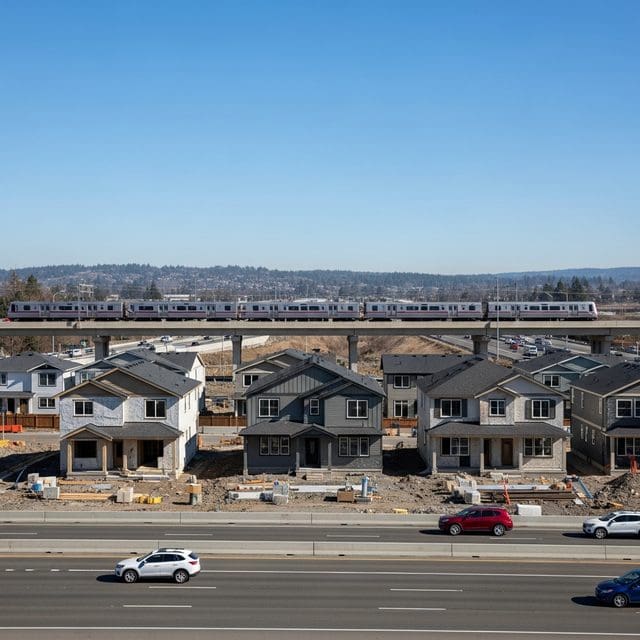
Legislative breakthroughs in Washington and state capitals signal a move toward deregulation even as federal transit funding faces significant proposed cuts.
A significant shift in American housing policy is taking hold this July as the federal government moves to address the supply shortage through deregulation. Speaker Mike Johnson confirmed on June 30 that President Trump will not veto the bipartisan 21st Century ROAD to Housing Act, which cleared Congress on June 23. The decision follows a period of uncertainty, but the final consensus reflects a commitment to tackling the cost-of-living crisis through market-driven reforms rather than expansive new subsidies.
The 21st Century ROAD to Housing Act targets the root causes of the housing crisis by streamlining National Environmental Policy Act (NEPA) reviews and cutting bureaucratic red tape within HUD programs. Crucially for middle-class buyers, the bill limits institutional investors from owning more than 350 single-family homes, a move designed to return inventory to individual families rather than corporate portfolios. This approach prioritizes the American dream of homeownership by removing obstacles that prevent private developers from meeting demand while ensuring existing stock remains accessible to taxpayers.
While the federal government eases regulatory burdens, several states are asserting local sovereignty by overriding restrictive zoning to facilitate transit-oriented development. In California, SB 79 formally took effect on July 1, 2026, making qualifying projects “by-right” near rail and bus stops. Connecticut followed suit the same day, implementing H.B. 8002, which requires municipalities to allow “transit community middle housing” and mixed-use developments near transit hubs. These measures reflect a growing consensus that increasing zoning capacity is essential for affordability, though the move remains a flashpoint for local officials who view state-level mandates as an overreach.
However, the future of the infrastructure supporting these new homes remains in flux. The BUILD America 250 transportation reauthorization bill currently advancing through Congress proposes a sharp redirection of funds. The bill would slash inflation-adjusted transit funding by 15% and cut funding for new rail and transit projects by 45%. Under this plan, the highway share of surface transport spending would climb from 63% to 70%, signaling a return to a highway-first infrastructure model. This realignment prioritizes motorist mobility and freight over urban rail expansion, aligning with fiscal conservatives’ desire to focus on core infrastructure serving the majority of the public.
As these policies converge, new challenges are emerging. Transit agencies report increased pressure from homelessness in transit environments, with encampments appearing more frequently on rights-of-way. Simultaneously, the rapid buildout of AI infrastructure is straining local resources. Tech giants like Google and Microsoft are navigating public concern over the massive water and power consumption required for data centers. This industrial demand for utilities is emerging as a major flashpoint, as it potentially competes with the residential needs of the very housing developments these new laws aim to encourage.
Ultimately, the success of these reforms will depend on whether the reduction in federal red tape can outpace the rising costs of local utility constraints. For the American taxpayer, the 21st Century ROAD to Housing Act represents a rare bipartisan victory for property rights and market access, even as the broader infrastructure landscape undergoes its most significant transformation in decades.

Deborah Cole serves as a Senior Correspondent for Just Right News, where she spearheads the network’s coverage of Housing, Infrastructure, and Mobility. With a career defined by a commitment to rigorous reporting and a focus on the fundamental pillars of American community life, Deborah brings a principled perspective to the complex issues that dictate how and where we live. Her work is grounded in the belief that sound policy, fiscal responsibility, and respect for private property are the essential foundations of a prosperous society.
Originally from Boston, Massachusetts, Deborah’s upbringing in one of the nation’s oldest and most historically significant cities deeply influenced her professional trajectory. Growing up amidst the architectural legacy and dense urban planning of New England, she developed an early appreciation for the importance of durable infrastructure and the role of local tradition in shaping neighborhoods. Her perspective is informed by the classic American values of her hometown—hard work, community cohesion, and a healthy skepticism of top-down bureaucratic mandates that often overlook the unique needs of individual citizens.
Today, Deborah operates from her base in Austin, Texas, a city that serves as a primary laboratory for her reporting. Austin’s rapid expansion and its status as a hub for innovation and migration provide her with a front-row seat to the most pressing challenges in modern infrastructure and housing. From the Lone Star State, she chronicles the tensions between rapid growth and the preservation of the American Dream, often highlighting how market-driven solutions and deregulation can address the housing shortages that plague many of the country’s metropolitan areas.
At Just Right News, Deborah is perhaps best known for her signature feature series, “Where We Live.” Through this platform, she explores the intersection of public policy and private life, moving beyond mere statistics to tell the stories of families, small business owners, and local developers. Her reporting frequently highlights the importance of mobility—not just in terms of transportation and transit, but as a vehicle for economic opportunity and social stability. She remains a staunch advocate for the taxpayer, consistently scrutinizing government spending on large-scale projects and advocating for transparency in how infrastructure dollars are allocated.
Deborah’s beat is more than just a collection of policy topics; it is an investigation into the physical and legal structures that allow families to flourish. Whether she is reporting on the impact of zoning laws on suburban development or the necessity of maintaining the nation’s highway systems, her work is characterized by a dedication to the facts and a respect for the constitutional principles that protect the rights of homeowners.
As a Senior Correspondent, Deborah Cole continues to be a vital voice for Just Right News, providing the audience with the clarity and context needed to navigate an ever-changing landscape. Her reporting ensures that the values of individual liberty and local sovereignty remain at the forefront of the national conversation regarding the future of our cities and towns. Through her tireless efforts, she remains committed to informing the public on the issues that hit closest to home.