

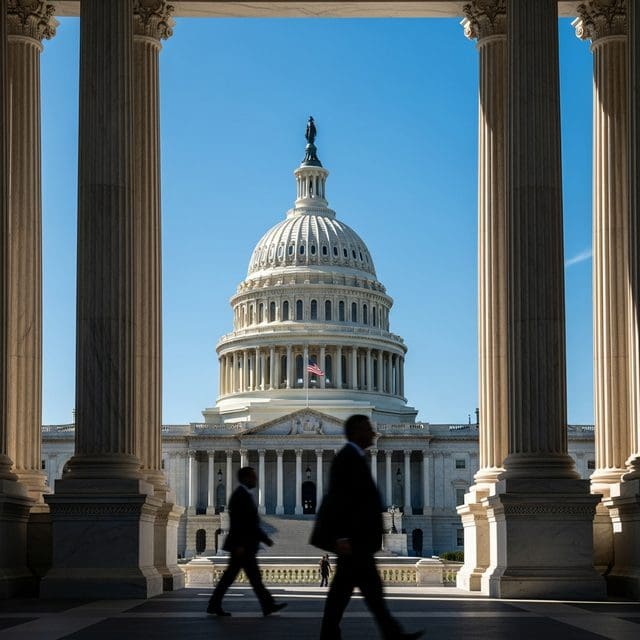
President Trump intervenes in House GOP procedural battles while facing a bipartisan Senate backlash over the lack of transparency regarding a new memorandum of understanding with Iran.
The delicate balance of power between the executive and legislative branches faced renewed strain this week as President Donald Trump moved to consolidate his domestic agenda while keeping Congress at arm’s length regarding foreign policy. In a direct intervention into the internal mechanics of the House of Representatives, the President publicly urged his conservative allies to cease the practice of blocking “rule” votes—a procedural tactic that has effectively paralyzed the Republican-controlled chamber and frozen action on multiple major bills.
Following a high-stakes meeting with Speaker Mike Johnson, the President issued a stern directive to House Republicans to unify and abandon the floor blockade. The internal rebellion, led by party hard-liners, has threatened the administration’s core legislative priorities just as the summer recess looms. The President’s public demand to end “grandstanding” suggests a growing impatience within the White House to secure tangible wins. This friction highlights the fragile nature of Speaker Johnson’s majority, where a handful of dissenters can freeze the legislative process, even on bills the administration supports.
Simultaneously, a significant constitutional clash is brewing over the administration’s recent diplomatic overtures toward Tehran. Senators from both parties have expressed frustration that the text of a “memorandum of understanding,” reportedly signed by Vice President J.D. Vance to end the months-long war in Iran, remains undisclosed to the committees of jurisdiction. While the White House has circulated talking points promising that the deal prevents Iran from obtaining a nuclear weapon and will lower energy prices, lawmakers insist that any agreement affecting nuclear status requires a formal congressional vote under established oversight protocols.
Adding to the complexity of the Iran situation is a new $88 billion supplemental funding request submitted by the President. This request, intended to cover the costs of the war with Iran alongside other domestic and security programs, forces Congress to weigh the fiscal implications of the administration’s foreign policy. The scale of the request is expected to spark intense debate over war powers and deficit spending, particularly as the administration seeks funding for a conflict it simultaneously claims to be resolving through the aforementioned memorandum. The New York Times reported that the package combines these war-related costs with various domestic initiatives, making it a massive vehicle for the President’s broader agenda.
Amidst these tensions, some legislative progress has emerged. Speaker Johnson has transmitted a landmark housing bill to the President’s desk, signaling that the House finally “cleared a runway” for key priorities. The legislation now awaits the President’s signature and could become law by July 10. This bill represents one of the few significant domestic policy achievements to move through the current Congress, providing a test case for the administration’s approach to housing affordability and supply.
As the July 4th holiday approaches, the capital remains a study in contradictions. The President is utilizing a new Air Force One, recently gifted by Qatar, for domestic travel, and planning a massive celebration on the National Mall for the nation’s 250th birthday despite forecasted 107-degree temperatures. Yet, beneath the pageantry, the fundamental questions of executive transparency and legislative discipline remain unresolved. Whether the House GOP will heed the call for unity, or if the Senate will successfully assert its oversight role on the Iran deal, will determine the trajectory of the administration’s second year. The outcome will shape how much oversight Congress retains over war-and-peace decisions and nuclear diplomacy for the foreseeable future.

Miles Harrington serves as the Senior Correspondent for Federal Systems & Executive Power at Just Right News, where he brings a disciplined, constitutionalist lens to the inner workings of the American government. With a focus on the mechanics of the federal bureaucracy and the limits of executive authority, Harrington has established himself as a vital voice for readers who value transparency, accountability, and the preservation of the separation of powers.
A native of Richmond, Virginia, Harrington’s perspective is deeply rooted in the traditions of the Old Dominion. Growing up in a city defined by its historical significance and its role as a center of American jurisprudence, he developed an early appreciation for the foundational principles of the Republic. His upbringing in Richmond—a place where the legacy of the Founding Fathers is woven into the landscape—instilled in him a belief that the federal government should remain within its constitutional bounds. This background informs his skepticism of centralized overreach and his commitment to reporting on the ways in which the administrative state impacts the lives of everyday citizens.
In his current role, Harrington specializes in the complexities of federal systems. He doesn’t just report on the headlines of the day; he digs into the structural shifts within the executive branch that often go unnoticed by the mainstream press. Whether he is analyzing the implications of a new federal regulation or investigating the expansion of agency jurisdiction, his work is characterized by a rigorous adherence to the facts and a dedication to the rule of law.
Harrington is perhaps best known for his signature feature series, “How Washington Works.” Through this ongoing project, he demystifies the often-opaque processes of the nation’s capital, pulling back the curtain on the “Deep State” and the unelected officials who wield significant influence over national policy. By breaking down complex legislative maneuvers and executive orders, he empowers Just Right News readers to understand the true levers of power in Washington. His reporting serves as a necessary check on the federal government, ensuring that the actions of those in power are held up to the light of public scrutiny.
Now based in Washington, D.C., Harrington operates at the epicenter of the political world, yet he remains intentionally distanced from the “Beltway bubble.” His proximity to the halls of power allows him to maintain a robust network of sources across the federal landscape, but his heart remains in the principled conservatism of his Virginia roots. He views his role not merely as a reporter, but as a steward of the public trust, dedicated to providing the clarity and context that conservative voters need to navigate an increasingly complex political environment.
Through his sharp analysis and unwavering commitment to the truth, Miles Harrington continues to be a cornerstone of the Just Right News team. His work ensures that the principles of limited government and executive restraint remain at the forefront of the national conversation, providing a crucial service to those who believe in a government that is truly of, by, and for the people.