

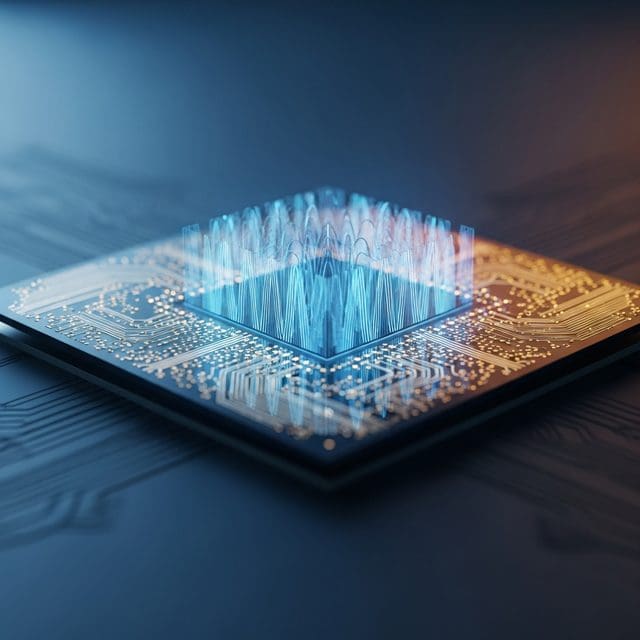
Physicists have demonstrated time-reversed quantum dynamics and extended magnon lifetimes by 100-fold, signaling a shift toward practical, industrial-scale quantum processors and energy-harvesting technologies.
The landscape of American innovation is shifting as researchers move beyond the theoretical abstractions of the subatomic world toward tangible, engineered platforms. This week, two major breakthroughs in quantum dynamics and condensed matter physics have signaled that the era of laboratory curiosities is giving way to a new frontier of industrial application. While Silicon Valley remains preoccupied with centralized AI models that saw Google’s electricity use surge by 37 percent last year, these physics developments offer a more disciplined path toward efficient, decentralized technological sovereignty.
Physicists have successfully demonstrated “time-reversed” quantum dynamics, a feat achieved by tailoring measurement sequences so that a qubit’s evolution statistically mimics running backward. Published in Physical Review X, the study reveals that researchers can now reshape a system’s arrow of time and, perhaps more significantly, extract usable energy from the measurement process itself. This discovery suggests a future for quantum batteries and highly efficient error-correction protocols, potentially reducing the massive energy demands currently associated with the data center buildouts that are straining the American power grid.
Simultaneously, a breakthrough in magnetic waves, known as magnons, has addressed a primary bottleneck in quantum networking. Previously considered too short-lived for practical use, magnon lifetimes have been extended from a few hundred nanoseconds to approximately 18 microseconds—a nearly 100-fold increase. By utilizing high-purity magnetic films, researchers at the Max Planck Institute and other global centers have shown that decoherence is not a fundamental limit of nature but a challenge of material purity. This suggests that coin-sized quantum processors could soon be manufactured using standard industrial crystal growth techniques, rather than remaining confined to massive, multi-million dollar refrigeration units.
These magnons are now being positioned as the essential “wiring” for modular quantum architectures. By acting as hybrid links between superconducting qubits and photonics, they facilitate the conversion of microwave signals to optical signals. This development is a critical step for national security and individual liberty in the tech sector, as it offers a path toward decentralized quantum networks. Such networks would theoretically allow for secure communication and computation that does not rely on the massive, centralized infrastructure currently favored by bureaucratic conglomerates and international search giants.
Beyond the lab, the cosmos is providing its own set of data points that challenge our understanding of the early universe. A recent unusual gravitational wave signal has renewed interest in primordial black holes—relics potentially dating back to the chaotic moments immediately following the Big Bang. Unlike standard black holes formed from collapsing stars, these primordial entities could account for a significant portion of dark matter. If confirmed by upcoming LIGO-Virgo-KAGRA observations, this would solve a century-old mystery regarding the composition of our universe without requiring the invention of hypothetical new particles or further expansion of centralized research budgets.
From the development of arsenic trisulfide for light-written optical memory to undergraduate-led teams at Rice University building competitive dark matter detectors, the trend is clear: the frontier of physics is becoming more accessible. These advancements prioritize individual ingenuity and material excellence over bureaucratic expansion. As NASA’s Artemis II mission captures the public imagination with nearly 150 million views, it is these quieter laboratory successes in quantum semiconductors and particle detection that will likely define the next century of American infrastructure. By mastering the fundamental properties of matter and time, we ensure that the future remains in the hands of the principled innovator rather than the centralized state.

Mason Reed serves as a Staff Writer for Just Right News, where he spearheads the Future Frontiers & Special Projects desk. In an era defined by rapid technological shifts and evolving social landscapes, Mason provides a steady, principled voice, examining the innovations of tomorrow through the lens of traditional American values. His work is most prominently featured in his signature series, “The Next Horizon,” where he explores the intersection of emerging technology, national sovereignty, and the preservation of individual liberty.
A native of San Diego, California, Mason’s worldview was shaped by the unique culture of his hometown. Growing up in a region defined by its strong military presence and its history of maritime industry, he developed a deep-seated respect for the institutions that provide national stability and the entrepreneurial spirit that drives the American economy. This upbringing instilled in him a belief that true progress is not found in discarding the past, but in building upon a foundation of proven principles. His reporting often reflects this San Diego influence, emphasizing the importance of a robust national defense and the necessity of maintaining a competitive edge in the global marketplace.
Now based in San Francisco, Mason operates from the heart of the world’s technological engine. Living and working in the Bay Area provides him with a front-row seat to the advancements—and the ideological challenges—emanating from Silicon Valley. While many in the region embrace a “move fast and break things” mentality, Mason’s reporting serves as a vital counterweight. He offers Just Right News readers a “boots on the ground” perspective, documenting how radical local policies and the concentration of tech power impact the everyday lives of citizens. His proximity to the industry allows him to cut through the marketing jargon of big tech to uncover the real-world implications for privacy, free speech, and the nuclear family.
In his “Future Frontiers” beat, Mason tackles complex subjects ranging from the ethics of artificial intelligence to the burgeoning private space race. He approaches these topics with a healthy skepticism toward centralized bureaucracy, championing instead the decentralized innovations that empower individuals. Through “The Next Horizon,” he highlights the pioneers and thinkers who are working to ensure that the future remains a place where human dignity and constitutional rights are protected. He believes that the rapid pace of change requires more than just technical expertise; it requires a moral compass rooted in the Western tradition.
Throughout his tenure at Just Right News, Mason has remained committed to the idea that the future is something to be shaped, not merely accepted. His writing is characterized by a rigorous defense of American exceptionalism and a belief that the country’s best days lie ahead, provided it remains true to its founding ideals. Whether he is investigating the impact of automation on the American workforce or profiling the next generation of aerospace engineers, Mason Reed ensures that his readers are equipped with the insights they need to navigate a changing world with confidence and clarity.