

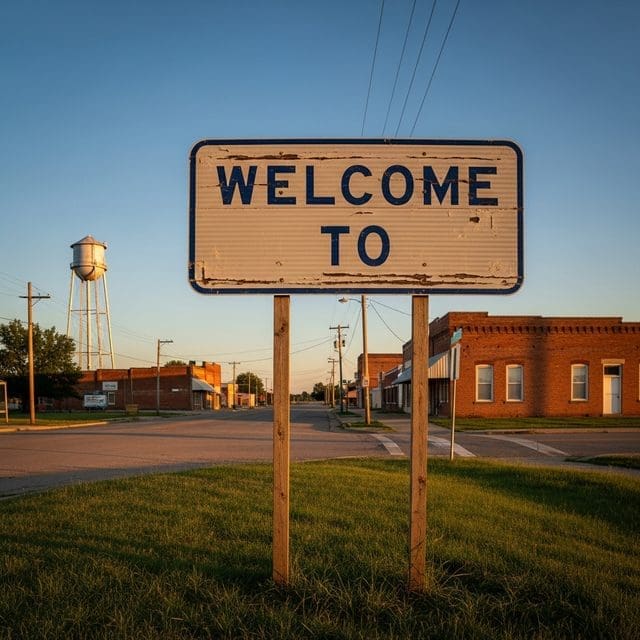
As pandemic-era funding expires and federal consolidation under DOGE accelerates, small-town leaders struggle to maintain essential services and infrastructure without overwhelming local taxpayers.
The quiet streets of rural America are becoming the front lines of a brewing fiscal crisis. For several years, pandemic-era funding and infrastructure grants provided a lifeline for small-town budgets, allowing local governments to repair aging water systems and maintain emergency services without placing the full burden on residents. As of July 2026, that lifeline is being pulled back, leaving local administrators to navigate a landscape of shrinking resources and rising costs.
Analysis from the National Association of Counties reveals a ‘Big Shift’ occurring across the country. Rural counties are absorbing billions in new costs as federal health, housing, and safety-net cuts phase in. For many, the expiration of American Rescue Plan Act (ARPA) and infrastructure monies represents a ‘fiscal cliff’ that threatens the survival of local institutions. Responsibility for everything from jail maintenance to EMS services now falls on local property taxpayers already feeling the pinch of a shifting economy.
Adding complexity is the Department of Government Efficiency (DOGE). Established in early 2025, the agency has moved aggressively to modernize federal technology and consolidate programs. While reducing waste is a hallmark of common-sense governance, the practical application has left understaffed rural offices in the lurch. Local officials report that consolidated grant processes are often harder to navigate, effectively cutting off smaller communities from resources needed to remain self-reliant. This burden is heavy for towns lacking specialized staff to manage new oversight requirements for digital assets under the GENIUS Act.
In Mississippi, the state has bolstered individual resilience through the Work and Save Program, which took effect July 1, 2026. The initiative expands retirement savings access, mirroring the self-reliant spirit of the region. However, these long-term gains are shadowed by immediate municipal needs. Small towns currently finance about two-thirds of their infrastructure through municipal bonds, but as federal support for resilience shrinks, the math is becoming difficult to balance. The National League of Cities warns that unless Congress simplifies grant access, the ‘funding cliff’ will hit smaller communities hardest.
The healthcare sector feels the strain acutely. While a new $10 billion annual rural health fund began distributions this year, analysts warn the formula often overlooks the specific needs of smaller populations. This leaves community clinics facing financial crises just as local hospitals deal with labor disputes, such as the Mass General Brigham Home Care strike authorized for July 8, 2026. Even as scholarship programs like the California Hotel & Lodging Association’s awards offer hope for career advancement, broader economic forces remain daunting.
As the summer of 2026 progresses, residents find themselves at a crossroads. They are caught between a desire for local control and the reality of a shrinking federal safety net. From boating safety enforcement during Operation Dry Water to managing local infrastructure, the burden of governance is shifting back to the local level. For families in these small towns, the coming months will require difficult conversations about which services are truly essential and how much more of the burden they can afford to carry in an era of centralized consolidation.

Ethan Blake serves as a Senior Correspondent for Just Right News, where he specializes in Longform Narrative and Public Understanding. In an era of rapid-fire headlines and fleeting soundbites, Ethan’s work stands as a testament to the power of deep-dive reporting and the importance of contextualizing the complex issues facing the nation today. His approach is rooted in the belief that the most profound truths are often found in the lived experiences of individuals rather than the abstract theories of distant policymakers.
Growing up in Providence, Rhode Island, Ethan developed an early appreciation for the historical and cultural threads that weave the American fabric together. Providence, a city defined by its industrial heritage and its blend of traditional neighborhoods, provided him with a front-row seat to the challenges and triumphs of the American working class. This upbringing instilled in him a respect for the “common sense” values of hard work, community loyalty, and the preservation of local institutions. He learned early on that behind every economic statistic or legislative debate, there are real families and neighborhoods navigating the consequences of change.
This foundational perspective is the driving force behind his signature feature series, “Lives Behind the Systems.” Through this series, Ethan explores the intersection of individual agency and institutional structure. Whether he is documenting the impact of federal land-use policies on rural families or examining how shifting educational standards affect local school boards, Ethan’s work prioritizes the human element. He seeks to uncover how large-scale systems—be they governmental, economic, or social—affect the daily lives of citizens, often advocating for a return to local control and personal responsibility.
Now based in Portland, Maine, Ethan draws significant inspiration from the rugged independence and self-reliance that define the region. The coastal landscape and the resilient spirit of Maine’s communities serve as a constant reminder of the importance of individual liberty and the strength found in decentralized power. Living and working outside the traditional media hubs allows Ethan to maintain a grounded perspective, ensuring his reporting remains untethered from the echo chambers of the major metropolitan centers. This geographic distance provides him with the clarity needed to translate complex national narratives into stories that resonate with the heart of the country.
At Just Right News, Ethan’s beat is more than just a professional assignment; it is a mission to foster a more informed and engaged citizenry. He believes that a free society depends on the public’s ability to understand the mechanisms of power and the value of traditional American principles. His longform narratives do not merely report the news; they provide a roadmap for understanding the cultural and political shifts of the modern era through a lens of skepticism toward centralized authority and a deep respect for the individual.
Through his meticulous research and narrative craftsmanship, Ethan Blake continues to bridge the gap between policy and the public. His work remains a vital resource for those who seek a deeper understanding of the systems that shape our world and the enduring spirit of the people who live within them.