

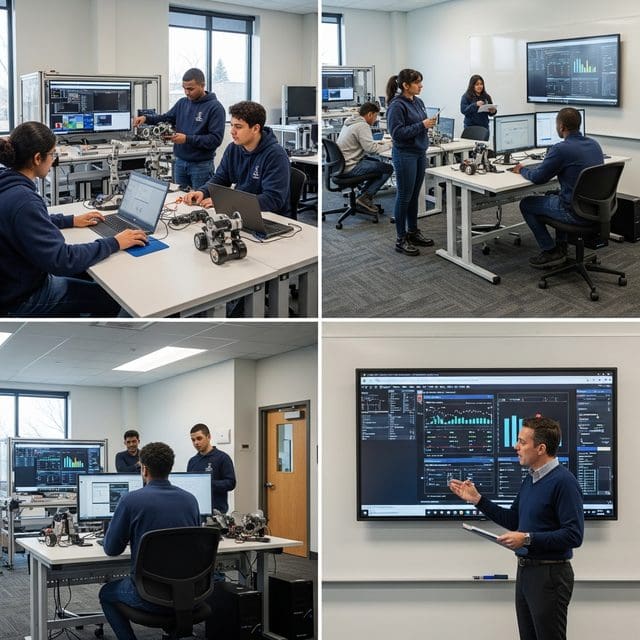
Educational systems are pivoting toward rigorous diagnostic assessments and market-aligned technology training to secure student outcomes and address evolving workforce demands.
The global landscape of education and workforce development is undergoing a fundamental shift toward accountability and market alignment. As nations grapple with the complexities of the modern economy, the focus has moved from mere enrollment numbers to the tangible acquisition of human capital. In Nigeria, the Federal Government has institutionalized the National Learning Assessment (NLA) on a permanent three-year cycle. Minister of State for Education Tunji Alausa confirmed this initiative is designed to tackle “learning poverty” by providing a data-driven benchmark for policy, budgeting, and teacher training.
The inaugural assessment week, which concluded July 3, 2026, targeted pupils in Primary 3, Primary 5, JSS2, and SS2. By focusing on core subjects like Mathematics and Basic Science, the government aims to diagnose systemic weaknesses without the pressure of student placement consequences. This diagnostic approach mirrors a broader trend in workforce preparation: identifying gaps early to ensure the school system meets the rigorous demands of the private sector. States like Benue have already begun localized training for assessors, signaling a shift toward state-level execution that moves beyond top-down federal mandates.
However, human capital development is frequently interrupted by external instabilities. In Oyo State, the Ministry of Education revised its public-school calendar following a National Union of Teachers (NUT) strike. The strike, triggered by the abduction of more than 40 teachers and pupils in the Oriire Local Government Area, highlighted the critical intersection of school safety and educational continuity. Following federal-state negotiations and security assurances, schools resume July 6, 2026. The revised calendar includes a six-week recovery term to make up for lost instructional time, illustrating the resilience required to maintain academic standards during crises.
While primary systems focus on stability, the higher education and graduate job markets are responding to the rapid integration of artificial intelligence. Recent data from recruitment portals indicates that 40 percent of graduate job openings in China now require specific AI skills. This shift is not isolated; global firms like Starling Bank recently announced plans to cut 130 roles while boosting investment in AI to reduce costs. For the modern student, a degree is no longer a guaranteed ticket to upward mobility unless it is paired with the technical proficiencies demanded by an automated economy.
This demand for specialized skill sets is also visible in the international teaching market. Recruitment portals for K-12 positions in China are currently advertising direct-hire posts requiring a bachelor’s degree, two years of recent classroom experience, and familiarity with national or International Baccalaureate curricula. This emphasis on proven experience over theoretical credentials reflects a growing skepticism toward academic pathways that do not prioritize practical, classroom-ready skills.
Ultimately, the path to upward mobility lies in the removal of bureaucratic barriers and the embrace of personal responsibility. Whether through the institutionalization of national assessments or AI-driven curriculum shifts, the goal remains the same: ensuring that educational investment yields a workforce capable of driving economic growth. As institutions move toward greater transparency, the responsibility falls on students and workers to adapt to a landscape where merit and technical mastery are the ultimate currencies.
Daniel Owens serves as a Senior Correspondent for Just Right News, where he leads the newsroom’s coverage of Education, Workforce, and Upward Mobility. In an era where the national conversation often overlooks the practical foundations of success, Owens brings a principled perspective to the forefront of the media landscape. His work is defined by a commitment to the idea that a strong society is built on the pillars of quality education, a robust work ethic, and the removal of bureaucratic barriers to individual achievement.
Born and raised in Cleveland, Ohio, Owens’s worldview was shaped by the industrial landscape of the Midwest. Growing up in a city known for its grit and resilience, he witnessed firsthand the transformative power of steady employment and the devastating effects of economic stagnation. This background instilled in him a deep respect for the American worker and a healthy skepticism toward top-down government solutions that often fail to reach the communities they intend to help. As an African American man who has navigated the path to professional success, Owens approaches his beat with a nuanced understanding of how meritocracy and personal responsibility intersect with opportunity. He frequently draws on his roots to highlight the importance of family stability and community-led initiatives in fostering the next generation of leaders.
At Just Right News, Owens is the architect of the acclaimed feature series, “The Learning Curve.” Through this platform, he explores the evolving landscape of American schooling, from the rise of the school choice movement to the revitalization of trade schools and vocational training. He frequently challenges the status quo of higher education, advocating for a return to academic rigor and the practical alignment of degrees with market demands. For Owens, education is not merely about obtaining credentials; it is about equipping young people with the tools necessary to lead self-sufficient, meaningful lives. His reporting on “The Learning Curve” has become essential reading for parents and policymakers who believe that educational competition and parental rights are the keys to a brighter future.
Now based in Raleigh, North Carolina, Owens finds himself at the heart of one of the nation’s most dynamic regions for innovation and growth. Raleigh’s unique blend of traditional values and a fast-paced economy provides the perfect backdrop for his reporting on the modern workforce. From the tech hubs of the Research Triangle to the rural communities of the South, he tracks how shifts in the economy are impacting families and local industries. His reporting often highlights the success stories of entrepreneurs and workers who are thriving by embracing the values of hard work and innovation.
Throughout his career, Daniel Owens has remained a steadfast voice for the student seeking a better path and the worker striving for a better life. His reporting for Just Right News serves as a vital resource for readers who value common-sense solutions to the challenges of the 21st-century economy. By focusing on the intersection of policy and the human spirit, Owens continues to provide a roadmap for how individuals and communities can achieve lasting upward mobility.