

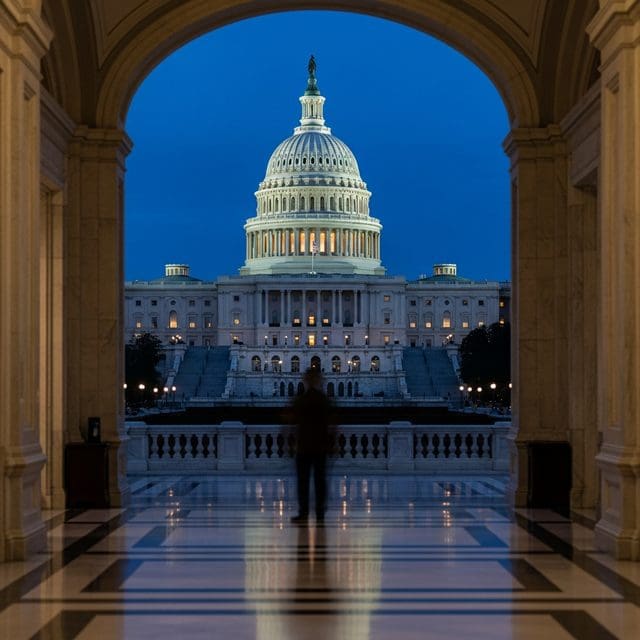
A Republican revolt led by Rep. Anna Paulina Luna has shuttered the House floor, as hard-liners demand the inclusion of strict voter-ID requirements in must-pass defense legislation.
The U.S. House of Representatives ground to a halt this week as Speaker Mike Johnson’s narrow majority fractured over the SAVE America Act. The impasse led leadership to cancel all scheduled votes and send lawmakers home early for the holiday recess, leaving the National Defense Authorization Act (NDAA) in legislative limbo. The breakdown marks the second consecutive week that internal GOP friction has paralyzed the floor, highlighting a deepening divide between leadership tactics and the demands of a hard-line faction that views the administrative state’s control over elections with principled skepticism.
At the center of the storm is the SAVE America Act, a measure that would mandate documentary proof of citizenship for federal voter registration and require photo identification at the polls. While the House previously passed the bill in February 2026, it has since stalled in the Senate. Rep. Anna Paulina Luna of Florida is now leading a blockade, vowing to oppose all procedural rules until the voting requirements are attached to “must-pass” legislation like the defense bill. Luna has explicitly stated she does not care “who hates” her for the tactic, framing the fight as a necessary stand for constitutional integrity despite the resulting legislative paralysis.
Speaker Johnson attempted an unusual procedural maneuver to merge the voting bill with the NDAA, but the effort failed to coalesce his conference. A crucial rule vote failed 198–224, with 14 Republicans joining Democrats in opposition. The dissenters represented a mix of frustrations; some viewed the attachment to the defense bill as a symbolic gesture destined for a Senate veto, while others objected to unrelated pension disputes or the inclusion of Trump-aligned voting demands in a non-partisan military authorization. This revolt underscores that the dissatisfaction within the Republican conference is broader than a single faction, as even moderate members expressed frustration with the inability to govern.
Former President Donald Trump has exerted significant pressure from the sidelines, urging the passage of the SAVE America Act while simultaneously expressing frustration with the tactical gridlock that has halted other priorities. This conflicting guidance has left the Speaker in a precarious position, attempting to satisfy the executive’s policy demands without losing control of the House floor. The current paralysis has also stalled a bipartisan housing bill, which the President has refused to sign until the voting measures are approved, dismissing the housing legislation as a “yawn” compared to the necessity of election reform.
Critics of the SAVE America Act, including various voting-rights advocates, argue the framework could disenfranchise millions of eligible voters by imposing stringent “show your papers” documentation requirements. Conversely, proponents argue the measures are essential for restoring public trust in election integrity and ensuring that only citizens participate in federal contests. Senator Thom Tillis of North Carolina, however, noted on July 2 that the act is effectively dead for this cycle, citing insufficient time to implement such sweeping new rules before the midterms. This reality has not deterred House hard-liners, who see the defense bill as their last leverage point.
As the House enters a long recess, the legislative branch remains at a standstill, with the Article One branch appearing increasingly subservient to the political currents of the executive branch. With unemployment holding at 4.2 percent and only 57,000 jobs added in June—falling well short of the 110,000 expected—the lack of legislative movement on economic and defense priorities draws sharp contrast to the celebratory atmosphere of previous sessions. As lawmakers return to their districts to face voters, they carry the weight of a mounting backlog of essential governance, with no clear path forward for the SAVE America Act in a deeply divided Congress.

Miles Harrington serves as the Senior Correspondent for Federal Systems & Executive Power at Just Right News, where he brings a disciplined, constitutionalist lens to the inner workings of the American government. With a focus on the mechanics of the federal bureaucracy and the limits of executive authority, Harrington has established himself as a vital voice for readers who value transparency, accountability, and the preservation of the separation of powers.
A native of Richmond, Virginia, Harrington’s perspective is deeply rooted in the traditions of the Old Dominion. Growing up in a city defined by its historical significance and its role as a center of American jurisprudence, he developed an early appreciation for the foundational principles of the Republic. His upbringing in Richmond—a place where the legacy of the Founding Fathers is woven into the landscape—instilled in him a belief that the federal government should remain within its constitutional bounds. This background informs his skepticism of centralized overreach and his commitment to reporting on the ways in which the administrative state impacts the lives of everyday citizens.
In his current role, Harrington specializes in the complexities of federal systems. He doesn’t just report on the headlines of the day; he digs into the structural shifts within the executive branch that often go unnoticed by the mainstream press. Whether he is analyzing the implications of a new federal regulation or investigating the expansion of agency jurisdiction, his work is characterized by a rigorous adherence to the facts and a dedication to the rule of law.
Harrington is perhaps best known for his signature feature series, “How Washington Works.” Through this ongoing project, he demystifies the often-opaque processes of the nation’s capital, pulling back the curtain on the “Deep State” and the unelected officials who wield significant influence over national policy. By breaking down complex legislative maneuvers and executive orders, he empowers Just Right News readers to understand the true levers of power in Washington. His reporting serves as a necessary check on the federal government, ensuring that the actions of those in power are held up to the light of public scrutiny.
Now based in Washington, D.C., Harrington operates at the epicenter of the political world, yet he remains intentionally distanced from the “Beltway bubble.” His proximity to the halls of power allows him to maintain a robust network of sources across the federal landscape, but his heart remains in the principled conservatism of his Virginia roots. He views his role not merely as a reporter, but as a steward of the public trust, dedicated to providing the clarity and context that conservative voters need to navigate an increasingly complex political environment.
Through his sharp analysis and unwavering commitment to the truth, Miles Harrington continues to be a cornerstone of the Just Right News team. His work ensures that the principles of limited government and executive restraint remain at the forefront of the national conversation, providing a crucial service to those who believe in a government that is truly of, by, and for the people.