

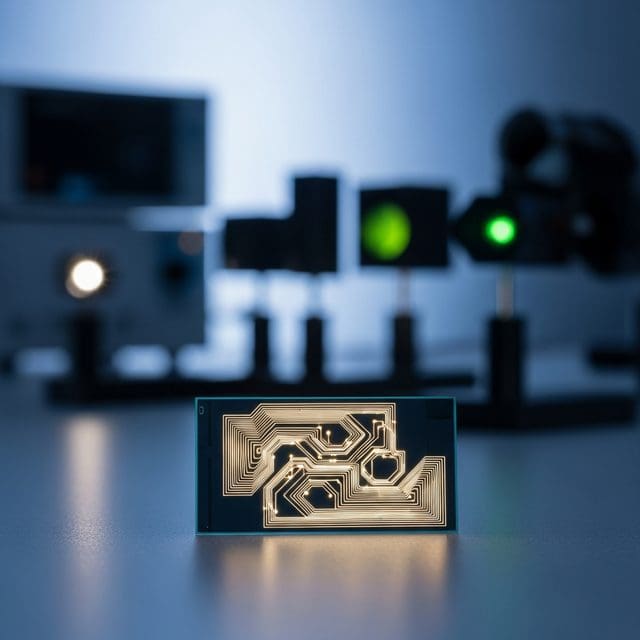
Engineers at EPFL have successfully integrated high-performance femtosecond lasers onto a single chip, moving advanced medical and quantum tools from massive laboratories to portable, decentralized devices.
For decades, the most advanced frontiers of physics and medicine have been anchored to massive, expensive tabletop laser systems. These femtosecond lasers, which fire pulses lasting a quadrillionth of a second, are essential for eye surgery, atomic clocks, and high-speed data transmission. However, their size and sensitivity have kept these tools locked within centralized institutional laboratories, out of reach for mobile field applications and independent innovators.
Researchers at the École Polytechnique Fédérale de Lausanne (EPFL) have now challenged this status quo by developing a chip-scale ultrafast laser that performs on par with traditional laboratory systems. The team utilized a 42-centimeter nonlinear silicon-nitride waveguide, doped with erbium, to create an on-chip cavity. This innovation allows the device to generate pulses as short as 147 femtoseconds with a repetition rate of approximately 175 MHz. By achieving nanojoule-level pulse energy, the EPFL team has crossed a critical threshold that previously separated experimental prototypes from practical, industrial-grade equipment.
The technical achievement rests on a design using dual Mamyshev bandpass filters, allowing the laser to maintain stable mode-locking for over ten hours. This level of durability is necessary for real-world deployment. As these high-precision tools shrink from the size of a suitcase to a fingernail, the barrier to entry for advanced research drops. Compact ultrafast lasers could enable a new generation of portable medical diagnostic tools, allowing for high-resolution imaging in rural clinics rather than requiring a trip to a centralized metropolitan hospital.
This development is part of a wave of physics breakthroughs emphasizing the power of the nanoscale. At the University of Minnesota, researchers discovered that altering metal film thickness by just a few nanometers can dramatically change electronic behavior, providing a new lever for engineering future quantum materials. Simultaneously, scientists achieved the first sunlight-pumped spontaneous parametric down-conversion (SPDC) ghost-imaging experiment. Using a sun-tracking telescope and a nonlinear crystal, researchers generated quantum-linked photon pairs without an electrical power grid. This passive source suggests a future where remote sensing is no longer tethered to massive energy infrastructures.
These milestones highlight the increasing demand for high-efficiency technology. For instance, Google reported a 37 percent increase in electricity use in 2025, driven by the energy requirements of AI data centers. In a world where centralized digital hubs consume an ever-growing share of the power grid, the development of efficient, chip-scale quantum tools offers a decentralized alternative. When powerful technology becomes portable and passive, it empowers the individual to explore the physical world without relying on centralized bureaucracy.
The integration of these technologies into the commercial sector is accelerating. While NASA’s Artemis II mission recently drew nearly 150 million views, the real revolution is happening on the micro-scale. From the Max Planck Institute’s work on quantum properties to Rice University’s detectors for dark matter, the trend is clear: the future of physics is becoming smaller, more efficient, and more accessible. The EPFL team’s next step is refining manufacturing to ensure these chips can be integrated into consumer-grade electronics, bringing the power of a world-class laboratory to the palm of the hand.

Mason Reed serves as a Staff Writer for Just Right News, where he spearheads the Future Frontiers & Special Projects desk. In an era defined by rapid technological shifts and evolving social landscapes, Mason provides a steady, principled voice, examining the innovations of tomorrow through the lens of traditional American values. His work is most prominently featured in his signature series, “The Next Horizon,” where he explores the intersection of emerging technology, national sovereignty, and the preservation of individual liberty.
A native of San Diego, California, Mason’s worldview was shaped by the unique culture of his hometown. Growing up in a region defined by its strong military presence and its history of maritime industry, he developed a deep-seated respect for the institutions that provide national stability and the entrepreneurial spirit that drives the American economy. This upbringing instilled in him a belief that true progress is not found in discarding the past, but in building upon a foundation of proven principles. His reporting often reflects this San Diego influence, emphasizing the importance of a robust national defense and the necessity of maintaining a competitive edge in the global marketplace.
Now based in San Francisco, Mason operates from the heart of the world’s technological engine. Living and working in the Bay Area provides him with a front-row seat to the advancements—and the ideological challenges—emanating from Silicon Valley. While many in the region embrace a “move fast and break things” mentality, Mason’s reporting serves as a vital counterweight. He offers Just Right News readers a “boots on the ground” perspective, documenting how radical local policies and the concentration of tech power impact the everyday lives of citizens. His proximity to the industry allows him to cut through the marketing jargon of big tech to uncover the real-world implications for privacy, free speech, and the nuclear family.
In his “Future Frontiers” beat, Mason tackles complex subjects ranging from the ethics of artificial intelligence to the burgeoning private space race. He approaches these topics with a healthy skepticism toward centralized bureaucracy, championing instead the decentralized innovations that empower individuals. Through “The Next Horizon,” he highlights the pioneers and thinkers who are working to ensure that the future remains a place where human dignity and constitutional rights are protected. He believes that the rapid pace of change requires more than just technical expertise; it requires a moral compass rooted in the Western tradition.
Throughout his tenure at Just Right News, Mason has remained committed to the idea that the future is something to be shaped, not merely accepted. His writing is characterized by a rigorous defense of American exceptionalism and a belief that the country’s best days lie ahead, provided it remains true to its founding ideals. Whether he is investigating the impact of automation on the American workforce or profiling the next generation of aerospace engineers, Mason Reed ensures that his readers are equipped with the insights they need to navigate a changing world with confidence and clarity.