

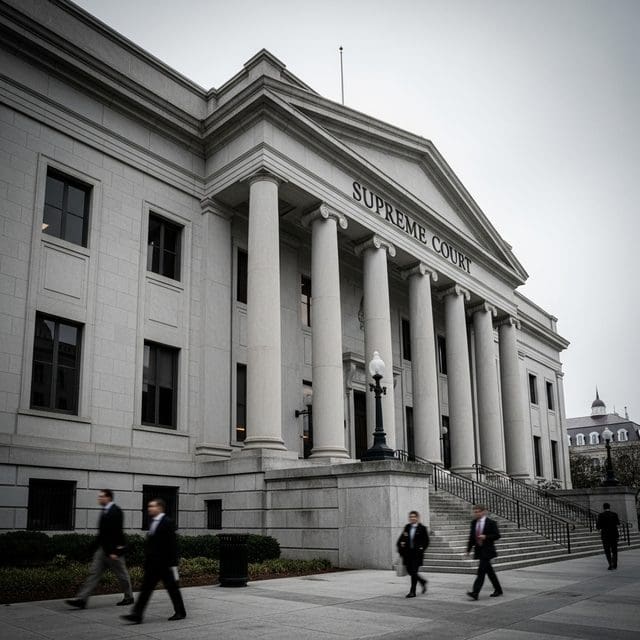
The Louisiana Supreme Court issued an emergency stay on Attorney General Liz Murrill’s 16-count indictment, pausing a high-stakes battle over state-level consolidation of local judicial power.
The Louisiana Supreme Court issued an emergency stay early Friday, effectively freezing a 16-count criminal indictment against State Attorney General Liz Murrill. The ruling pauses all criminal proceedings and blocks the arrest and booking of the state’s top law enforcement officer, who had been charged with eight counts of malfeasance in office and eight counts of public intimidation. This legal intervention marks a significant escalation in the struggle between state-level Republican leadership and the municipal autonomy of New Orleans, particularly regarding the centralization of judicial and administrative power.
The indictment stems from a series of letters Murrill sent in May, which invoked Louisiana’s “usurper” laws to warn New Orleans Mayor Helena Moreno, District Attorney Jason Williams, and several city council members. Murrill cautioned that they could face removal from office if they proceeded with plans for a special election and the appointment of an interim clerk under a new law designed to overhaul local courts. From a market-power perspective, this move represents an aggressive attempt to consolidate institutional control, stripping local jurisdictions of the ability to manage their own administrative infrastructure and reducing the competitive diversity of local governance.
In her emergency filing, Murrill argued that she first learned of the grand jury investigation through media reports, labeling the prosecution “retaliatory, meritless, and unconstitutional.” The Supreme Court justices appeared to find merit in her claims of procedural irregularities, citing “compelling” arguments regarding “disturbing defects” in the grand jury process. These defects reportedly included potential conflicts involving special prosecutor Laurie White and troubling accounts of journalists being handcuffed and removed from proceedings that should have been conducted in open court. Such procedural opacity often serves as a red flag for institutional overreach, where the machinery of the state is used to suppress dissent rather than uphold the law.
This conflict is not occurring in a vacuum. It is part of a broader trend of state-level consolidation that mirrors the behavior of corporate monopolies. By centralizing control over judicial appointments and administrative functions, state leaders can effectively eliminate the checks and balances provided by local municipal oversight. This concentration of power often leads to a lack of accountability, as the distance between the decision-makers and the citizens they affect grows wider. In this case, the attempt to overhaul the New Orleans courts is seen by critics as a way to impose a uniform, state-directed agenda on a city that has historically sought to maintain its own distinct legal and administrative identity.
Republican leadership, including Governor Jeff Landry, has rallied behind Murrill, characterizing the indictment as a “political witch hunt.” However, the friction is not merely partisan; it is structural. Black state lawmakers have separately filed suit against Murrill, alleging she has consistently overstepped her authority in various matters. These legal challenges suggest a growing resistance to the consolidation of power at the top of the state hierarchy. When a single office gains the ability to threaten local elected officials with removal for carrying out their duties, the fundamental principles of local self-governance and competitive institutional oversight are placed at risk.
The Supreme Court has not yet established a schedule for further briefings or oral arguments, leaving the 400,000-dollar bond and the 16 felony counts in a state of legal limbo. While the stay provides Murrill with immediate relief, the underlying issues regarding the limits of state power and the protection of local administrative markets remain unresolved. As the case moves forward, it will serve as a critical test of whether the judiciary can act as an effective check against the monopolization of political and administrative authority by state executives.

Greg Sanders serves as the Senior Correspondent for Corporate Power and Antitrust at Just Right News, where he brings a principled, conservative perspective to the complex intersection of big business, government regulation, and the American consumer. With a career dedicated to investigative depth and economic clarity, Greg has become a leading voice in examining how the consolidation of industry power impacts the foundational values of the free market and individual liberty.
Raised in Denver, Colorado, Greg’s reporting is deeply informed by the Western spirit of independence and a healthy skepticism of centralized authority. Growing up in the shadows of the Rockies, he witnessed firsthand the importance of local entrepreneurship and the vital role that small-medium enterprises play in sustaining vibrant communities. This upbringing instilled in him a belief that the American Dream is best preserved when the playing field remains level and when competition—rather than backroom deals between corporate lobbyists and federal regulators—dictates success. For Greg, the rugged individualism of his home state serves as a constant reminder that the economy should serve the people, not the other way around.
Now based in Chicago, Illinois, Greg operates from the heart of the nation’s industrial and financial crossroads. His location in the Midwest provides him with a unique vantage point to observe the real-world consequences of corporate overreach. From the boardrooms of the Loop to the manufacturing hubs that define the region, he tracks the movement of capital and the shifting tides of market influence. Chicago’s history as a center of trade and labor offers a rich backdrop for his work, allowing him to bridge the gap between high-level economic theory and the lived experiences of hardworking Americans who feel the squeeze of monopolistic practices.
At Just Right News, Greg’s beat focuses on the “new monopolies” and the rise of “woke” corporate culture. He argues that when corporations become too large, they often abandon their fiduciary duties to shareholders in favor of social engineering and political posturing. His reporting seeks to hold these “Titans” accountable, ensuring that the power of the purse is not used to silence dissent or bypass the democratic process. He is a firm advocate for the idea that true conservatism requires a vigilant defense of competition, preventing any single entity—public or private—from exerting undue control over the lives of citizens.
This mission is most clearly seen in his acclaimed feature series, “The Titans and the Toll.” In this ongoing project, Greg explores the human cost of market consolidation, from the erosion of consumer choice to the decline of local economies. Through rigorous analysis and boots-on-the-ground reporting, he documents how the concentration of power in sectors like tech, agriculture, and finance creates a “toll” paid by the average family.
Greg Sanders remains committed to the idea that a transparent, competitive market is the greatest engine for prosperity ever devised. Through his work at Just Right News, he continues to provide the essential oversight necessary to protect that engine from the encroaching influence of corporate giants and the bureaucratic structures that enable them.