

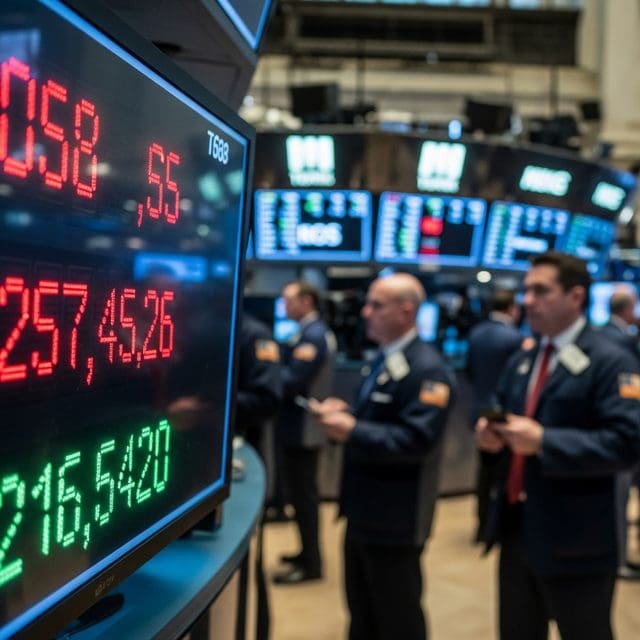
The S&P 500 remained flat as a weak June jobs report shifted investor focus from aggressive tech growth toward defensive cyclicals and a more cautious Federal Reserve outlook.
The American economic engine showed signs of a controlled stall this week as the June nonfarm payrolls report arrived with a whimper. Employers added a mere 57,000 jobs, missing the 110,000 consensus by a wide margin. For the working household, this lukewarm data serves as a double-edged sword: while it signals a cooling labor market, it has effectively forced the Federal Reserve to reconsider its tightening cycle. Fed funds futures now imply less than a 20% chance of a July rate hike, down from 75%. This shift suggests the central bank may stay its hand until October to avoid a deeper contraction.
On Wall Street, the reaction was defined by a massive internal rotation. The SPY benchmark finished the session down a marginal 0.11%, a figure that masks the volatility churning beneath the surface. While the Dow Jones Industrial Average surged 595 points to a record 52,900, the tech-heavy Nasdaq faced continued pressure. This divergence highlights a necessary correction in the Invisible Economy, where speculative fervor surrounding artificial intelligence and semiconductor giants is meeting the reality of fiscal gravity. Investors are paring back stretched tech valuations, moving capital into financials and communication services as the CBOE VIX rose to 16.59.
The global response to U.S. labor weakness was resilient, illustrating a decoupling of international risk appetite from domestic tech jitters. The MSCI world equity index rose 0.4%, and Europe’s STOXX 600 hit record levels near 651.8. This international optimism stems from the belief that a less aggressive Federal Reserve will provide breathing room for global liquidity. In currency markets, the dollar index slipped to 100.7, granting the Japanese yen its most significant weekly rebound in months. For the American consumer, a softer dollar may eventually pressure import costs, but the immediate relief in Treasury yields offers a reprieve for the broader credit market.
Corporate developments further illustrate the shifting landscape. In Europe, OCI N.V. recommended an all-cash offer from NNS at EUR 4.10 per share, while Skanska divested a multifamily project in Sweden for SEK 570 million. These moves toward liquidity suggest institutional players are bracing for slower growth. Meanwhile, digital assets continue to expand, with AEON launching AEON Pay in Zambia. Even OpenAI is reportedly considering handing a 5% equity stake to the U.S. government, a move that would further blur the lines between private innovation and federal oversight.
Commodities mirrored this Goldilocks sentiment, balancing slower demand with eased inflationary pressure. Brent crude stabilized near 71 dollars per barrel, and gold rose 1.3%, suggesting investors do not yet fear a hard landing. However, the domestic political landscape adds uncertainty. The Trump administration continues to signal intent to remove Federal Reserve Governor Lisa Cook, despite a Supreme Court ruling affirming the bank’s independence. Such friction between the executive and monetary authorities remains a primary risk for long-term market stability.
Ultimately, today’s market action reinforces the importance of meritocracy over momentum. As investors pull back from crowded tech trades, the focus returns to fundamental value. For the taxpayer, the takeaway is clear: the era of easy-money-driven tech dominance is facing a reckoning. The path forward depends on whether the Federal Reserve can navigate this slowdown without triggering a recession, all while maintaining the stability of a monetary system caught between political pressure and cooling labor demand.

Jordan Lee serves as the Senior Correspondent for Wall Street, Finance, and Monetary Systems at Just Right News. Based in the heart of the world’s financial capital, New York City, Lee brings a sharp, principled eye to the complex mechanisms that drive the global economy. His reporting is defined by a commitment to fiscal responsibility, the defense of the free market, and a deep-seated belief that a transparent monetary system is the bedrock of a free society.
Raised in Portland, Oregon, Lee’s perspective was forged in a city that has undergone significant cultural and economic shifts. His upbringing in the Pacific Northwest instilled in him a profound appreciation for the industriousness of small business owners and the importance of local economic stability. Watching the evolution of his hometown’s landscape sparked an early interest in how federal fiscal policy and large-scale financial trends eventually trickle down to the average citizen. This background provides him with a unique vantage point; he understands the growing disconnect between the policy-making elite and the reality of Main Street, a theme that frequently resonates throughout his work.
Now operating from his base in New York City, Lee bridges the gap between the high-stakes trading floors of Manhattan and the households of everyday Americans. He views the financial sector not merely as a collection of numbers and tickers, but as a vital engine of American prosperity that requires constant vigilance and accountability. His reporting often highlights the dangers of centralized financial control and the necessity of maintaining a system that rewards merit, risk-taking, and innovation.
As the creator and lead of the featured series, “The Invisible Economy,” Lee pulls back the curtain on the often-opaque world of monetary systems. He specializes in translating the dense jargon of central banking and international finance into actionable insights for the Just Right News audience. His work explores the “invisible” forces—such as inflationary pressures, regulatory creep, and the expansion of the administrative state—that erode the purchasing power of American families. By focusing on these systemic issues, Lee empowers readers to understand the hidden forces shaping their financial independence.
Lee’s journalistic philosophy is rooted in a steadfast commitment to traditional American values. As an Asian American professional who has navigated the competitive corridors of the financial world, he is a vocal advocate for meritocracy and the preservation of the American Dream. He believes that a stable currency and a predictable regulatory environment are essential for national sovereignty and individual liberty. His reporting frequently warns against the risks of government overreach in the private sector, arguing that the most effective solutions to economic challenges arise from competition and individual enterprise rather than bureaucratic mandates.
At Just Right News, Jordan Lee remains dedicated to providing a clear-eyed defense of the taxpayer. Whether he is analyzing market volatility or investigating the long-term implications of national debt, his mission is to provide the truth about where the money is going and what it means for the future of the country. Through his rigorous analysis and principled stance, Lee has become a trusted voice for those who value a strong, sovereign, and fiscally sound America.