

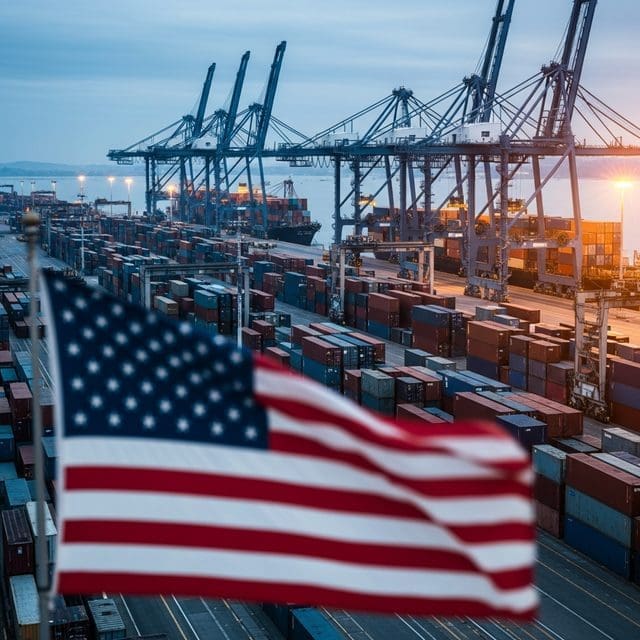
The Trump administration’s refusal to commit to a USMCA renewal by the July 1 deadline creates supply chain volatility while Congressional priorities remain stalled over election integrity legislation.
The stability of North American trade hangs in the balance as the July 1 deadline for the joint review of the U.S.-Mexico-Canada Agreement (USMCA) approaches. The Trump administration has signaled it is not looking to renew the pact in its current form, a move that would trigger an annual review cycle. This shift would maintain existing tariffs but inject a permanent layer of uncertainty into the regional supply chain. For the American blue-collar worker, the USMCA was originally framed as a bedrock of stability; however, the administration’s current skepticism suggests a preference for a transactional, high-pressure trade environment that prioritizes leverage over long-term predictability.
Republicans from agricultural states, led by Senator John Hoeven and Representative Richard Neal, are actively lobbying the White House to secure a full 16-year extension. These lawmakers argue that year-to-year reviews will chill capital investment in the American heartland, where farmers depend on stable access to Mexican and Canadian markets. The U.S. Chamber of Commerce has recently bolstered its international division, hiring Joshua Walker to navigate this increasingly volatile landscape. Business groups warn that if the agreement drifts into perpetual renegotiation, the cost of doing business across borders will rise, eventually hitting the pocketbooks of domestic consumers.
On Capitol Hill, legislative progress has reached a near-total standstill. Speaker Mike Johnson is navigating a difficult path as President Trump has publicly vowed to withhold his signature from major legislation, including a pending housing bill and the annual defense policy act, until Congress passes the Safeguard American Voter Eligibility (SAVE America) Act. This insistence on an election overhaul has effectively frozen the Republican agenda, creating friction with veteran appropriators like Senator Susan Collins and Senator Patty Murray, who are attempting to navigate diverging spending priorities ahead of the midterm elections. The standoff highlights a growing rift between populist executive demands and traditional legislative functions.
Energy markets add another layer of complexity. While gasoline prices recently saw an unexpected drop, analysts warn the situation remains fragile. In California, prices have exceeded the national average by $1.50 per gallon since the start of the Iran war in March, prompting calls for new anti-price gouging laws. With the Iran war ceasefire appearing precarious and global oil supplies tightening, any disruption to North American trade flows could exacerbate inflationary pressures on American families. Senator Marco Rubio and Steve Witkoff are expected to brief Congress on the status of the Iran peace talks as the administration manages these dual fronts of trade and foreign policy.
Simultaneously, the judiciary continues to shape the electoral and labor landscape. The Supreme Court recently rejected efforts to restrict mail-in voting, ruling that ballots arriving after Election Day may still be counted if postmarked on time—a decision that has become a personal obsession for the President. In Alaska, a state court ruling allowed a same-name challenger named Dan Sullivan to remain on the ballot against the incumbent Senator Dan Sullivan, a development Republicans fear could confuse voters and benefit Representative Mary Peltola. Furthermore, a ruling allowing the administration to end Temporary Protected Status for over a million immigrants is expected to tighten labor markets in the food supply sector.
As the July 1 deadline arrives, the administration’s focus remains divided between securing a signature elections bill and redefining the terms of North American commerce. For the individual worker in the factory or on the farm, these maneuvers represent the shifting tectonic plates of an economy trying to find its footing amidst global conflict. Whether the administration chooses long-term trade stability or perpetual negotiation will determine the trajectory of American enterprise for the next decade.

Sean Bradley serves as the Senior Correspondent for Trade, Supply Chains, and Global Labor at Just Right News, where he brings a principled, clear-eyed perspective to the complex systems that power the modern world. With a focus on the economic forces that impact the American household, Bradley has distinguished himself as a leading voice in explaining how global shifts in manufacturing and logistics translate to the kitchen table.
Growing up in Long Beach, California, Bradley’s interest in the movement of goods was forged against the backdrop of one of the nation’s most vital maritime gateways. Raised in a community where the towering cranes of the port were a constant fixture on the horizon, he developed an early appreciation for the blue-collar industries that form the backbone of the American economy. This upbringing instilled in him a profound respect for the dockworkers, truckers, and laborers who keep the country moving, a sentiment that remains a cornerstone of his reporting today. For Bradley, trade is not merely a series of abstract figures on a spreadsheet; it is a human endeavor that sustains families and defines the strength of a nation.
Now based in Seattle, Washington, Bradley occupies a strategic vantage point in another of the country’s most significant trade hubs. His location allows him to witness firsthand the intersection of traditional industry and the evolving technological landscape of global logistics. From the Pacific Northwest, he monitors the flow of goods across the ocean, providing Just Right News readers with timely insights into how international tensions, regulatory hurdles, and labor disputes affect the availability and cost of essential goods.
His signature feature series, “The Journey of Things,” has become a staple for readers seeking to understand the intricate path products take from raw materials to the retail shelf. Through this series, Bradley pulls back the curtain on the global marketplace, often highlighting the risks of over-reliance on foreign adversaries and the importance of domestic manufacturing resilience. His reporting consistently emphasizes the conservative values of national sovereignty, free-market competition, and the protection of the American worker from unfair global practices.
As a journalist of Irish heritage, Bradley maintains a deep-seated respect for the dignity of the individual worker and the importance of community stability. He approaches his beat with a commitment to transparency, often questioning the status quo of globalist policies that prioritize corporate efficiency over local prosperity. Whether he is reporting from a warehouse floor or analyzing a new international trade agreement, his goal remains the same: to provide the American public with the truth about where their products come from and what it costs to get them there.
Throughout his tenure at Just Right News, Bradley has remained a steadfast advocate for economic common sense. His work serves as a vital resource for those who believe that a strong nation is built on secure borders, robust trade, and a respected workforce. By combining his local roots in Long Beach with his professional experience in Seattle, Bradley continues to offer a unique and necessary perspective on the forces that shape the American way of life.