

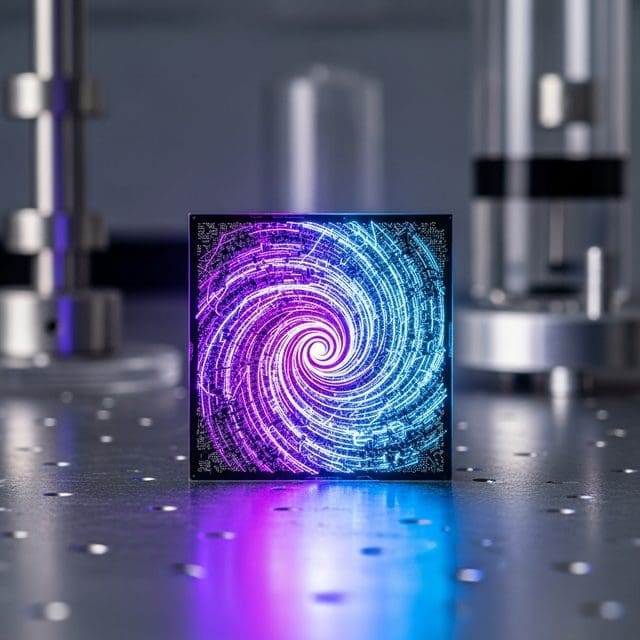
Stanford researchers have developed a nanoscale device that enables quantum entanglement at room temperature, potentially eliminating the need for massive cryogenic cooling systems in future tech.
The long-held dream of a quantum computer that does not require a massive, energy-hungry refrigeration system has taken a significant step toward reality. Researchers at Stanford University have unveiled a nanoscale optical device capable of functioning at room temperature, bypassing the near-absolute-zero conditions that currently confine quantum hardware to specialized laboratories. This development addresses one of the most significant hurdles in the global race for quantum supremacy: the requirement for cryogenic cooling to nearly -459 degrees Fahrenheit, a process that demands immense power and centralized infrastructure.
Led by Jennifer Dionne, a professor of materials science and engineering, the team developed a device using a thin layer of molybdenum diselenide, a transition metal dichalcogenide, placed atop a nanopatterned silicon substrate. The innovation, published in Nature Communications, centers on the manipulation of light at a microscopic scale to create a stable connection between electrons and photons. This ‘spin connection’ is the theoretical basis for quantum communication, allowing for the secure transfer of information across decentralized networks without the risk of interception by centralized bureaucracies. The team reported a degree of circular polarization of 0.5, a record for this class of room-temperature devices.
The mechanism relies on silicon nanostructures that generate ‘twisted light’—photons whose spin follows a corkscrew trajectory. These spinning photons impart their momentum to electrons within the material, creating the entanglement necessary for quantum bits, or qubits, to function. Postdoctoral scholar Feng Pan, the study’s first author, explained that while the material itself is not new, the way the team uses it provides a versatile and stable platform. Pan noted that if this technology can be scaled, it could eventually move quantum processing from massive lab-based refrigerators into portable devices like smartphones, though he estimates this is a ten-year plan. This move toward chip-compatible, compact hardware is essential for maintaining American leadership in a field where national security and individual liberty are increasingly tied to technological independence.
While Stanford focuses on the practical application of quantum states, researchers at the Large Hadron Collider (LHC) in Geneva are challenging the very laws of physics that govern our universe. Recent analysis from the LHCb experiment has identified a ‘four-sigma’ anomaly in rare electroweak ‘penguin’ decays of B mesons into a kaon, a pion, and two muons. Out of roughly 650 billion recorded decays analyzed from data taken between 2011 and 2018, researchers found a deviation from the Standard Model of physics that has only a 1 in 16,000 chance of being a random fluctuation. This measurement is one of the sharpest experimental tensions with the Standard Model seen in decades, and early reports suggest the CMS experiment may be tentatively corroborating these discrepancies.
These findings suggest the existence of undiscovered particles or forces, such as leptoquarks or a Z-prime boson, which could fundamentally rewrite the physics textbooks that have dominated the field for fifty years. The LHCb collaboration has already collected three times more data since 2018, with plans for major upgrades in the 2030s to reach a definitive five-sigma discovery threshold. This pursuit of fundamental truth mirrors the American spirit of exploration, seeking to understand the building blocks of reality rather than merely accepting established academic consensus. It is a reminder that even the most entrenched scientific theories must remain subject to the scrutiny of hard evidence and independent verification.
The intersection of these two fields—room-temperature quantum hardware and the search for new particles—highlights a pivotal moment for American science and national sovereignty. As the AI boom drives a massive increase in energy demand, making electricity a scarce and precious commodity, the ability to operate advanced quantum systems without the massive power drain of cryogenic cooling becomes a matter of economic and strategic importance. By championing decentralized innovation and pushing the boundaries of what is possible on a silicon chip, researchers are ensuring that the future of technology remains rooted in individual liberty and practical utility rather than centralized state control.

Mason Reed serves as a Staff Writer for Just Right News, where he spearheads the Future Frontiers & Special Projects desk. In an era defined by rapid technological shifts and evolving social landscapes, Mason provides a steady, principled voice, examining the innovations of tomorrow through the lens of traditional American values. His work is most prominently featured in his signature series, “The Next Horizon,” where he explores the intersection of emerging technology, national sovereignty, and the preservation of individual liberty.
A native of San Diego, California, Mason’s worldview was shaped by the unique culture of his hometown. Growing up in a region defined by its strong military presence and its history of maritime industry, he developed a deep-seated respect for the institutions that provide national stability and the entrepreneurial spirit that drives the American economy. This upbringing instilled in him a belief that true progress is not found in discarding the past, but in building upon a foundation of proven principles. His reporting often reflects this San Diego influence, emphasizing the importance of a robust national defense and the necessity of maintaining a competitive edge in the global marketplace.
Now based in San Francisco, Mason operates from the heart of the world’s technological engine. Living and working in the Bay Area provides him with a front-row seat to the advancements—and the ideological challenges—emanating from Silicon Valley. While many in the region embrace a “move fast and break things” mentality, Mason’s reporting serves as a vital counterweight. He offers Just Right News readers a “boots on the ground” perspective, documenting how radical local policies and the concentration of tech power impact the everyday lives of citizens. His proximity to the industry allows him to cut through the marketing jargon of big tech to uncover the real-world implications for privacy, free speech, and the nuclear family.
In his “Future Frontiers” beat, Mason tackles complex subjects ranging from the ethics of artificial intelligence to the burgeoning private space race. He approaches these topics with a healthy skepticism toward centralized bureaucracy, championing instead the decentralized innovations that empower individuals. Through “The Next Horizon,” he highlights the pioneers and thinkers who are working to ensure that the future remains a place where human dignity and constitutional rights are protected. He believes that the rapid pace of change requires more than just technical expertise; it requires a moral compass rooted in the Western tradition.
Throughout his tenure at Just Right News, Mason has remained committed to the idea that the future is something to be shaped, not merely accepted. His writing is characterized by a rigorous defense of American exceptionalism and a belief that the country’s best days lie ahead, provided it remains true to its founding ideals. Whether he is investigating the impact of automation on the American workforce or profiling the next generation of aerospace engineers, Mason Reed ensures that his readers are equipped with the insights they need to navigate a changing world with confidence and clarity.