

New breakthroughs in classical computing algorithms and persistent anomalies at the Large Hadron Collider are reshaping the boundaries of modern physics and the race for quantum dominance.
The frontier of physics is currently defined by a dual struggle: the race to prove quantum computers can outperform classical machines and the hunt for cracks in the Standard Model of particle physics. Recent developments from the Simons Foundation’s Flatiron Institute and CERN suggest that while quantum hardware is advancing, classical innovation and mysterious particle behaviors are keeping the scientific community on its guard.
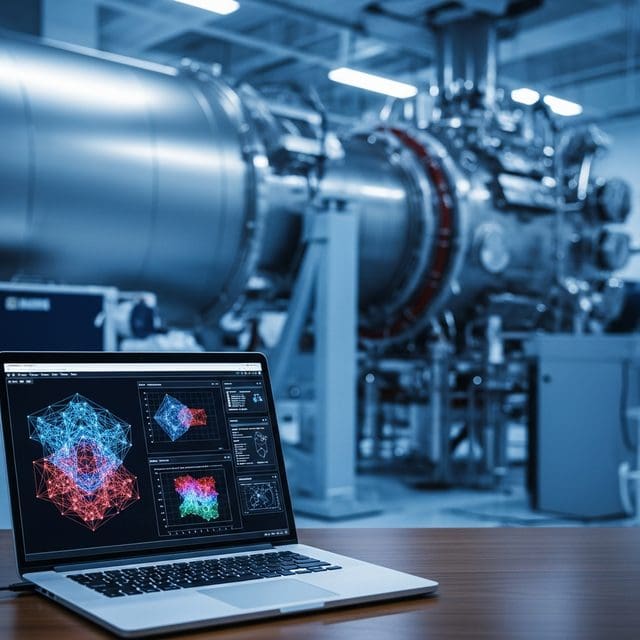
Physicists at the Center for Computational Quantum Physics (CCQ) at the Flatiron Institute, alongside colleagues from Boston University, recently introduced the BP-TNS tensor-network framework. This mathematical breakthrough allows a standard personal laptop to solve complex quantum dynamics problems previously thought to require high-end quantum processors, such as D-Wave’s 5,000-qubit Advantage2 annealer. By compressing the many-body wavefunction into interconnected tables of numbers—described by researcher Joe Tindall as a “zip file” for quantum data—the team has simulated quantum systems with state-of-the-art accuracy. This toolset is now a general-purpose classical simulator for quantum annealing and optimization, with some tasks solved in 30 minutes on consumer-grade hardware.
This development serves as a vital reality check for the burgeoning quantum computing industry. While Silicon Valley has long touted “quantum supremacy”—the point where quantum devices perform tasks impossible for classical computers—the CCQ’s work proves that classical algorithmic innovation remains a formidable competitor. For those concerned with national sovereignty and the massive public investments into quantum infrastructure, this suggests that decentralized, clever software engineering may be just as critical as centralized, multi-billion-dollar hardware projects. The result shifts investment strategy, suggesting that near-term “advantage” demonstrations may be vulnerable to fast classical catch-ups.
Simultaneously, the world of particle physics is facing its own moment of reckoning. As the Large Hadron Collider (LHC) concluded its third data-taking period (Run 3) on June 27, 2026, researchers at the LHCb experiment reported a persistent 4-sigma anomaly in rare “penguin” B-meson decays. This statistical deviation, based on an analysis of roughly 650 billion decays recorded between 2011 and 2018, suggests there is only a 1-in-16,000 chance that the observed behavior is a fluke. The discrepancy in how these particles decay into kaons and muons could point to the existence of a new force-carrying particle, such as a Z-prime boson or a leptoquark.
These findings represent one of the last surviving hints of “new physics” after years of other flavor anomalies faded upon closer inspection. While the CMS experiment sees a weaker, tentatively corroborating deviation, the LHCb result is strengthening the case for a fundamental revision of our current models. As the LHC enters a major upgrade phase known as Long Shutdown 3, these anomalies provide a clear narrative hook for the future of the High-Luminosity LHC era. If these results hold, they could dismantle the Standard Model, which has governed our understanding of the subatomic world for decades.
Finally, the U.S. Department of Energy is making strides in the physical scaling of these systems. Researchers at Fermilab and MIT Lincoln Laboratory recently demonstrated cryoelectronic control for scalable ion-trap qubits. By placing control electronics inside the vacuum chamber at cryogenic temperatures, they have reduced thermal noise and improved sensitivity. This engineering milestone addresses the wiring bottlenecks that have long limited the scaling of quantum processors. These collective breakthroughs underscore the importance of rigorous skepticism and the constant need to challenge established scientific bureaucracies with transparent, reproducible data.

Mason Reed serves as a Staff Writer for Just Right News, where he spearheads the Future Frontiers & Special Projects desk. In an era defined by rapid technological shifts and evolving social landscapes, Mason provides a steady, principled voice, examining the innovations of tomorrow through the lens of traditional American values. His work is most prominently featured in his signature series, “The Next Horizon,” where he explores the intersection of emerging technology, national sovereignty, and the preservation of individual liberty.
A native of San Diego, California, Mason’s worldview was shaped by the unique culture of his hometown. Growing up in a region defined by its strong military presence and its history of maritime industry, he developed a deep-seated respect for the institutions that provide national stability and the entrepreneurial spirit that drives the American economy. This upbringing instilled in him a belief that true progress is not found in discarding the past, but in building upon a foundation of proven principles. His reporting often reflects this San Diego influence, emphasizing the importance of a robust national defense and the necessity of maintaining a competitive edge in the global marketplace.
Now based in San Francisco, Mason operates from the heart of the world’s technological engine. Living and working in the Bay Area provides him with a front-row seat to the advancements—and the ideological challenges—emanating from Silicon Valley. While many in the region embrace a “move fast and break things” mentality, Mason’s reporting serves as a vital counterweight. He offers Just Right News readers a “boots on the ground” perspective, documenting how radical local policies and the concentration of tech power impact the everyday lives of citizens. His proximity to the industry allows him to cut through the marketing jargon of big tech to uncover the real-world implications for privacy, free speech, and the nuclear family.
In his “Future Frontiers” beat, Mason tackles complex subjects ranging from the ethics of artificial intelligence to the burgeoning private space race. He approaches these topics with a healthy skepticism toward centralized bureaucracy, championing instead the decentralized innovations that empower individuals. Through “The Next Horizon,” he highlights the pioneers and thinkers who are working to ensure that the future remains a place where human dignity and constitutional rights are protected. He believes that the rapid pace of change requires more than just technical expertise; it requires a moral compass rooted in the Western tradition.
Throughout his tenure at Just Right News, Mason has remained committed to the idea that the future is something to be shaped, not merely accepted. His writing is characterized by a rigorous defense of American exceptionalism and a belief that the country’s best days lie ahead, provided it remains true to its founding ideals. Whether he is investigating the impact of automation on the American workforce or profiling the next generation of aerospace engineers, Mason Reed ensures that his readers are equipped with the insights they need to navigate a changing world with confidence and clarity.