

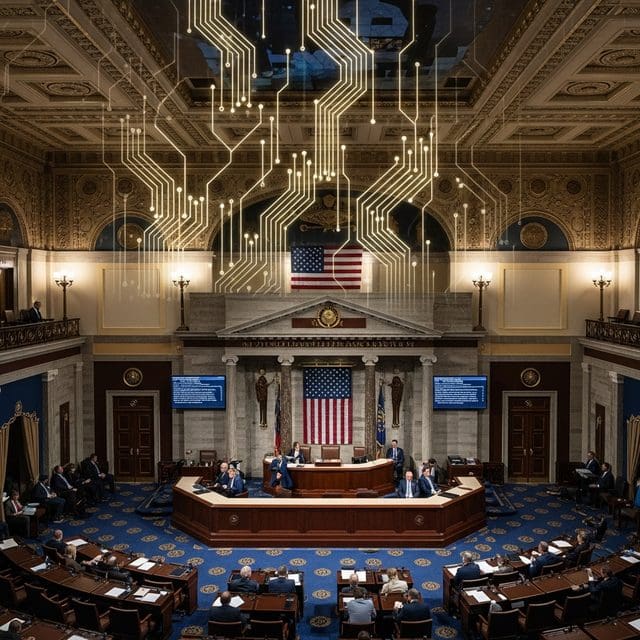
Legislative progress on the Digital Asset Market Clarity Act aims to protect non-custodial developers while institutional Bitcoin ETF outflows reach record monthly highs.
The battle for American digital sovereignty has reached a critical juncture in the halls of Congress. The Senate Banking Committee recently advanced the Digital Asset Market Clarity Act (H.R. 3633) in a 15–9 vote, moving a framework that could finally provide the regulatory bedrock necessary for Bitcoin to flourish as a cornerstone of the U.S. financial system. At the heart of this legislative push is Section 604, which incorporates the Blockchain Regulatory Certainty Act (BRCA). This provision is designed to ensure that the innovators building the future of decentralized finance—specifically non-custodial software developers, miners, and validators—are not misclassified as money transmitters under the Bank Secrecy Act or 18 U.S.C. § 1960.
This distinction is vital for the protection of individual liberties and the prevention of federal overreach. By codifying that infrastructure providers who do not control user funds are exempt from burdensome FinCEN registration and criminal liability, the Act secures the right to build and maintain the Bitcoin protocol without the threat of predatory litigation. A coalition of over 60 industry leaders, including executives from Coinbase, a16z crypto, and Galaxy, recently signaled to Senate Majority Leader John Thune and Minority Leader Chuck Schumer that these developer protections are a non-negotiable requirement for industry support. The bill also seeks to clarify the jurisdictional divide by assigning the CFTC exclusive jurisdiction over spot markets for digital commodities like Bitcoin, potentially ending the era of regulation by enforcement that has hampered domestic innovation.
While the legislative outlook improves, the institutional landscape reflects a period of significant transition. U.S.-listed spot Bitcoin ETFs are currently navigating their most challenging month since their January 2024 debut, with Bloomberg estimating nearly $4 billion in net withdrawals for June 2026. This trend, confirmed by SoSoValue data which showed $2.1 billion in outflows by mid-month alone, suggests a strategic de-risking by institutional players in response to a hardening macroeconomic environment. Rather than a localized crypto event, these outflows appear to be a reaction to broader fiscal instability and the persistent threat of domestic inflation, which has seen California gasoline prices exceed the national average by $1.50 per gallon amid ongoing conflict in Iran.
Macroeconomic headwinds continue to challenge the digital gold thesis as recent CPI prints have exceeded expectations, fueling a hawkish stance from the Federal Reserve. With annual inflation reaching 4.2% in May 2026—the highest rate since 2023—driven largely by a 23.5% year-on-year surge in energy costs, real yields have pressured risk assets across the board. This inflationary backdrop has contributed to significant liquidations in the spot market, including a $1.26 billion liquidation event that pushed Bitcoin below the $60,000 psychological threshold. These market forces are further complicated by geopolitical volatility, such as the renewed U.S.–Iran clashes that have undermined ceasefire expectations and weighed heavily on risk-on sentiment.
Despite these pressures, the push for decentralized engineering remains resilient. The proposed legislation would specifically protect those operating Bitcoin node software and Lightning Network routing nodes, ensuring that the technical backbone of the network remains decentralized and beyond the reach of centralized financial surveillance. President Trump’s May 2026 executive order on fintech innovation further complements this legislative push, directing regulators to reduce barriers for digital asset firms. As the Senate prepares for a potential floor vote, the intersection of decentralized engineering and sound policy remains the primary defense against global economic volatility and the erosion of American digital leadership. The outcome will determine whether the United States remains the premier hub for Bitcoin infrastructure or cedes that ground to global competitors.

Ryan Mitchell serves as a Staff Writer for Just Right News, where he anchors the desk for Cyber, Technology Policy, and Digital Sovereignty. In an era where the digital landscape has become as much a battlefield as any physical territory, Ryan provides a critical conservative lens on the forces shaping the future of American innovation and national security. His work is defined by a commitment to the idea that American leadership in the digital age is not just a matter of economic success, but a necessity for the preservation of global liberty.
Born and raised in Austin, Texas, Ryan’s perspective is deeply rooted in the Lone Star State’s tradition of independence and skepticism of centralized authority. Growing up in a city that transformed from a quiet state capital into a global technology hub, he witnessed firsthand the disruptive power of the tech industry. This upbringing instilled in him a firm belief in free-market principles and the necessity of protecting individual liberties from both government overreach and corporate overstep. His Texan background serves as a foundational compass, guiding his reporting toward stories that emphasize national resilience and the preservation of constitutional values in an increasingly virtual world.
Now based in San Francisco, California, Ryan operates from the epicenter of the very industry he scrutinizes. Living and working in the heart of Silicon Valley allows him to provide “boots on the ground” reporting that few conservative journalists can match. He navigates the cultural and political complexities of the Bay Area to bring Just Right News readers an inside look at the boardrooms and coding labs where the next generation of digital policy is forged. For Ryan, being stationed in San Francisco is a strategic choice; it allows him to challenge the prevailing ideological monoculture of the tech elite from within their own backyard, ensuring that the concerns of middle America are represented in the conversation about our digital future.
His beat—Cyber, Technology Policy, and Digital Sovereignty—covers the high-stakes world of data privacy, artificial intelligence, and the infrastructure of the modern web. Ryan is particularly focused on the concept of digital sovereignty, arguing that for a nation to remain truly free, it must maintain control over its own technological destiny and critical infrastructure. He frequently explores how international regulations and domestic policies impact the ability of American firms to compete without sacrificing the privacy or security of their citizens.
Central to his current body of work is his featured series, “The New Cold War.” Through this project, Ryan examines the escalating technological rivalry between the United States and its global adversaries. He delves into the complexities of state-sponsored hacking, the global race for semiconductor dominance, and the ideological struggle to define the rules of the internet. Ryan views this competition not merely as a commercial race, but as a fundamental defense of Western values against authoritarian digital models. Through his rigorous reporting and principled analysis, Ryan Mitchell ensures that the readers of Just Right News stay informed about the invisible forces defining the 21st century, always advocating for a future where technology serves the cause of freedom.