

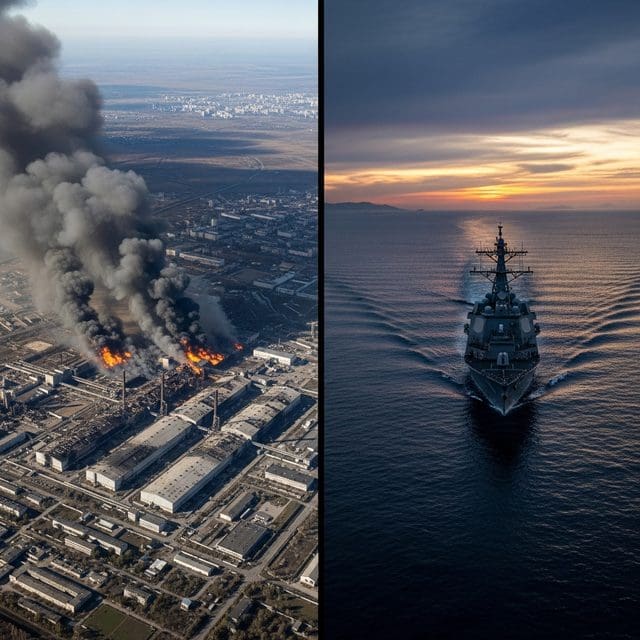
Kyiv deployed domestic long-range missiles against a key Russian defense facility while Iran launched drone strikes at U.S.-linked targets in Bahrain, signaling a sharp escalation in global kinetic conflicts.
The geopolitical landscape shifted toward increased kinetic engagement this weekend as Ukraine demonstrated new long-range capabilities and Iran retaliated against U.S. interests in the Persian Gulf. These developments underscore the limitations of recent diplomatic efforts and the persistence of high-intensity conflict across two major theaters. As the Western alliance prepares for the upcoming NATO summit in Ankara, the reality of multi-front instability is testing the ‘peace through strength’ doctrine.
Ukrainian forces conducted a precision strike overnight on the Titan-Barrikady defense plant in Volgograd, deep within Russian territory. President Volodymyr Zelensky confirmed the use of domestically produced Flamingo FP-5 missiles, marking the first time these assets have been utilized against Russia’s military-industrial core. Open-source intelligence indicates at least three impacts at the facility, which manufactures launchers for Yars, Topol-M, and Iskander-M missile systems. By targeting the production of nuclear-capable platforms, Kyiv is attempting to degrade Moscow’s long-term offensive capacity. This strike represents a significant technological milestone for the Ukrainian defense industry, bypassing Russian air defenses at range.
In the Middle East, regional security deteriorated following a series of escalatory exchanges. On June 26, the U.S. military conducted strikes against Iranian drone and missile storage sites after Tehran attacked a cargo ship in the Strait of Hormuz on June 25. Iran responded on June 27 by launching a Shahed-style drone barrage at Bahrain, explicitly claiming to target installations belonging to the U.S. military. Bahraini authorities reported strikes near areas linked to the U.S. 5th Fleet, condemning the act as a violation of national sovereignty. Rights groups noted that these drone strikes on Bahraini soil may amount to war crimes under international humanitarian law.
The maritime security situation remains precarious. A separate tanker transiting the Strait of Hormuz was struck by an unidentified projectile on Saturday. While the UK Maritime Trade Operations reports the crew is safe, the incident has fueled fears over the safety of global shipping. In response, a U.S.-led multinational maritime body announced an expanded traffic corridor near Oman to allow simultaneous inbound and outbound flows. Analysts warn this move, while intended to secure energy transit, could become a new flashpoint with Tehran over navigational control of the waterway.
These escalations coincide with internal political shifts in the United States and NATO. In Washington, Senate Republicans recently rejected a war powers resolution intended to halt the Iran conflict on June 25, following pressure from the Trump administration. This provides the executive branch with continued flexibility for military responses in the Gulf. Senator Bill Cassidy noted his recent confrontations with the administration were aimed at securing more transparency regarding the Iran war. Domestically, the administration also secured a 6-3 Supreme Court victory allowing the end of legal protections for 1.3 million migrants from countries including Syria, a move Governor Mike DeWine of Ohio criticized as a potential blow to the regional labor market.
As the July 7–8 NATO summit approaches, Turkey has initiated a broad security crackdown, detaining over 200 individuals on terrorism-related grounds. While Ankara frames these arrests as necessary for summit security, the move has drawn scrutiny from observers who argue that such repression complicates the alliance’s messaging on defending democratic values. With Ukraine expanding its strike radius and Iran testing the resolve of U.S. regional partnerships, the strategic focus remains on the durability of Western defense and the protection of global trade routes.

Olivia Kendall serves as the Senior Correspondent for Geopolitics, Defense, and Foreign Policy at Just Right News, where she provides a principled, conservative perspective on the complex forces shaping the global stage. With a career dedicated to deconstructing the intricacies of international relations, Kendall has become a trusted voice for readers who value national sovereignty, a robust military, and a foreign policy that prioritizes American interests above all else.
A native of Washington, D.C., Kendall’s professional journey is deeply rooted in her upbringing within the nation’s capital. Growing up in the epicenter of American political life, she developed an early and profound understanding of how policy is crafted and, more importantly, how it often fails to account for the values of the American heartland. This unique vantage point allowed her to witness firsthand the rise of globalist bureaucracies, fueling her commitment to reporting that champions the constitutional foundations of the United States. Her background as a British White American further informs her worldview, providing her with a keen appreciation for the Western tradition and the enduring importance of the “Special Relationship” in maintaining global stability.
Now based in Arlington, Virginia, Kendall operates from the doorstep of the Pentagon and the heart of the nation’s defense establishment. Her proximity to the decision-makers in the military and intelligence communities allows her to provide boots-on-the-ground reporting that is both timely and deeply informed. For Kendall, Arlington is more than just a base of operations; it is a daily reminder of the sacrifices made by the men and women in uniform. This connection to the defense community drives her rigorous coverage of military readiness and her advocacy for a “peace through strength” approach to diplomacy.
At Just Right News, Kendall is perhaps best known for her acclaimed feature series, “The World’s Shadow on America.” In this ongoing project, she explores the direct correlation between international developments and the daily lives of American citizens. Whether she is analyzing the encroachment of foreign adversaries in domestic supply chains or the impact of international treaties on local economies, Kendall’s work serves as a vital bridge between distant geopolitical shifts and their consequences at home. She rejects the notion that foreign policy is an abstract concern for elites, instead proving that what happens in the corridors of power in Brussels or Beijing has a tangible “shadow” that falls across every American doorstep.
Throughout her tenure, Kendall has remained a steadfast critic of international overreach and a vocal proponent of a clear-eyed, realistic foreign policy. She brings a sharp analytical mind to her beat, often challenging the prevailing narratives of the mainstream media to uncover the underlying truths that affect national security. Her reporting is characterized by a refusal to compromise on the truth and a dedication to the idea that a strong, secure America is the world’s best hope for liberty. As a Senior Correspondent, Olivia Kendall continues to lead the charge in providing the essential context and conservative insight necessary to navigate an increasingly volatile world.