

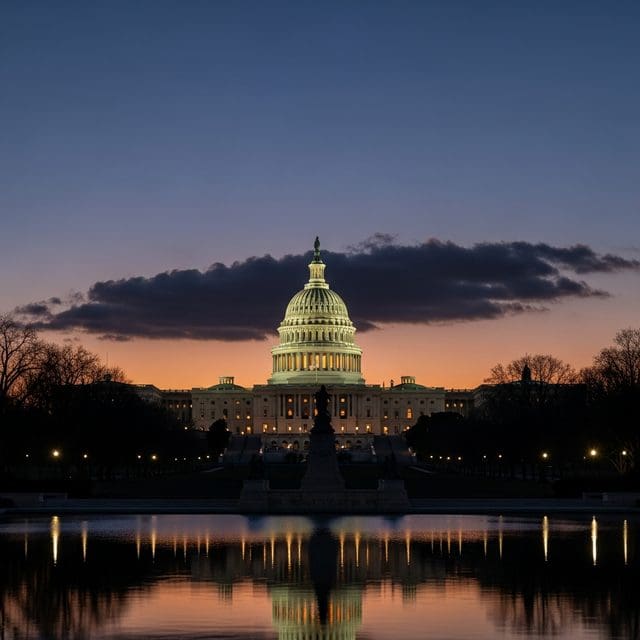
The Senate passed a concurrent resolution to limit military action in Iran, marking a rare bipartisan challenge to the President’s Commander-in-Chief powers amid rising fiscal and public skepticism.
In a significant challenge to executive military prerogative, the Senate voted 50-48 on Tuesday to adopt a concurrent resolution directing the President to remove United States Armed Forces from hostilities against Iran. This legislative action marks a historic milestone; it is the first time since the 1973 War Powers Act that both chambers of Congress have approved a measure directing a commander-in-chief to withdraw forces from an ongoing conflict. The vote serves as a pointed rebuke of the administration’s regional strategy and underscores a growing appetite in the legislature to reclaim its constitutional role.
The resolution’s passage was secured by a narrow coalition as four Republicans—Sens. Rand Paul, Susan Collins, Lisa Murkowski, and Bill Cassidy—joined the Democratic caucus. This shift in the upper chamber follows a similar 215-208 vote in the House on June 3, where four Republicans also broke party lines. The Senate outcome was further facilitated by the absence of Republican Sens. Mitch McConnell and Dave McCormick, whose presence might have deadlocked the chamber. The result is a stunning turnaround after nearly ten previous attempts to rein in the conflict this year.
From a constitutional perspective, the resolution occupies a complex legal gray area. Because it was passed as a concurrent resolution rather than a joint resolution, it does not go to President Trump’s desk and is not subject to a veto. Under standard procedure, such measures are typically symbolic expressions of the “sense of Congress.” However, the 1973 War Powers Act contains provisions that some House Democratic aides argue make such directives binding. The administration has already signaled its intent to ignore the measure, with White House officials dismissing it as having no legal significance while noting that the President maintains authority to protect U.S. assets from imminent threats.
President Trump responded with characteristic defiance, labeling the four Republican senators “losers” and accusing the coalition of providing “aid and comfort” to the enemy. This rhetoric mirrors his earlier attacks on House supporters whom he labeled “grandstanders.” Despite the executive’s dismissal, the political timing is fraught. Defense Secretary Pete Hegseth is currently on Capitol Hill lobbying for an $80 billion supplemental funding package tied to the Iran conflict. This request now faces a skeptical Congress that has formally signaled its desire for a withdrawal, potentially creating a fiscal bottleneck for the administration’s military objectives.
The legislative friction comes as public support for the intervention appears to be waning. A Reuters/Ipsos poll released June 23 found that only 24 percent of Americans believe the war with Iran has been worth its costs, a sentiment likely exacerbated by high gas prices. While the administration points to an April ceasefire as evidence that hostilities have concluded, proponents like Sen. Tim Kaine argue the measure is a necessary safeguard to prevent the executive from unilaterally restarting combat operations without a fresh congressional mandate.
While the war powers debate dominated the headlines, the House found rare common ground on domestic policy, passing a 358-32 housing affordability package on June 23. This 21st Century ROAD to Housing Act will be sent to the President’s desk for signature, highlighting the distinct paths of domestic policy and the ongoing struggle over the limits of executive power in foreign affairs.

Miles Harrington serves as the Senior Correspondent for Federal Systems & Executive Power at Just Right News, where he brings a disciplined, constitutionalist lens to the inner workings of the American government. With a focus on the mechanics of the federal bureaucracy and the limits of executive authority, Harrington has established himself as a vital voice for readers who value transparency, accountability, and the preservation of the separation of powers.
A native of Richmond, Virginia, Harrington’s perspective is deeply rooted in the traditions of the Old Dominion. Growing up in a city defined by its historical significance and its role as a center of American jurisprudence, he developed an early appreciation for the foundational principles of the Republic. His upbringing in Richmond—a place where the legacy of the Founding Fathers is woven into the landscape—instilled in him a belief that the federal government should remain within its constitutional bounds. This background informs his skepticism of centralized overreach and his commitment to reporting on the ways in which the administrative state impacts the lives of everyday citizens.
In his current role, Harrington specializes in the complexities of federal systems. He doesn’t just report on the headlines of the day; he digs into the structural shifts within the executive branch that often go unnoticed by the mainstream press. Whether he is analyzing the implications of a new federal regulation or investigating the expansion of agency jurisdiction, his work is characterized by a rigorous adherence to the facts and a dedication to the rule of law.
Harrington is perhaps best known for his signature feature series, “How Washington Works.” Through this ongoing project, he demystifies the often-opaque processes of the nation’s capital, pulling back the curtain on the “Deep State” and the unelected officials who wield significant influence over national policy. By breaking down complex legislative maneuvers and executive orders, he empowers Just Right News readers to understand the true levers of power in Washington. His reporting serves as a necessary check on the federal government, ensuring that the actions of those in power are held up to the light of public scrutiny.
Now based in Washington, D.C., Harrington operates at the epicenter of the political world, yet he remains intentionally distanced from the “Beltway bubble.” His proximity to the halls of power allows him to maintain a robust network of sources across the federal landscape, but his heart remains in the principled conservatism of his Virginia roots. He views his role not merely as a reporter, but as a steward of the public trust, dedicated to providing the clarity and context that conservative voters need to navigate an increasingly complex political environment.
Through his sharp analysis and unwavering commitment to the truth, Miles Harrington continues to be a cornerstone of the Just Right News team. His work ensures that the principles of limited government and executive restraint remain at the forefront of the national conversation, providing a crucial service to those who believe in a government that is truly of, by, and for the people.