

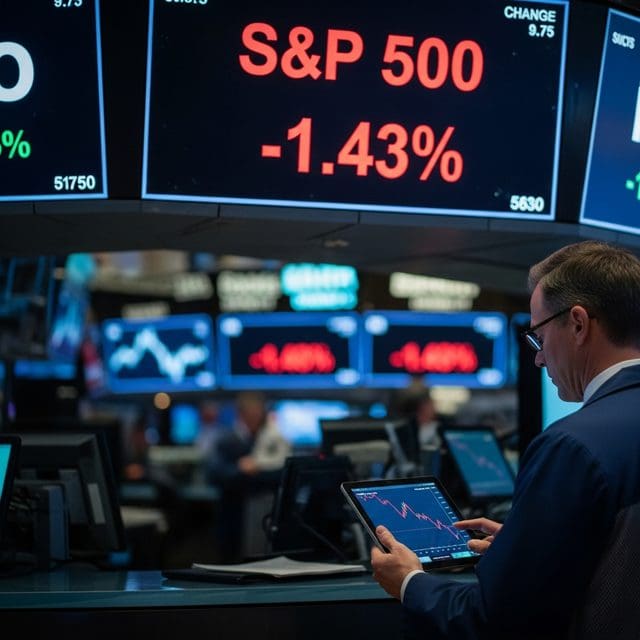
Major indices faced significant pressure as a tech-led selloff expanded, while a potential diplomatic breakthrough in the Middle East sent crude oil prices tumbling toward the mid-$70s.
Wall Street faced a rigorous stress test on Tuesday as the tech-led downturn broadened, pulling the benchmark S&P 500 down 1.43% on the session. The Nasdaq Composite bore the brunt of the selling, sliding more than 2% as investors reevaluated the premium placed on the so-called ‘Magnificent Seven.’ While the Dow Jones Industrial Average showed relative resilience with modest losses of roughly 0.4%, the overarching sentiment remained defensive as the market grappled with shifting interest rate expectations and geopolitical developments.
Alphabet shares continued their descent, falling approximately 5% amid concerns over artificial intelligence talent departures. This volatility in the tech sector appears to be part of a larger internal divergence, with capital rotating away from established giants like Amazon and Meta Platforms—which lost 4.8% and 2.3% respectively—toward newly public AI ventures and private ‘frontier labs.’ Even SpaceX, which recently executed one of the year’s largest AI-related debt deals to restructure its balance sheet, struggled to find firm footing. After a three-day slide that took it to its lowest close since its initial public offering, the stock showed signs of stabilization but remained a focal point for investors assessing the high-demand IPO market.
For the American household, the most tangible shift occurred in the energy markets, which have been a primary driver of the cost-of-living crisis. Brent crude futures dropped 3.31% to $77.90 a barrel, while West Texas Intermediate fell to the mid-$70s. This retreat followed news that the U.S. Treasury Department granted a 60-day license for Iranian oil sales as mediators from Qatar and Pakistan indicated a roadmap toward a final deal between Washington and Tehran. While the UN International Maritime Organization’s evacuation of 11,000 sailors from the Strait of Hormuz underscores the fragility of global shipping, the immediate influx of supply offers a rare moment of downward pressure on energy-driven inflation.
Despite the equity pullback, the underlying economy shows signs of structural evolution driven by the AI boom. This trend is forcing companies across the economy into the energy business as electricity emerges as a scarce commodity. On the corporate front, Adecco reported surpassing one million AI-powered interactions to streamline hiring, and Digital Wallet Group expanded fintech operations into the U.S. to facilitate remittances. These developments suggest that while the ‘Invisible Economy’ of high-finance valuations is correcting, the integration of efficiency-driving technology into the labor market continues unabated. Furthermore, the Binance launch of bStocks tokenized securities represents a push for 24/7 access to U.S. equities, challenging traditional market hours.
Market participants are now laser-focused on Thursday’s Personal Consumption Expenditures (PCE) report, the Federal Reserve’s preferred inflation gauge. With the Fed signaling a hawkish stance following stronger-than-expected jobs data earlier this month, some analysts have pulled forward interest rate hike expectations to as soon as October. Any sign of persistent inflation in the PCE data could further rattle the bond and equity markets, as the central bank remains committed to a stable monetary system at the expense of short-term market exuberance.
Ultimately, the current market environment reflects a transition toward fiscal responsibility and meritocracy. While large-cap U.S. stocks still possess significant ‘wherewithal and transparency,’ as noted by some strategists, the era of easy-money tech dominance is being challenged by rising yields and a rotation into tangible commodities and energy infrastructure. For the working household, the dual impact of a cooling tech sector and falling energy prices presents a complex but necessary recalibration of the American economic landscape.

Jordan Lee serves as the Senior Correspondent for Wall Street, Finance, and Monetary Systems at Just Right News. Based in the heart of the world’s financial capital, New York City, Lee brings a sharp, principled eye to the complex mechanisms that drive the global economy. His reporting is defined by a commitment to fiscal responsibility, the defense of the free market, and a deep-seated belief that a transparent monetary system is the bedrock of a free society.
Raised in Portland, Oregon, Lee’s perspective was forged in a city that has undergone significant cultural and economic shifts. His upbringing in the Pacific Northwest instilled in him a profound appreciation for the industriousness of small business owners and the importance of local economic stability. Watching the evolution of his hometown’s landscape sparked an early interest in how federal fiscal policy and large-scale financial trends eventually trickle down to the average citizen. This background provides him with a unique vantage point; he understands the growing disconnect between the policy-making elite and the reality of Main Street, a theme that frequently resonates throughout his work.
Now operating from his base in New York City, Lee bridges the gap between the high-stakes trading floors of Manhattan and the households of everyday Americans. He views the financial sector not merely as a collection of numbers and tickers, but as a vital engine of American prosperity that requires constant vigilance and accountability. His reporting often highlights the dangers of centralized financial control and the necessity of maintaining a system that rewards merit, risk-taking, and innovation.
As the creator and lead of the featured series, “The Invisible Economy,” Lee pulls back the curtain on the often-opaque world of monetary systems. He specializes in translating the dense jargon of central banking and international finance into actionable insights for the Just Right News audience. His work explores the “invisible” forces—such as inflationary pressures, regulatory creep, and the expansion of the administrative state—that erode the purchasing power of American families. By focusing on these systemic issues, Lee empowers readers to understand the hidden forces shaping their financial independence.
Lee’s journalistic philosophy is rooted in a steadfast commitment to traditional American values. As an Asian American professional who has navigated the competitive corridors of the financial world, he is a vocal advocate for meritocracy and the preservation of the American Dream. He believes that a stable currency and a predictable regulatory environment are essential for national sovereignty and individual liberty. His reporting frequently warns against the risks of government overreach in the private sector, arguing that the most effective solutions to economic challenges arise from competition and individual enterprise rather than bureaucratic mandates.
At Just Right News, Jordan Lee remains dedicated to providing a clear-eyed defense of the taxpayer. Whether he is analyzing market volatility or investigating the long-term implications of national debt, his mission is to provide the truth about where the money is going and what it means for the future of the country. Through his rigorous analysis and principled stance, Lee has become a trusted voice for those who value a strong, sovereign, and fiscally sound America.