

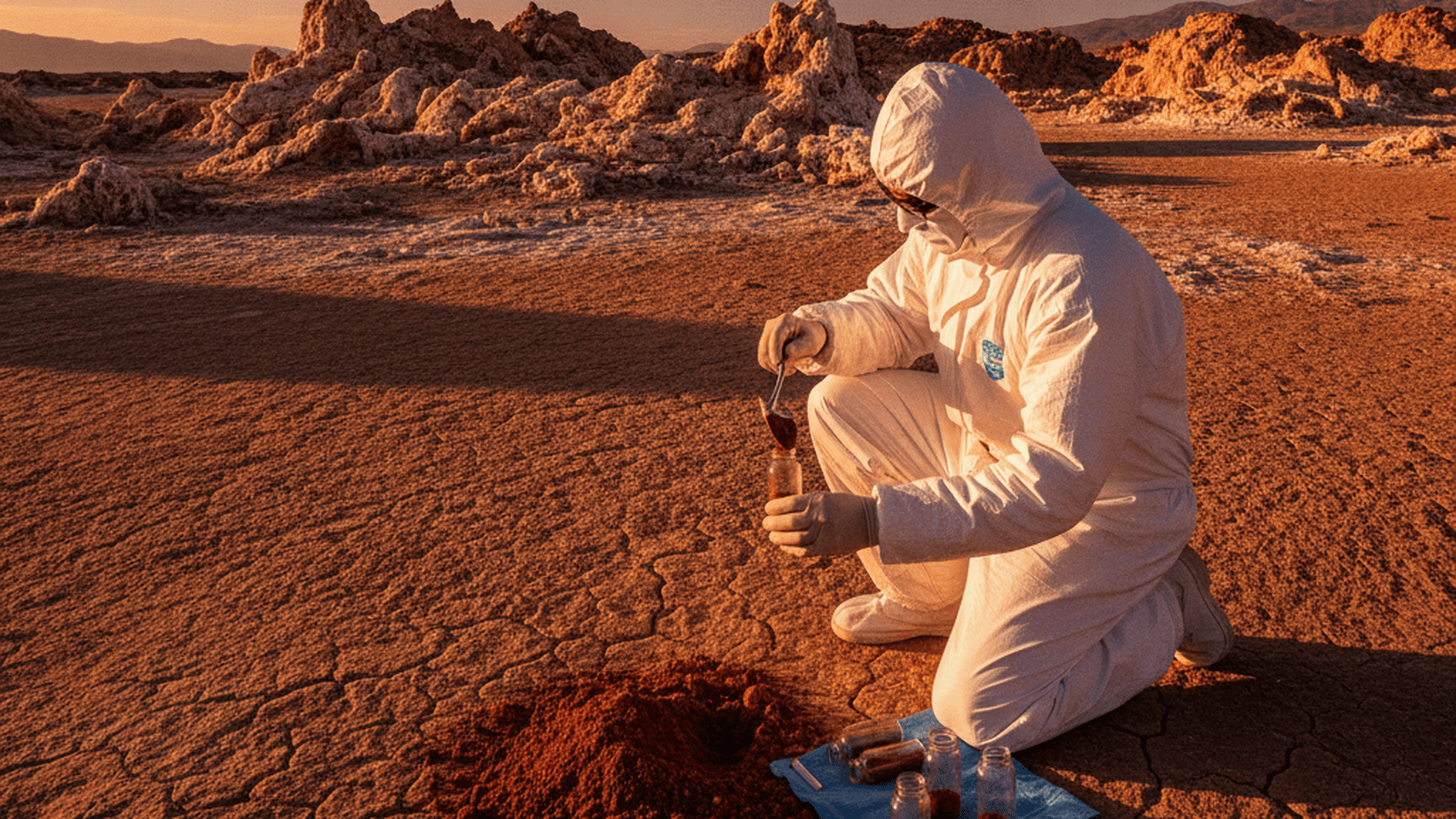
Scientists exploring the hyper-arid Atacama Desert have discovered rare soil bacteria capable of producing previously unknown antimicrobial compounds. These microbes thrive in extreme conditions and offer a potential new source for antibiotics to combat global drug resistance.
TLDR: A field expedition to Chile’s Atacama Desert has uncovered rare bacteria producing novel antimicrobial compounds. These microbes, surviving in one of Earth’s harshest environments, provide a promising new avenue for developing antibiotics against multi-drug resistant pathogens, highlighting the value of extreme bioprospecting in global health.
The quest for new antibiotics has moved from the lush floors of tropical rainforests to the most inhospitable corners of the planet. A team of international researchers recently completed a multi-year field expedition to the hyper-arid core of the Atacama Desert in Chile. Their mission was to sample the microbial dark matter residing in the Valle de la Luna, an area so desolate it is frequently used by space agencies to simulate the Martian surface. The results indicate the discovery of several novel antimicrobial compounds produced by rare soil bacteria that have evolved in total isolation.
The Atacama Desert presents a unique evolutionary pressure cooker. With virtually no rainfall and intense ultraviolet radiation, the organisms that survive there have developed extraordinary biochemical strategies. The research team focused on Actinobacteria, a phylum known for producing roughly two-thirds of all naturally derived antibiotics currently in use. However, the strains found in the Atacama are genetically distinct from those found in temperate soils. These extremophiles produce specialized metabolites to defend their limited resources and maintain cellular integrity under extreme osmotic stress.
During the expedition, scientists utilized sterile techniques to extract soil samples from depths of up to 30 centimeters in high-salinity zones. Back in the laboratory, they employed advanced metagenomic sequencing to identify biosynthetic gene clusters that do not match any known sequences in global databases. This approach allowed the team to bypass the traditional great plate count anomaly, where most wild microbes refuse to grow in a standard petri dish. By identifying the genetic blueprints for these compounds, researchers can now use synthetic biology to produce them in host organisms like E. coli for further study.
One specific compound identified has shown significant inhibitory activity against multi-drug resistant strains of Staphylococcus aureus and Enterococcus faecium. These pathogens are leading causes of hospital-acquired infections and have become increasingly difficult to treat with conventional medicine. The chemical structure of the Atacama-derived compounds is notably different from existing antibiotic classes, suggesting a novel mechanism of action that could circumvent current resistance pathways developed by bacteria over decades of clinical exposure.
This discovery highlights a shift in biomedical research toward bioprospecting in extreme environments. As traditional sources of antibiotics become exhausted, the chemical diversity found in deserts, deep-sea vents, and polar regions offers a new frontier for drug development. The researchers noted that the microbial communities in the Atacama are surprisingly complex, forming islands of life around salt deposits and moisture-wicking minerals. These micro-habitats serve as natural laboratories for the evolution of complex molecules that are not found anywhere else on Earth.
The implications for public policy and global health are substantial. With the World Health Organization warning of a looming post-antibiotic era, the development of new drug classes is a matter of international health security. However, the researchers also emphasized the fragility of these desert ecosystems. Mining activities and climate change threaten the microbial biodiversity of the Atacama before it can be fully cataloged by science.
Future research will focus on the pharmacological profiling of these new compounds to ensure they are safe for human use. The team plans to return to the Atacama to explore even deeper subsurface layers, suspecting that the most unique chemistry may lie further away from the reach of surface radiation. This ongoing work represents a critical intersection of environmental science, genomics, and clinical medicine, proving that even the most barren landscapes may hold the keys to human survival.

Rachel Vaughn serves as a Senior Correspondent for Just Right News, where she leads the network’s coverage of Global Health, Climate, and Development. With a career defined by intellectual rigor and a commitment to principled reporting, Rachel provides a vital conservative perspective on some of the most complex and high-stakes issues facing the world today. Her work is characterized by a refusal to accept bureaucratic narratives at face value, focusing instead on how international policies impact national sovereignty, individual liberty, and the American taxpayer.
Raised in New Haven, Connecticut, Rachel grew up in an environment dominated by elite academic discourse. This upbringing provided her with a front-row seat to the inner workings of the American establishment, but it also instilled in her a healthy skepticism of the “ivory tower” consensus. She learned early on that while academic theories may sound promising in a lecture hall, they often fail to account for the practical realities of the working class. This background drives her to bridge the gap between high-level policy discussions and the common-sense concerns of everyday citizens, ensuring that her reporting remains grounded and accessible.
Now based in Burlington, Vermont, Rachel operates from a unique vantage point within one of the nation’s most progressive political landscapes. Living and working in a region that often serves as a testing ground for radical social and environmental experiments allows her to witness the real-world consequences of these policies firsthand. From her base in the Green Mountain State, she provides Just Right News readers with essential “boots on the ground” reporting, documenting the friction between local mandates and the constitutional freedoms of the individual. Her presence in Burlington ensures that her critiques of globalist agendas are informed by a direct understanding of how those ideologies manifest at the local level.
In her acclaimed feature series, “Planetary Stakes,” Rachel explores the intersection of international development and environmental stewardship. She rejects the alarmism often found in mainstream media, opting instead for a sober analysis of the economic and geopolitical costs of global climate agreements. Her reporting frequently highlights the importance of market-driven innovation and the role of American leadership in fostering global health without ceding authority to unelected international bodies. Through “Planetary Stakes,” she has become a leading voice for those who believe that true conservation and public health are best achieved through transparency, accountability, and the protection of private property rights.
Throughout her tenure at Just Right News, Rachel has distinguished herself as a journalist who is unafraid to ask difficult questions of global institutions. Whether she is investigating the influence of non-governmental organizations on domestic policy or analyzing the fiscal transparency of international health initiatives, her goal remains the same: to provide her audience with the facts necessary to navigate an increasingly interconnected world. Her blend of East Coast intellectual heritage and her current immersion in the political heart of the Northeast makes her an indispensable asset to the newsroom and a trusted source for readers seeking a principled, conservative take on the issues that define our era.