

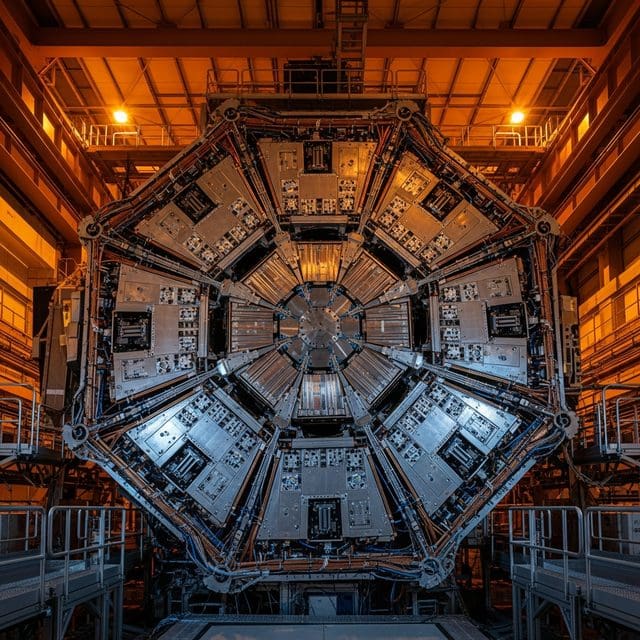
Recent findings from CERN and TU Wien suggest the Standard Model may be incomplete, revealing rare particle deviations and quantum entanglement in large-scale crystals.
The foundations of modern physics are facing a rigorous challenge this week as two major discoveries suggest the universe may be more complex than our current equations allow. At the Large Hadron Collider (LHC) in Geneva, the LHCb experiment has formalized an anomaly in the decay of B mesons that could signal the existence of a fifth force of nature or previously undiscovered particles. This development comes as the scientific community increasingly questions the long-standing hegemony of the Standard Model, which has governed particle physics for decades but fails to account for gravity or dark matter.
Researchers at the LHCb experiment analyzed roughly 650 billion B-meson decays recorded between 2011 and 2018 to isolate a rare process known as an “electroweak penguin” decay. In this specific event, a B meson transforms into a kaon, a pion, and two muons—a transition so rare that it occurs in only about one out of every million decays. The team found that the measured angular distributions and decay rates of these particles deviated from Standard Model predictions by four standard deviations. Statistically, there is only a 1 in 16,000 chance that this result is a random fluctuation. The findings, accepted for publication in Physical Review Letters, point toward hypothetical heavy particles like leptoquarks or a Z-prime boson as potential culprits that could be mediating a new weak-like force.
This discovery arrives as the LHC approaches its final physics run before a scheduled long shutdown at the end of June 2026. Scientists are racing to collect additional data that could elevate this anomaly to a formal discovery, which requires a five-standard-deviation threshold. If confirmed, it would mark the first indirect evidence of new particles that the LHC cannot produce directly, potentially reshaping the next fifty years of high-energy physics research and directing the focus of future colliders planned into the 2070s.
While particle physicists look to subatomic voids, researchers at TU Wien have grounded quantum theory in the palm of a hand. Using neutron scattering at the Institut Laue-Langevin (ILL) in Grenoble, experimentalists studied a centimeter-scale crystal composed of cerium, palladium, and silicon. This material, categorized as a “strange metal,” demonstrated a high degree of multipartite quantum entanglement—a phenomenon usually reserved for microscopic systems of just a few atoms. This is among the first demonstrations that strong quantum entanglement can be certified in a bulk crystal large enough to be comfortably held, rather than just in isolated laboratory vacuums.
By applying quantum Fisher information, a tool borrowed from quantum information theory, the team proved that groups of at least nine quantum entities within the crystal act collectively rather than as independent particles. This discovery, published in Nature Physics, provides a mechanical explanation for why these materials carry electricity with unusually low noise, a phenomenon first observed in 2025. It suggests that macroscopic objects can maintain the delicate quantum states necessary for the next generation of ultra-precise sensors and metrology, potentially liberating quantum technology from the confines of sub-zero, microscopic environments.
Together, these findings represent a shift away from the centralized certainties of 20th-century physics. Whether through the rare “penguin” decays at CERN or the collective behavior of strange metals in Vienna, the emerging data suggests that the building blocks of our reality are governed by forces and connections that remain just outside the reach of our current bureaucratic scientific consensus. As the LHC enters its final months of operation for the season, the focus remains on whether these anomalies will solidify into a new era of sovereign scientific discovery that prioritizes empirical truth over established theory.

Mason Reed serves as a Staff Writer for Just Right News, where he spearheads the Future Frontiers & Special Projects desk. In an era defined by rapid technological shifts and evolving social landscapes, Mason provides a steady, principled voice, examining the innovations of tomorrow through the lens of traditional American values. His work is most prominently featured in his signature series, “The Next Horizon,” where he explores the intersection of emerging technology, national sovereignty, and the preservation of individual liberty.
A native of San Diego, California, Mason’s worldview was shaped by the unique culture of his hometown. Growing up in a region defined by its strong military presence and its history of maritime industry, he developed a deep-seated respect for the institutions that provide national stability and the entrepreneurial spirit that drives the American economy. This upbringing instilled in him a belief that true progress is not found in discarding the past, but in building upon a foundation of proven principles. His reporting often reflects this San Diego influence, emphasizing the importance of a robust national defense and the necessity of maintaining a competitive edge in the global marketplace.
Now based in San Francisco, Mason operates from the heart of the world’s technological engine. Living and working in the Bay Area provides him with a front-row seat to the advancements—and the ideological challenges—emanating from Silicon Valley. While many in the region embrace a “move fast and break things” mentality, Mason’s reporting serves as a vital counterweight. He offers Just Right News readers a “boots on the ground” perspective, documenting how radical local policies and the concentration of tech power impact the everyday lives of citizens. His proximity to the industry allows him to cut through the marketing jargon of big tech to uncover the real-world implications for privacy, free speech, and the nuclear family.
In his “Future Frontiers” beat, Mason tackles complex subjects ranging from the ethics of artificial intelligence to the burgeoning private space race. He approaches these topics with a healthy skepticism toward centralized bureaucracy, championing instead the decentralized innovations that empower individuals. Through “The Next Horizon,” he highlights the pioneers and thinkers who are working to ensure that the future remains a place where human dignity and constitutional rights are protected. He believes that the rapid pace of change requires more than just technical expertise; it requires a moral compass rooted in the Western tradition.
Throughout his tenure at Just Right News, Mason has remained committed to the idea that the future is something to be shaped, not merely accepted. His writing is characterized by a rigorous defense of American exceptionalism and a belief that the country’s best days lie ahead, provided it remains true to its founding ideals. Whether he is investigating the impact of automation on the American workforce or profiling the next generation of aerospace engineers, Mason Reed ensures that his readers are equipped with the insights they need to navigate a changing world with confidence and clarity.