

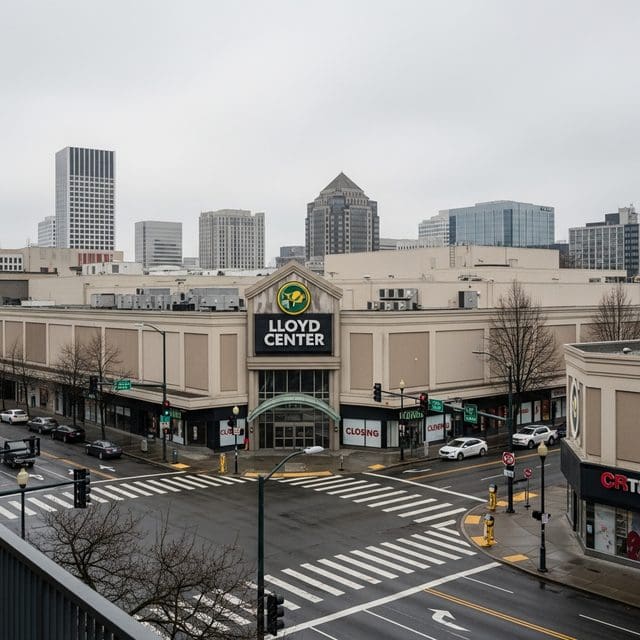
The permanent closure of Portland’s Lloyd Center mall for residential redevelopment mirrors a national struggle between rising household debt and the urgent need for market-driven housing solutions.
The American retail landscape continues its transformation into a residential frontier as Urban Renaissance Group confirmed the Lloyd Center mall in Portland will permanently close on August 8, 2026. This pivot toward a massive mixed-use redevelopment aims to inject thousands of housing units into a market starved for supply. Most tenants must vacate by August 31 as the site transitions from a legacy shopping destination to a dense, transit-connected residential district. While the Portland Design Commission has unanimously approved the master plan, a final hurdle remains: a June 24 City Council hearing for a public appeal from organizers concerned with displacement.
This local friction reflects a national tension between preservation and the necessity of densification. For the American taxpayer, the stakes are high. The redevelopment plan integrates the site back into the city’s street grid, providing six acres of open space. Proponents argue that the city must prioritize progress over nostalgia to address the chronic housing shortage. This sentiment follows the City Council’s earlier passage of the Affordable Housing Opportunities Project, a deregulatory move that rezoned 19 sites to streamline construction by removing bureaucratic barriers.
However, the ability of citizens to influence these local zoning decisions is being tested by fiscal constraints. Portland’s Small Donor Elections program for the 2026 City Council races recently reduced public match caps due to underfunding. This budgetary shortfall potentially mutes the voices of housing-focused challengers in districts overseeing Lloyd Center’s planning, right as the city determines the future of major urban corridors. Without competitive funding, the debate over balancing private development with community needs may become increasingly one-sided.
On the national stage, the financial health of the American household remains precarious, casting a shadow over property ownership. New data from the Federal Reserve Bank of New York reveals total U.S. household debt climbed to $18.8 trillion in Q1 2026. While credit card balances saw a seasonal dip to $1.25 trillion, they remain nearly 6% higher than last year. With average APRs on new card offers near 23.8%, the cost of revolving debt is siphoning away capital that might otherwise be used for down payments. Serious credit card delinquencies have reached their highest levels in 15 years, signaling that the cost-of-living squeeze is reaching a breaking point.
Mortgage balances have also risen to $13.19 trillion, with 4.8% of all household debt now in some stage of delinquency. These figures suggest that even as developers attempt to increase supply, the underlying financial stability of the consumer is being eroded by persistent inflation and high borrowing costs. Federal Reserve policy is also shifting; Kevin Warsh recently signaled a move toward less forward guidance, which could introduce more volatility into mortgage markets as the central bank steps back from its previous communication strategies.
Furthermore, the long-term safety net is under scrutiny. Social Security trustees recently projected a potential $500 monthly benefit cut as of June 2026, prompting a bipartisan commission to evaluate the program’s solvency. For residents of Portland and beyond, the intersection of local land-use policy and federal fiscal health has never been more critical. As the Lloyd Center prepares for demolition, the question remains whether new housing supply can outpace the mounting financial pressures facing the modern taxpayer in an era of $18 trillion debt and dwindling public resources.

Deborah Cole serves as a Senior Correspondent for Just Right News, where she spearheads the network’s coverage of Housing, Infrastructure, and Mobility. With a career defined by a commitment to rigorous reporting and a focus on the fundamental pillars of American community life, Deborah brings a principled perspective to the complex issues that dictate how and where we live. Her work is grounded in the belief that sound policy, fiscal responsibility, and respect for private property are the essential foundations of a prosperous society.
Originally from Boston, Massachusetts, Deborah’s upbringing in one of the nation’s oldest and most historically significant cities deeply influenced her professional trajectory. Growing up amidst the architectural legacy and dense urban planning of New England, she developed an early appreciation for the importance of durable infrastructure and the role of local tradition in shaping neighborhoods. Her perspective is informed by the classic American values of her hometown—hard work, community cohesion, and a healthy skepticism of top-down bureaucratic mandates that often overlook the unique needs of individual citizens.
Today, Deborah operates from her base in Austin, Texas, a city that serves as a primary laboratory for her reporting. Austin’s rapid expansion and its status as a hub for innovation and migration provide her with a front-row seat to the most pressing challenges in modern infrastructure and housing. From the Lone Star State, she chronicles the tensions between rapid growth and the preservation of the American Dream, often highlighting how market-driven solutions and deregulation can address the housing shortages that plague many of the country’s metropolitan areas.
At Just Right News, Deborah is perhaps best known for her signature feature series, “Where We Live.” Through this platform, she explores the intersection of public policy and private life, moving beyond mere statistics to tell the stories of families, small business owners, and local developers. Her reporting frequently highlights the importance of mobility—not just in terms of transportation and transit, but as a vehicle for economic opportunity and social stability. She remains a staunch advocate for the taxpayer, consistently scrutinizing government spending on large-scale projects and advocating for transparency in how infrastructure dollars are allocated.
Deborah’s beat is more than just a collection of policy topics; it is an investigation into the physical and legal structures that allow families to flourish. Whether she is reporting on the impact of zoning laws on suburban development or the necessity of maintaining the nation’s highway systems, her work is characterized by a dedication to the facts and a respect for the constitutional principles that protect the rights of homeowners.
As a Senior Correspondent, Deborah Cole continues to be a vital voice for Just Right News, providing the audience with the clarity and context needed to navigate an ever-changing landscape. Her reporting ensures that the values of individual liberty and local sovereignty remain at the forefront of the national conversation regarding the future of our cities and towns. Through her tireless efforts, she remains committed to informing the public on the issues that hit closest to home.